
Search Market Research Report
Genomics Personalized Health Market Size, Share Global Analysis Report, 2026-2034

Genomics Personalized Health Market Size, Share, Growth Analysis Report By Test Type (Oncology Testing, Infectious Disease Testing, Orphan Disease Testing, Autoimmune Disease Testing, Obstetrics Testing, and Others), By Technology (NGS Platforms, RT-PCR, Microarray, and Genetic Analyzers), By End User (Academic Research Institutes, Diagnostic Centers, and Others), and By Region - Global Industry Insights, Overview, Comprehensive Analysis, Trends, Statistical Research, Market Intelligence, Historical Data and Forecast 2026-2034
Industry Insights
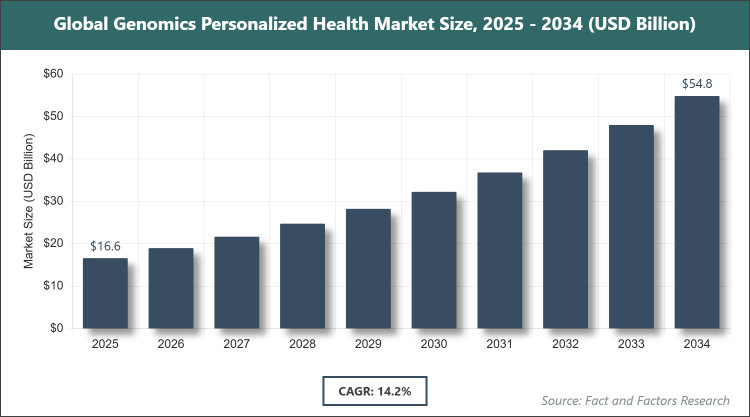
[235+ Pages Report] According to Facts & Factors, the global Genomics Personalized Health Market size was estimated at USD 16.6 billion in 2025 and is expected to reach USD 54.9 billion by the end of 2034. The Genomics Personalized Health industry is anticipated to grow by a CAGR of 14.2% between 2026 and 2034. The Genomics Personalized Health Market is driven by increasing demand for tailored medical solutions based on individual genetic profiles.
 Market Overview
The Genomics Personalized Health Market refers to the integration of genomic data into healthcare practices to deliver customized medical care, focusing on analyzing an individual's genetic makeup to inform diagnosis, treatment selection, and preventive measures for various diseases. This market emphasizes precision approaches that consider genetic variations, enabling more effective therapies while minimizing adverse effects through targeted interventions.
Key Insights
- As per the analysis shared by our research analyst, the Genomics Personalized Health Market is estimated to grow annually at a CAGR of around 14.2% over the forecast period (2026-2034).
- In terms of revenue, the Genomics Personalized Health Market size was valued at around USD 16.6 billion in 2025 and is projected to reach USD 54.9 billion by 2034.
- The market is driven by rapid advancements in genome sequencing technologies and rising adoption of precision medicine.
- Based on the Test Type, the Oncology Testing segment dominated with 41% share due to the increasing prevalence of cancer and the need for targeted therapies that leverage genetic biomarkers for better treatment outcomes.
- Based on the Technology, the NGS Platforms segment dominated with significant share because of its high-throughput capabilities, cost-effectiveness, and ability to provide comprehensive genomic insights, driving widespread adoption in clinical settings.
- Based on the End User, the Diagnostic Centers segment dominated with notable share owing to their role in providing accessible genetic testing services and integrating genomics into routine diagnostics for personalized care.
- North America dominated the global market with 41% share, attributed to advanced healthcare infrastructure, substantial investments in genomic research, and supportive regulatory frameworks.
Growth Drivers
- Rapid Reductions in Genome Sequencing Costs
The declining costs of genome sequencing have made genomic analysis more accessible, enabling broader adoption in clinical and research settings. This affordability has facilitated the integration of personalized genomics into routine healthcare, allowing for early disease detection and customized treatment plans that improve patient outcomes.
Furthermore, lower costs have spurred investments from pharmaceutical companies in developing targeted therapies, accelerating innovation in precision medicine and expanding the market's reach to underserved populations.
- Integration of AI-Powered Genomic Analysis Tools
AI tools enhance the speed and accuracy of interpreting complex genomic data, enabling healthcare providers to deliver precise diagnostics and personalized recommendations. This technology supports the identification of genetic variants linked to diseases, streamlining workflows in diagnostics and research.
Additionally, AI-driven platforms facilitate large-scale data analysis, fostering collaborations between biotech firms and healthcare institutions to advance personalized health solutions and drive market growth.
Restraints
- High Costs of Genomic Analysis and Personalized Treatments
The elevated expenses associated with advanced genomic testing and tailored therapies limit accessibility, particularly in developing regions where healthcare budgets are constrained. This financial barrier hinders widespread adoption and exacerbates disparities in personalized healthcare delivery.
Moreover, the need for specialized equipment and skilled professionals adds to operational costs, posing challenges for smaller diagnostic centers and slowing market penetration in cost-sensitive markets.
- Data Privacy Concerns and Potential Misuse of Genetic Information
Concerns over the security and ethical handling of sensitive genetic data deter patients and providers from embracing genomic technologies. Risks of data breaches or unauthorized use raise trust issues, impacting market expansion.
In addition, varying global regulations on data protection create compliance complexities for companies, potentially delaying product launches and limiting cross-border collaborations in the genomics sector.
Opportunities
- Advancements in Gene-Editing Technologies like CRISPR
Innovations in gene-editing tools offer potential for corrective therapies in genetic disorders, opening new avenues for personalized treatments beyond traditional diagnostics. This progress attracts investments and fosters partnerships in biotechnology.
Furthermore, expanding applications in areas like oncology and rare diseases enhance therapeutic efficacy, positioning the market for significant growth through novel, patient-specific interventions.
- Development of Ultra-Fast Sequencing Platforms
Emerging high-speed sequencing technologies reduce turnaround times and costs, making genomics more viable for point-of-care applications. This enables real-time insights in clinical settings, boosting adoption rates.
Additionally, these platforms support multi-omics integration, providing holistic views of patient health and creating opportunities for comprehensive personalized wellness programs.
Challenges
- Ethical, Legal, and Social Implications of Genetic Testing
The mainstreaming of genetic testing raises issues around consent, discrimination, and equity, complicating market growth. Stakeholders must navigate these concerns to build public trust.
Moreover, addressing biases in genomic data representation across diverse populations is essential to ensure inclusive personalized health solutions and avoid exacerbating health disparities.
- Need for Stronger Regulatory Frameworks
Inconsistent global regulations on genetic data governance hinder standardization and innovation. Companies face challenges in complying with varying standards, affecting product development timelines.
Furthermore, evolving policies require ongoing adaptations, increasing operational complexities and potentially delaying the commercialization of new genomic technologies.
Report Scope
Report Attribute |
Details |
Market Size 2025 |
USD 16.6 Billion |
Projected Market Size in 2034 |
USD 54.9 Billion |
CAGR Growth Rate |
14.2% CAGR |
Base Year |
2025 |
Forecast Years |
2026-2034 |
Key Market Players |
F. Hoffmann-La Roche AG, Thermo Fisher Scientific Inc., Quest Diagnostics, Agilent Technologies Inc., Lonza Group, PerkinElmer Inc., Illumina Inc., Bio-Rad Laboratories Inc., Exact Sciences Corporation, QIAGEN N.V, Natera Inc., Adaptive Biotechnologies Corporation, Myriad Genetics Inc., NanoString Technologies Inc., Pacific Biosciences of California Inc., Personalis Inc., DNA Genotek Inc., Twist Bioscience Corporation, GRAIL Inc., Eastern Biotech and Life Sciences, INVITAE Corporation, Genetic Technologies Limited, XCode Life Sciences Private Limited, Biome Inc., BGI Genomics Co. Ltd., and Others. |
Key Segment |
By Test Type, By Technology, By End User, and By Region |
Major Regions Covered |
North America, Europe, Asia Pacific, Latin America, and the Middle East & Africa |
Purchase Options |
Request customized purchase options to meet your research needs. Explore purchase options |
Market Segmentation
The Genomics Personalized Health market is segmented by test type, technology, end-user, and region.
Based on Test Type Segment, the Genomics Personalized Health market is divided into oncology testing, infectious disease testing, orphan disease testing, autoimmune disease testing, obstetrics testing, and others.
Oncology testing emerges as the most dominant segment, holding a substantial market share due to the rising incidence of cancer worldwide and the critical role of genomic profiling in identifying mutations for targeted therapies; this dominance drives the market by enabling more effective, individualized cancer treatments that improve survival rates and reduce side effects from non-specific therapies. The infectious disease testing segment is the second most dominant, fueled by the need for rapid genomic analysis in outbreak management and antibiotic resistance profiling, which supports market growth through enhanced public health responses and personalized antimicrobial strategies.
Based on Technology Segment, the Genomics Personalized Health market is divided into NGS platforms, RT-PCR, microarray, and genetic analyzers.
NGS platforms stand out as the most dominant segment, commanding a significant share owing to their ability to process large volumes of genetic data quickly and affordably, revolutionizing personalized diagnostics; this leadership propels the market forward by facilitating comprehensive genome-wide studies that inform precise medical decisions and accelerate research in complex diseases. RT-PCR follows as the second most dominant, valued for its sensitivity in detecting specific genetic markers, particularly in real-time applications like viral load monitoring, thereby contributing to market expansion through reliable, targeted testing in clinical environments.
Based on End User Segment, the Genomics Personalized Health market is divided into academic research institutes, diagnostic centers, and others.
Diagnostic centers represent the most dominant segment, with a notable share attributed to their frontline role in delivering accessible genetic testing and integrating genomics into everyday healthcare; this position drives the market by bridging research advancements with patient care, enabling timely personalized interventions that enhance treatment efficacy. Academic research institutes are the second most dominant, leveraging genomics for groundbreaking studies and collaborations, which fuel market growth by generating new insights and technologies that translate into clinical applications.
Recent Developments
- In March 2023, Illumina launched Connected Insights, a cloud-based software platform designed for tertiary analysis of clinical next-generation sequencing data, focusing on oncology applications to streamline data interpretation and reporting processes.
- In January 2023, Agilent Technologies acquired Avida Biomed for USD 30 million, enhancing its next-generation sequencing capabilities and expanding into clinical research and diagnostics, particularly for high-resolution genomics tools in oncology.
- In January 2025, NVIDIA announced collaborations to advance drug discovery and genomic research using AI, aiming to improve healthcare services through accelerated analysis of genetic data.
- In September 2024, Neuberg Diagnostics unveiled the “Geniee – Decode your DNA” platform, offering personalized genomic insights for health and wellness.
Regional Analysis
- North America to dominate the global market
North America leads the Genomics Personalized Health Market, with the United States as the dominating country, owing to its advanced healthcare systems, extensive research funding from institutions like the NIH, and a strong emphasis on precision medicine initiatives that integrate genomics into clinical practice. This region's dominance is further supported by collaborations between biotech firms and academic centers, fostering innovation in genetic testing and personalized therapies. The presence of leading companies and favorable regulatory environments, such as FDA guidelines for genomic tools, accelerate adoption across diverse applications like oncology and rare diseases. Additionally, high awareness among consumers and providers about the benefits of tailored healthcare contributes to sustained growth. Overall, North America's ecosystem promotes rapid translation of genomic research into actionable health solutions.
Europe holds a significant position in the Genomics Personalized Health Market, with Germany as the dominating country, driven by robust investments in biotechnology and government-backed programs like Genomics England that emphasize population-scale sequencing for personalized care. The region's focus on ethical data handling and cross-border collaborations enhances genomic research and application in areas such as autoimmune and infectious diseases. Strong academic networks and pharmaceutical partnerships facilitate the development of targeted therapies, while universal healthcare systems support widespread access to genetic testing. Innovations in AI-integrated genomics further bolster Europe's market presence, enabling precise diagnostics and preventive strategies. This collaborative approach ensures Europe remains a key player in advancing personalized health globally.
Asia Pacific is experiencing rapid growth in the Genomics Personalized Health Market, with China as the dominating country, fueled by massive government investments in genomic infrastructure and initiatives like the China Precision Medicine Initiative that aim to build large genetic databases for tailored treatments. The region's expanding middle class and rising chronic disease burden drive demand for personalized diagnostics in oncology and cardiovascular areas. Collaborations with international firms bring advanced technologies like NGS platforms, while local innovations in cost-effective sequencing address accessibility challenges. Increasing awareness of preventive healthcare and supportive policies accelerate adoption. Asia Pacific's dynamic market is poised for continued expansion through technological integration and research advancements.
Latin America is emerging in the Genomics Personalized Health Market, with Brazil as the dominating country, supported by growing investments in biotechnology and public health programs that incorporate genomic testing for infectious and orphan diseases. The region's focus on addressing healthcare disparities through personalized approaches, coupled with partnerships with global organizations, enhances access to genetic services. Academic institutions play a vital role in research, translating findings into clinical applications. Rising awareness of genomics' benefits in preventive care drives market uptake. Despite challenges like infrastructure limitations, Latin America's potential lies in leveraging regional collaborations to advance personalized health solutions.
The Middle East & Africa region is gradually adopting the Genomics Personalized Health Market, with South Africa as the dominating country, driven by initiatives like the African Genome Project that aim to diversify genetic data and tailor treatments to local populations. Investments in healthcare infrastructure and collaborations with international biotech firms introduce advanced genomic technologies for diseases prevalent in the region, such as infectious and autoimmune conditions. Government efforts to integrate precision medicine into public health systems support growth. Increasing research funding and training programs build local expertise. The region's market expansion is fueled by a focus on equitable access to personalized care amid diverse health challenges.
Competitive Analysis
The global Genomics Personalized Health market is dominated by players:
- F. Hoffmann-La Roche AG
- Thermo Fisher Scientific Inc.
- Quest Diagnostics
- Agilent Technologies Inc.
- Lonza Group
- PerkinElmer Inc.
- Illumina Inc.
- Bio-Rad Laboratories Inc.
- Exact Sciences Corporation
- QIAGEN N.V
- Natera Inc.
- Adaptive Biotechnologies Corporation
- Myriad Genetics Inc.
- NanoString Technologies Inc.
- Pacific Biosciences of California Inc.
- Personalis Inc.
- DNA Genotek Inc.
- Twist Bioscience Corporation
- GRAIL Inc.
- Eastern Biotech and Life Sciences
- INVITAE Corporation
- Genetic Technologies Limited
- XCode Life Sciences Private Limited
- Biome Inc.
- BGI Genomics Co. Ltd.
The global Genomics Personalized Health market is segmented as follows:
By Test Type
- Oncology Testing
- Infectious Disease Testing
- Orphan Disease Testing
- Autoimmune Disease Testing
- Obstetrics Testing
- Others
By Technology
- NGS Platforms
- RT-PCR
- Microarray
- Genetic Analyzers
By End User
- Academic Research Institutes
- Diagnostic Centers
- Others
By Region
- North America
- The U.S.
- Canada
- Mexico
- Europe
- France
- The UK
- Spain
- Germany
- Italy
- Rest of Europe
- Asia Pacific
- China
- Japan
- India
- Australia
- Southeast Asia
- Rest of Asia Pacific
- The Middle East & Africa
- Saudi Arabia
- UAE
- Egypt
- Kuwait
- South Africa
- Rest of the Middle East & Africa
- Latin America
- Brazil
- Argentina
- Rest of Latin America
Table of Content
Industry Major Market Players
The global Genomics Personalized Health market is dominated by players:
- F. Hoffmann-La Roche AG
- Thermo Fisher Scientific Inc.
- Quest Diagnostics
- Agilent Technologies Inc.
- Lonza Group
- PerkinElmer Inc.
- Illumina Inc.
- Bio-Rad Laboratories Inc.
- Exact Sciences Corporation
- QIAGEN N.V
- Natera Inc.
- Adaptive Biotechnologies Corporation
- Myriad Genetics Inc.
- NanoString Technologies Inc.
- Pacific Biosciences of California Inc.
- Personalis Inc.
- DNA Genotek Inc.
- Twist Bioscience Corporation
- GRAIL Inc.
- Eastern Biotech and Life Sciences
- INVITAE Corporation
- Genetic Technologies Limited
- XCode Life Sciences Private Limited
- Biome Inc.
- BGI Genomics Co. Ltd.



Copyright © 2025 - 2026, All Rights Reserved, Facts and Factors