
Search Market Research Report
Energy Recovery Ventilator Market Size, Share Global Analysis Report, 2026-2034

Energy Recovery Ventilator Market Size, Share, Growth Analysis Report By Technology (Plate Heat Exchanger, Rotary Heat Exchanger, Heat Pipe Heat Exchanger, Run-Around Coil, and Others), By Installation Type (Wall-Mount, Ceiling-Mount, Cabinet, and Others), By Application (Residential, Commercial, Industrial, and Others), and By Region - Global Industry Insights, Overview, Comprehensive Analysis, Trends, Statistical Research, Market Intelligence, Historical Data and Forecast 2026-2034
Industry Insights
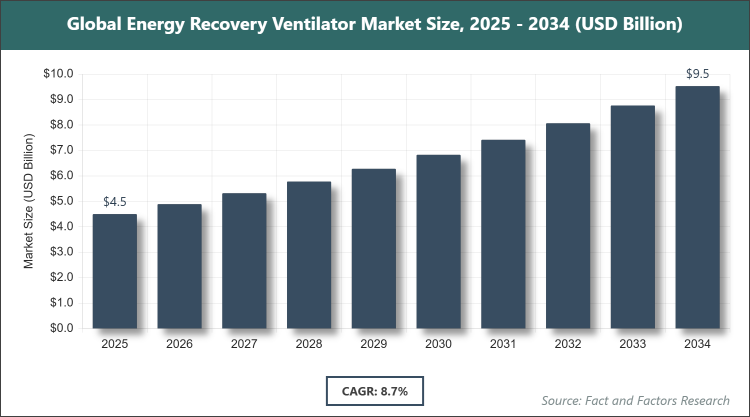
According to Facts & Factors, the global Energy Recovery Ventilator market size was estimated at USD 4.5 billion in 2025 and is expected to reach USD 9.5 billion by the end of 2034. The Energy Recovery Ventilator industry is anticipated to grow by a CAGR of 8.7% between 2026 and 2034. The Energy Recovery Ventilator Market is driven by increasing demand for energy-efficient systems amid rising energy costs and stringent environmental regulations.
 Market Overview
The Energy Recovery Ventilator (ERV) market encompasses systems designed to improve indoor air quality while minimizing energy loss in buildings. These devices exchange heat and moisture between incoming and outgoing air streams, ensuring fresh air circulation without significant energy expenditure. ERVs are integral to modern HVAC solutions, promoting sustainability by reducing heating and cooling demands in residential, commercial, and industrial settings.
Key Insights
- As per the analysis shared by our research analyst, the Energy Recovery Ventilator market is estimated to grow annually at a CAGR of around 8.7% over the forecast period (2026-2034).
- In terms of revenue, the Energy Recovery Ventilator market size was valued at around USD 4.5 billion in 2025 and is expected to reach USD 9.5 billion by 2034.
- The market is driven by growing emphasis on indoor air quality and energy conservation in building designs.
- Based on the technology, the plate heat exchanger segment dominated the market in 2025 with a revenue share of over 45% due to its high efficiency, low maintenance requirements, and cost-effectiveness in heat and moisture transfer.
- Based on the installation type, the ceiling-mount segment dominated the market in 2025 with a revenue share of over 42% owing to its space-saving design, ease of integration into existing structures, and widespread use in commercial buildings.
- Based on the application, the commercial segment dominated the market in 2025 with a revenue share of over 52% because of the high demand for efficient ventilation in offices, schools, and retail spaces to comply with building codes and enhance occupant comfort.
- Based on region, North America dominated the market in 2025 with a revenue share of over 35% attributed to strict energy efficiency standards, advanced infrastructure, and high adoption rates in the U.S. and Canada.
Market Dynamics
Growth Drivers
- Rising Awareness of Indoor Air Quality
The increasing recognition of the health impacts associated with poor indoor air quality has propelled the adoption of ERVs. These systems effectively filter pollutants, allergens, and excess moisture, creating healthier environments in homes and workplaces. Regulatory bodies worldwide are enforcing stricter standards for ventilation, further driving market growth as builders and facility managers seek compliant solutions.
As urbanization accelerates, densely populated areas face heightened risks from airborne contaminants. ERVs address this by providing continuous fresh air exchange without compromising energy efficiency, making them essential in modern construction projects. Technological advancements in ERV designs, such as improved sensors and smart controls, enhance their appeal by offering customizable air management.
Restraints
- High Initial Installation Costs
The upfront costs of ERV systems, including equipment and professional installation, can deter potential buyers, particularly in cost-sensitive markets. Small-scale residential projects often prioritize affordability over long-term savings, limiting widespread adoption.
Maintenance requirements and the need for compatible HVAC infrastructure add to the financial burden. In regions with limited skilled labor, installation complexities can lead to delays and increased expenses, restraining market expansion despite the proven energy-saving benefits.
Opportunities
- Expansion in Emerging Markets
Rapid urbanization in developing regions presents significant opportunities for ERV market growth. Countries in Asia Pacific and Latin America are investing in green building initiatives, creating demand for energy-efficient ventilation technologies.
Government incentives for sustainable construction and rising disposable incomes enable greater access to advanced HVAC systems. Partnerships between manufacturers and local distributors can facilitate market penetration, capitalizing on the shift toward eco-friendly infrastructure.
Challenges
- Installation and Maintenance Complexities
The technical expertise required for proper ERV installation poses a challenge, especially in retrofitting older buildings. Incompatible structures may require extensive modifications, increasing project timelines and costs.
Ongoing maintenance, such as filter replacements and system cleaning, is crucial for optimal performance but can be overlooked, leading to reduced efficiency. Addressing these issues through user-friendly designs and training programs is essential to overcome adoption barriers.
Report Scope
Report Attribute |
Details |
Market Size 2025 |
USD 4.5 Billion |
Projected Market Size in 2034 |
USD 9.5 Billion |
CAGR Growth Rate |
8.7% CAGR |
Base Year |
2025 |
Forecast Years |
2026-2034 |
Key Market Players |
Daikin Industries, Mitsubishi Electric Corporation, Panasonic Corporation, LG Electronics, Johnson Controls, Carrier Global Corporation, Greenheck Fan Corporation, RenewAire LLC, Zehnder Group AG, Munters, and Others. |
Key Segment |
By Technology, By Installation Type, By Application, and By Region |
Major Regions Covered |
North America, Europe, Asia Pacific, Latin America, and the Middle East & Africa |
Purchase Options |
Request customized purchase options to meet your research needs. Explore purchase options |
Market Segmentation
The Energy Recovery Ventilator market is segmented by technology, installation type, application, and region.
Based on Technology Segment, the Energy Recovery Ventilator market is divided into plate heat exchanger, rotary heat exchanger, heat pipe heat exchanger, run-around coil, and others. The plate heat exchanger segment is the most dominant, holding a significant market share due to its superior heat transfer efficiency and ability to handle both sensible and latent energy recovery, which reduces overall energy consumption in ventilation systems. This dominance drives the market by enabling cost savings in heating and cooling, making it ideal for large-scale applications. The rotary heat exchanger is the second most dominant, valued for its compact design and high recovery rates in varying climates, contributing to market growth through versatility in commercial and industrial settings.
Based on Installation Type Segment, the Energy Recovery Ventilator market is divided into wall-mount, ceiling-mount, cabinet, and others. The ceiling-mount segment is the most dominant, capturing a large share owing to its seamless integration into building ceilings, minimal space usage, and ease of access for maintenance, which appeals to architects and builders focused on aesthetics and functionality. This helps drive the market by supporting efficient air distribution in multi-story structures. The wall-mount segment is the second most dominant, preferred for its straightforward installation in smaller spaces and cost-effectiveness, boosting market expansion in residential retrofits where quick deployment is key.
Based on Application Segment, the Energy Recovery Ventilator market is divided into residential, commercial, industrial, and others. The commercial segment is the most dominant, with a substantial share driven by the need for high-volume air exchange in offices, malls, and hospitals to meet occupancy demands and regulatory standards, thereby propelling market growth through enhanced energy management. The residential segment is the second most dominant, growing due to homeowner interest in sustainable living and improved home air quality, which supports market development by increasing demand for compact, user-friendly systems.
Recent Developments
- In 2025, Daikin Industries launched an advanced ERV model with integrated IoT capabilities, allowing remote monitoring and optimization of energy usage, aimed at enhancing smart building integrations.
- Mitsubishi Electric announced a partnership with a leading U.S. construction firm in late 2025 to supply ERVs for a major green building project, focusing on reducing carbon footprints in commercial spaces.
- Panasonic Corporation introduced a new line of compact ERVs in 2026, designed for residential use with improved noise reduction features, targeting urban households concerned with air pollution.
Regional Analysis
- North America to dominate the global market
North America leads the ERV market due to robust regulatory frameworks promoting energy efficiency and indoor air quality. The region's advanced construction industry integrates ERVs extensively in both new builds and renovations. The United States, as the dominating country, drives this through federal incentives like tax credits for green technologies and widespread adoption in commercial sectors. High consumer awareness of health benefits from better ventilation further solidifies the market position. Investments in smart infrastructure enhance ERV integration, supporting long-term sustainability goals.
Europe follows closely, emphasizing sustainable development amid strict EU directives on building emissions. Germany dominates here with its strong manufacturing base and focus on passive house standards that mandate efficient ventilation. The region's cold climates necessitate effective heat recovery, boosting ERV demand in residential and industrial applications. Collaborative efforts between governments and industry players foster innovation in eco-friendly designs. Growing retrofitting activities in older buildings contribute to steady market expansion.
Asia Pacific is experiencing rapid growth fueled by urbanization and rising living standards. China, the dominating country, propels the market through massive infrastructure projects and government policies aimed at reducing urban pollution. Increasing commercial developments in cities require advanced ventilation to handle dense populations. The region's diverse climates drive demand for versatile ERV systems. Emerging economies invest in green technologies, creating opportunities for market penetration.
Latin America shows promising potential with increasing awareness of energy conservation. Brazil dominates, supported by urban expansion and initiatives for sustainable housing. Challenges like economic variability are offset by international funding for green projects. The focus on improving indoor environments in tropical climates enhances ERV adoption. Gradual regulatory improvements encourage market growth.
The Middle East & Africa region is emerging, driven by hot climates necessitating efficient cooling. The United Arab Emirates dominates with ambitious smart city projects incorporating ERVs for energy savings. Oil-rich economies shift toward diversification, investing in sustainable buildings. Challenges include arid conditions affecting system performance, but innovations address these. Growing tourism and commercial sectors boost demand.
Competitive Analysis
The global Energy Recovery Ventilator market is dominated by players:
- Daikin Industries
- Mitsubishi Electric Corporation
- Panasonic Corporation
- LG Electronics
- Johnson Controls
- Carrier Global Corporation
- Greenheck Fan Corporation
- RenewAire LLC
- Zehnder Group AG
- Munters
The global Energy Recovery Ventilator market is segmented as follows:
By Technology
- Plate Heat Exchanger
- Rotary Heat Exchanger
- Heat Pipe Heat Exchanger
- Run-Around Coil
- Others
By Installation Type
- Wall-Mount
- Ceiling-Mount
- Cabinet
- Others
By Application
- Residential
- Commercial
- Industrial
- Others
By Regional Segment Analysis
- North America
- The U.S.
- Canada
- Mexico
- Europe
- France
- The UK
- Spain
- Germany
- Italy
- Rest of Europe
- Asia Pacific
- China
- Japan
- India
- Australia
- Southeast Asia
- Rest of Asia Pacific
- The Middle East & Africa
- Saudi Arabia
- UAE
- Egypt
- Kuwait
- South Africa
- Rest of the Middle East & Africa
- Latin America
- Brazil
- Argentina
- Rest of Latin America
Table of Content
Industry Major Market Players
The global Energy Recovery Ventilator market is dominated by players:
- Daikin Industries
- Mitsubishi Electric Corporation
- Panasonic Corporation
- LG Electronics
- Johnson Controls
- Carrier Global Corporation
- Greenheck Fan Corporation
- RenewAire LLC
- Zehnder Group AG
- Munters



Copyright © 2025 - 2026, All Rights Reserved, Facts and Factors