
Search Market Research Report
Disabled and Elderly Assistive Technology Market Size, Share Global Analysis Report, 2026-2034

Disabled and Elderly Assistive Technology Market Size, Share, Growth Analysis Report By Product Type (Mobility Assistance Aids, Assistive Furniture, Bathroom Safety Devices, Communication Aids, Hearing Aids, Vision and Reading Aids, and Others), By Application (Daily Living, Medical, Mobility, Communication, and Ohers), By End-User (Hospitals, Elderly Nursing Homes, Home Care, and Others), and By Region - Global Industry Insights, Overview, Comprehensive Analysis, Trends, Statistical Research, Market Intelligence, Historical Data and Forecast 2026-2034
Industry Insights
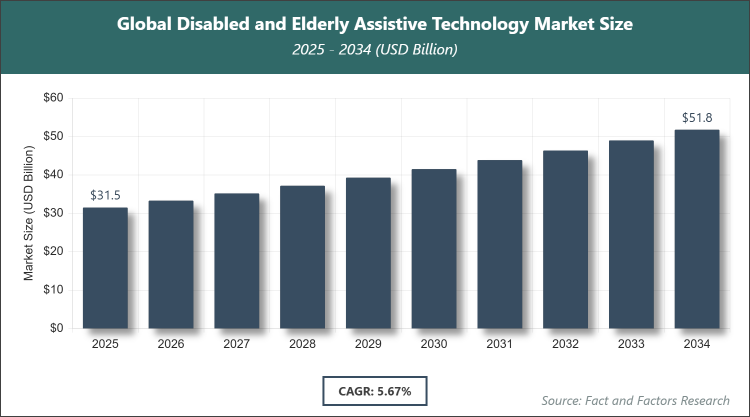
[218 + Pages Report] According to Facts & Factors, the global Disabled and Elderly Assistive Technology market size was estimated at USD 31.52 billion in 2025 and is expected to reach USD 51.94 billion by the end of 2034. The Disabled and Elderly Assistive Technology industry is anticipated to grow by a CAGR of 5.67% between 2026 and 2034. The Disabled and Elderly Assistive Technology Market is driven by the increasing aging population and the rising prevalence of disabilities worldwide.
 Market Overview
The Disabled and Elderly Assistive Technology market encompasses devices and systems designed to enhance the independence, safety, and quality of life for individuals with disabilities or elderly persons facing mobility, sensory, or cognitive challenges. These technologies include mobility aids like wheelchairs and walkers, sensory enhancements such as hearing and vision devices, and daily living aids like smart home systems and communication tools that facilitate easier navigation of everyday tasks. This market addresses the needs arising from physical limitations, chronic conditions, or age-related decline, promoting inclusion and reducing reliance on caregivers through innovative, user-friendly solutions tailored to diverse functional requirements.
Key Insights
- As per the analysis shared by our research analyst, the Disabled and Elderly Assistive Technology market is estimated to grow annually at a CAGR of around 5.67% over the forecast period (2026-2034).
- In terms of revenue, the Disabled and Elderly Assistive Technology market size was valued at around USD 31.52 billion in 2025 and is projected to reach USD 51.94 billion by 2034.
- The Disabled and Elderly Assistive Technology Market is driven by technological advancements and government initiatives for elderly care.
- Based on the Product Type, the Mobility Assistance Aids segment dominated the market in 2025 with a share of 40% due to high demand for devices enabling independent movement amid rising mobility impairments.
- Based on the Application, the Daily Living segment dominated the market in 2025 with a share of 35%, owing to the need for aids supporting routine activities in home settings.
- Based on the End-User, the Home Care segment dominated the market in 2025 with a share of 50% because of the preference for aging in place and cost-effective home-based solutions.
- North America dominated the global Disabled and Elderly Assistive Technology market in 2025 with a share of 40%, attributed to advanced healthcare infrastructure and a high elderly population.
Growth Drivers
- Aging Population and Rising Chronic Conditions
The global surge in elderly individuals, coupled with increasing incidences of age-related diseases like arthritis and dementia, drives demand for assistive technologies that support daily independence and reduce healthcare burdens. Government policies promoting inclusive living further accelerate adoption.
Advancements in AI and IoT integrate smart features into devices, enhancing usability and personalization, which attracts more users. Increased awareness through campaigns and improved affordability via subsidies expand market reach, particularly in developing regions.
Restraints
- High Costs and Limited Reimbursement
Expensive devices and inconsistent insurance coverage pose barriers, especially for low-income users, limiting market penetration in emerging economies. Complex regulatory approvals delay product launches.
Economic inequalities amplify access issues, as out-of-pocket expenses deter adoption, leading to underutilization. Supply chain disruptions for specialized components increase prices, constraining growth in price-sensitive segments.
Opportunities
- Technological Innovations in AI and Robotics
Emerging AI-driven devices like robotic exoskeletons and voice-activated systems offer enhanced functionality, opening new markets for personalized care solutions.
Collaborations with tech firms can develop affordable, scalable products, while telehealth integration expands remote monitoring. Growing e-commerce for assistive tech facilitates global distribution, tapping into underserved areas.
Challenges
- Lack of Awareness and Training
Limited user education on device benefits and operation hinders adoption, particularly in rural areas with inadequate training resources.
Cultural stigmas around disability aids reduce acceptance, while shortages of skilled professionals for fitting and maintenance affect outcomes. Infrastructure gaps in developing regions limit device compatibility and support.
Report Scope
Report Attribute |
Details |
Market Size 2025 |
USD 31.52 Billion |
Projected Market Size in 2034 |
USD 51.94 Billion |
CAGR Growth Rate |
5.67% CAGR |
Base Year |
2025 |
Forecast Years |
2026-2034 |
Key Market Players |
Sonova Holding AG, Invacare Corporation, Drive Medical, GN ReSound Group, Pride Mobility Products Corporation, Starkey Hearing Technologies, William Demant Holding A/S, Sunrise Medical LLC, Ai Squared, Siemens Ltd., and Others. |
Key Segment |
By Product Type, By Application, By End-User, and By Region |
Major Regions Covered |
North America, Europe, Asia Pacific, Latin America, and the Middle East & Africa |
Purchase Options |
Request customized purchase options to meet your research needs. Explore purchase options |
Market Segmentation
The Disabled and Elderly Assistive Technology market is segmented by product type, application, end-user, and region.
Based on Product Type Segment, the Disabled and Elderly Assistive Technology market is divided into mobility assistance aids, assistive furniture, bathroom safety devices, communication aids, hearing aids, vision and reading aids, and others. The most dominant segment is Mobility Assistance Aids, driven by the prevalence of mobility issues in aging populations. The second most dominant is Hearing Aids, supported by rising hearing impairments. Mobility Assistance Aids dominate due to their essential role in enabling independence for those with physical limitations, fostering market growth through innovations like powered wheelchairs that reduce caregiver dependency and improve quality of life.
Based on Application Segment, the Disabled and Elderly Assistive Technology market is divided into daily living, medical, mobility, communication, and others. The most dominant segment is Daily Living, owing to broad use in routine tasks. The second most dominant is Mobility, fueled by demand for movement support. Daily Living dominates as it addresses comprehensive needs like eating and grooming, driving market expansion by integrating smart tech that promotes self-reliance and reduces healthcare costs.
Based on End-User Segment, the Disabled and Elderly Assistive Technology market is divided into hospitals, elderly nursing homes, home care, and others. The most dominant segment is Home Care, as it aligns with aging-in-place trends. The second most dominant is Elderly Nursing Homes, with institutional demand. Home Care leads due to cost savings and user preference for familiar environments, propelling market growth via customizable devices that enhance safety and autonomy at home.
Recent Developments
- In February 2025, Nvidia partnered with the American Society for Deaf Children to launch an AI-based sign language learning platform featuring 3D avatars for demonstrating signs, advancing communication aids for the hearing impaired.
- In January 2025, AssisTech Foundation initiated an incubation program supporting 450 startups in developing assistive technologies, boosting innovation in the disability sector.
- In January 2024, Sunrise Medical introduced the Switch-It Vigo head control system, enhancing mobility for users with limited motor functions through advanced tracking technology.
- In July 2024, Drive DeVilbiss Healthcare acquired Mobility Designed, Inc., expanding its portfolio with innovative crutches and mobility solutions for elderly users.
- In 2024, Philips Healthcare launched AI-driven smart hearing aids with noise reduction and personalized amplification, improving auditory assistance for the elderly.
Regional Analysis
- North America to dominate the global market
North America leads the Disabled and Elderly Assistive Technology market, bolstered by robust healthcare systems, high R&D investments, and favorable reimbursement policies that facilitate device adoption. The region's focus on innovation, with numerous startups and tech integrations, strengthens its position. The United States dominates, with its large elderly demographic and government programs like Medicare supporting access to advanced aids, driving widespread use of smart devices for home care, which enhances user independence and positions the country as a hub for technological advancements in assistive solutions.
Europe holds a significant share in the Disabled and Elderly Assistive Technology market, driven by comprehensive welfare systems and emphasis on inclusive policies for aging populations. Collaborative research initiatives accelerate product development. Germany leads the region, leveraging its engineering expertise and universal healthcare to integrate robotic aids and AI monitoring, promoting efficient care delivery in nursing homes and homes, and fostering market growth through standardized quality and export-oriented manufacturing.
Asia-Pacific is rapidly growing in the Disabled and Elderly Assistive Technology market, fueled by urbanization and increasing life expectancy amid economic development. Government subsidies enhance affordability. Japan dominates, with its super-aged society and tech-savvy culture adopting exoskeletons and voice assistants, supported by national initiatives for elder care, accelerating innovation and market expansion through localized production and digital health integration.
Latin America emerges in the Disabled and Elderly Assistive Technology market, propelled by improving healthcare access and rising awareness of disability rights. International aid supports distribution. Brazil leads, with public health reforms and a growing middle class demanding mobility aids, aided by partnerships with global firms to introduce affordable devices, promoting gradual adoption and market maturation through community programs.
The Middle East & Africa region shows potential in the Disabled and Elderly Assistive Technology market, driven by healthcare investments and demographic shifts. NGO collaborations aid penetration. South Africa dominates, with urban infrastructure and government focus on disability inclusion, introducing basic aids like wheelchairs, enhanced by regional training, laying groundwork for advanced tech uptake and sustained growth.
Competitive Analysis
The global disabled and elderly assistive technology market is dominated by players:
- Sonova Holding AG
- Invacare Corporation
- Drive Medical
- GN ReSound Group
- Pride Mobility Products Corporation
- Starkey Hearing Technologies
- William Demant Holding A/S
- Sunrise Medical LLC
- Ai Squared
- Siemens Ltd.
The global disabled and elderly assistive technology market is segmented as follows:
By Product Type
- Mobility Assistance Aids
- Assistive Furniture
- Bathroom Safety Devices
- Communication Aids
- Hearing Aids
- Vision and Reading Aids
- Others
By Application
- Daily Living
- Medical
- Mobility
- Communication
By End-User
- Hospitals
- Elderly Nursing Homes
- Home Care
- Others
By Region
- North America
- The U.S.
- Canada
- Mexico
- Europe
- France
- The UK
- Spain
- Germany
- Italy
- Rest of Europe
- Asia Pacific
- China
- Japan
- India
- Australia
- Southeast Asia
- Rest of Asia Pacific
- The Middle East & Africa
- Saudi Arabia
- UAE
- Egypt
- Kuwait
- South Africa
- Rest of the Middle East & Africa
- Latin America
- Brazil
- Argentina
- Rest of Latin America
Table of Content
Industry Major Market Players
- Sonova Holding AG
- Invacare Corporation
- Drive Medical
- GN ReSound Group
- Pride Mobility Products Corporation
- Starkey Hearing Technologies
- William Demant Holding A/S
- Sunrise Medical LLC
- Ai Squared
- Siemens Ltd.



Copyright © 2025 - 2026, All Rights Reserved, Facts and Factors