
Search Market Research Report
Die Cut Lids Market Size, Share Global Analysis Report, 2026-2034

Die Cut Lids Market Size, Share, Growth Analysis Report By Material (Plastic, Paper, Aluminum, and Others), By Application (Cups, Trays, Bottles, Jars, and Others), By End-Use Industry (Food, Beverage, Pharmaceutical, Personal Care & Cosmetics, and Others), and By Region - Global Industry Insights, Overview, Comprehensive Analysis, Trends, Statistical Research, Market Intelligence, Historical Data and Forecast 2026-2034
Industry Insights
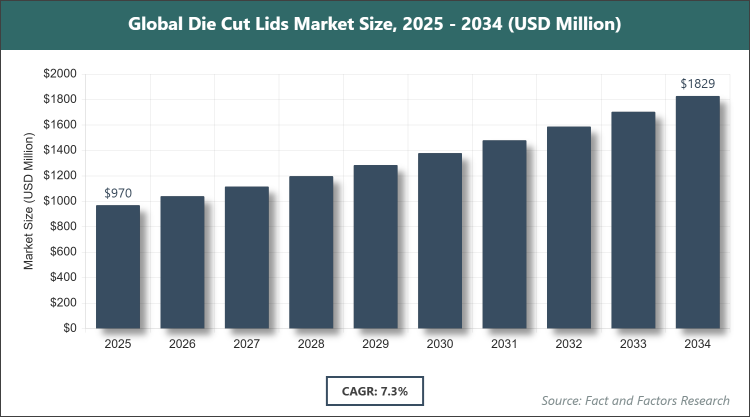
[228 + Pages Report] According to Facts & Factors, the global Die Cut Lids market size was estimated at USD 0.97 billion in 2025 and is expected to reach USD 1.84 billion by the end of 2034. The die-cut lids industry is anticipated to grow by a CAGR of 7.3% between 2026 and 2034. The Die Cut Lids Market is driven by increasing demand for convenient and sustainable packaging solutions in the food and beverage sectors.
 Market Overview
The Die Cut Lids market refers to the industry involved in the production and distribution of precisely cut lids used primarily for sealing containers in packaging applications. These lids are manufactured through a die-cutting process that shapes materials into custom forms to fit various containers, ensuring secure closure, tamper evidence, and product freshness. Commonly utilized in food packaging for items like yogurt cups or beverage containers, die-cut lids enhance shelf life by providing barriers against contaminants while allowing for branding and easy peelability. This market caters to the need for efficient, customizable packaging that balances functionality with aesthetic appeal across diverse consumer goods.
Key Insights
- As per the analysis shared by our research analyst, the Die Cut Lids market is estimated to grow annually at a CAGR of around 7.3% over the forecast period (2026-2034).
- In terms of revenue, the Die Cut Lids market size was valued at around USD 0.97 billion in 2025 and is projected to reach USD 1.84 billion by 2034.
- The Die Cut Lids Market is driven by the rising consumption of packaged foods and beverages globally.
- Based on the Material, the Plastic segment dominated the market in 2025 with a share of 55% due to its cost-effectiveness, durability, and versatility in various applications.
- Based on the Application, the Cups segment dominated the market in 2025 with a share of 35% owing to high demand in dairy products like yogurt and ready-to-eat meals.
- Based on the End-Use Industry, the Food segment dominated the market in 2025 with a share of 45% because of the need for hygienic and convenient packaging solutions in the growing food industry.
- Asia-Pacific dominated the global die-cut lids market in 2025 with a share of 40%, attributed to rapid urbanization, population growth, and expanding food processing sectors.
Growth Drivers
- Increasing Demand for Convenience Foods
The surge in busy lifestyles and urbanization has heightened the need for ready-to-eat and portable food products, driving demand for efficient packaging like die-cut lids that ensure freshness and ease of use. This trend is particularly evident in emerging economies where consumer preferences shift toward on-the-go consumption.
Innovations in lid designs, such as resealable and tamper-evident features, further support market growth by enhancing product safety and appeal. Additionally, the expansion of e-commerce in food delivery amplifies the requirement for durable packaging that withstands transportation, contributing to sustained industry expansion.
Restraints
- High Production Costs
The manufacturing of die-cut lids involves specialized machinery and raw materials, leading to elevated costs that can limit adoption among small-scale producers and in price-sensitive markets. Fluctuations in material prices, particularly for plastics and aluminum, exacerbate this issue.
Environmental regulations pushing for sustainable alternatives increase R&D expenses, potentially slowing innovation. Supply chain disruptions, such as those from global events, further raise operational costs, impacting profitability and market accessibility for new entrants.
Opportunities
- Shift Toward Sustainable Materials
Growing environmental awareness encourages the adoption of eco-friendly lids made from recyclable or biodegradable materials, opening avenues for innovation and market differentiation in green packaging.
Partnerships with sustainability-focused brands can expand reach, while government incentives for eco-packaging foster investment. Emerging technologies like bio-based polymers offer cost-effective alternatives, enabling penetration into untapped segments like organic foods.
Challenges
- Regulatory Compliance and Environmental Concerns
Stringent regulations on plastic usage and waste management pose hurdles, requiring constant adaptation and potentially increasing compliance costs for manufacturers.
Consumer backlash against non-recyclable materials pressures companies to reformulate products, while competition from alternative packaging solutions like flexible pouches intensifies. Limited recycling infrastructure in some regions complicates sustainability efforts, affecting overall market dynamics.
Report Scope
Report Attribute |
Details |
Market Size 2025 |
USD 0.97 Billion |
Projected Market Size in 2034 |
USD 1.84 Billion |
CAGR Growth Rate |
7.3% CAGR |
Base Year |
2025 |
Forecast Years |
2026-2034 |
Key Market Players |
Amcor plc, Constantia Flexibles Group, Huhtamaki Oyj, Winpak Ltd., Uflex Ltd., Sonoco Products Company, Sealed Air Corporation, Bemis Company, Inc., Tekni-Plex, Inc., ProAmpac LLC, and Others. |
Key Segment |
By Material, By Application, By End-Use Industry, and By Region |
Major Regions Covered |
North America, Europe, Asia Pacific, Latin America, and the Middle East & Africa |
Purchase Options |
Request customized purchase options to meet your research needs. Explore purchase options |
Market Segmentation
The Die Cut Lids market is segmented by material, application, end-use industry, and region.
Based on Material Segment, the Die Cut Lids market is divided into plastic, paper, aluminum, and others. The most dominant segment is Plastic, driven by its lightweight nature and excellent barrier properties against moisture and contaminants. The second most dominant is Aluminum, valued for its strength and recyclability in premium applications. Plastic dominates due to its affordability and adaptability in high-volume production, enabling customization for branding while maintaining product integrity, which drives market growth by meeting the demands of fast-moving consumer goods industries and reducing overall packaging costs.
Based on Application Segment, the Die Cut Lids market is divided into cups, trays, bottles, jars, and others. The most dominant segment is Cups, owing to widespread use in single-serve dairy and beverage products. The second most dominant is Trays, supported by demand in ready meals and foodservice. Cups lead because of their role in convenience packaging for on-the-go consumption, promoting hygiene and portion control, which accelerates market expansion through alignment with consumer trends toward quick, portable eating options.
Based on End-Use Industry Segment, the Die Cut Lids market is divided into food, beverage, pharmaceutical, personal care & cosmetics, and others. The most dominant segment is Food, as it requires secure sealing for perishable items. The second most dominant is Beverage, driven by bottled and cupped drinks. Food dominates due to its emphasis on freshness preservation and contamination prevention, fueling market growth by supporting the rise in processed foods and enhancing supply chain efficiency.
Recent Developments
- In May 2025, Aluflexpack AG announced the acquisition of an 80% stake in Teko, a flexible packaging provider specializing in dairy and beverage segments, aiming to strengthen its presence in Turkey and surrounding regions.
- In January 2025, Tekni-Plex partnered with PackPlus Embalagens as a distributor to expand its die cut lid offerings in South America, focusing on innovative solutions for food packaging.
- In October 2024, Oliver Healthcare Packaging launched a new range of sustainable die cut lids at the Med-Tech Innovation Expo, emphasizing eco-friendly materials for pharmaceutical and food applications.
- In March 2025, Liplid collaborated with the MAX burger chain to implement award-winning coffee cup lids, promoting sustainable and user-friendly designs in the foodservice industry.
- In February 2026, Constantia Flexibles introduced bio-based die cut lids for yogurt packaging, aligning with global sustainability trends and reducing plastic dependency.
Regional Analysis
- Asia-Pacific to dominate the global market
Asia-Pacific commands the Die Cut Lids market, propelled by booming food and beverage industries, rapid urbanization, and a massive consumer base demanding convenient packaging. The region's manufacturing prowess and cost advantages further bolster its lead. China dominates within Asia-Pacific, with its extensive food processing sector and export-oriented economy, integrating advanced die-cutting technologies to meet global standards, while government policies on food safety enhance adoption, driving innovation and market scalability.
North America maintains a strong position in the Die Cut Lids market, supported by advanced packaging technologies and high consumption of ready-to-eat foods. The emphasis on product safety and branding fuels demand. The United States leads the region, leveraging its robust retail and e-commerce infrastructure, where collaborations between packaging firms and food giants promote customized lids, improving shelf life and consumer appeal, thus sustaining steady growth.
Europe exhibits mature growth in the Die Cut Lids market, driven by stringent environmental regulations and a focus on sustainable packaging innovations. Consumer preferences for eco-friendly products accelerate adoption. Germany dominates, with its engineering expertise and strong dairy industry, implementing recyclable materials in lids to comply with EU directives, fostering R&D and enhancing competitive edges in premium packaging segments.
Latin America is witnessing emerging growth in the Die Cut Lids market, fueled by expanding food exports and rising middle-class consumption. Investments in packaging infrastructure support this trend. Brazil stands out as the dominant country, with its vibrant agriculture and beverage sectors, adopting die cut lids for tropical fruit juices and dairy, aided by trade agreements that boost exports and encourage technological upgrades.
The Middle East & Africa region shows promising potential in the Die Cut Lids market, driven by increasing urbanization and food import dependencies. Efforts to diversify economies aid market entry. South Africa leads, with its developed food processing industry and retail chains, utilizing die cut lids for preserved goods, supported by international partnerships that introduce sustainable practices and improve distribution networks.
Competitive Analysis
The global Die Cut Lids market is dominated by players:
- Amcor plc
- Constantia Flexibles Group
- Huhtamaki Oyj
- Winpak Ltd.
- Uflex Ltd.
- Sonoco Products Company
- Sealed Air Corporation
- Bemis Company, Inc.
- Tekni-Plex, Inc.
- ProAmpac LLC
The global Die Cut Lids market is segmented as follows:
By Material
- Plastic
- Paper
- Aluminum
- Others
By Application
- Cups
- Trays
- Bottles
- Jars
- Others
By End-Use Industry
- Food
- Beverage
- Pharmaceutical
- Personal Care & Cosmetics
- Others
By Region
- North America
- The U.S.
- Canada
- Mexico
- Europe
- France
- The UK
- Spain
- Germany
- Italy
- Rest of Europe
- Asia Pacific
- China
- Japan
- India
- Australia
- Southeast Asia
- Rest of Asia Pacific
- The Middle East & Africa
- Saudi Arabia
- UAE
- Egypt
- Kuwait
- South Africa
- Rest of the Middle East & Africa
- Latin America
- Brazil
- Argentina
- Rest of Latin America
Table of Content
Industry Major Market Players
- Amcor plc
- Constantia Flexibles Group
- Huhtamaki Oyj
- Winpak Ltd.
- Uflex Ltd.
- Sonoco Products Company
- Sealed Air Corporation
- Bemis Company, Inc.
- Tekni-Plex, Inc.
- ProAmpac LLC



Copyright © 2025 - 2026, All Rights Reserved, Facts and Factors