
Search Market Research Report
Compounding Pharmacies Market Size, Share Global Analysis Report, 2026-2034

Compounding Pharmacies Market Size, Share, Growth Analysis Report By Therapeutic Area (Pain Management, Hormone Replacement, Dermatology, Specialty Drugs, Others), By Product Type (Oral, Topical, Parenteral, Ophthalmic, Others), By Sterility (Sterile, Non-Sterile), By Pharmacy Type (503A, 503B), By End-User (Adults, Pediatric, Geriatric, Veterinary), and By Region - Global Industry Insights, Overview, Comprehensive Analysis, Trends, Statistical Research, Market Intelligence, Historical Data and Forecast 2026-2034
Industry Insights
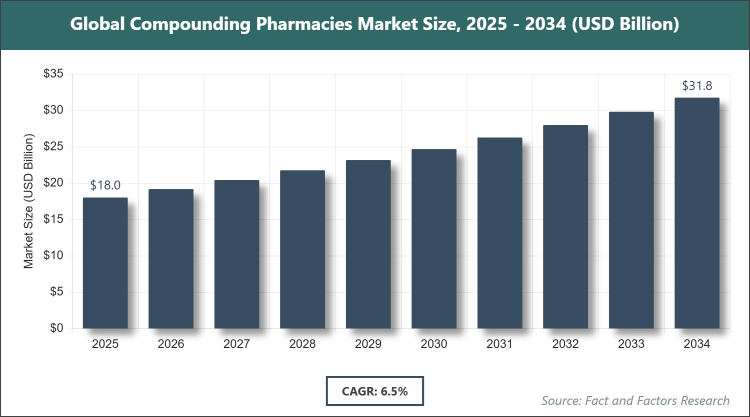
[250+ Pages Report] According to Facts & Factors, the global Compounding Pharmacies market size was estimated at USD 18.02 billion in 2025 and is expected to reach USD 31.77 billion by 2034, growing at a CAGR of 6.50% from 2026 to 2034. Compounding Pharmacies Market is driven by rising demand for personalized medications.
 Market Overview
Compounding pharmacies are specialized facilities that prepare customized medications by mixing, altering, or combining ingredients to meet the specific needs of individual patients, such as adjusting dosages, removing allergens, or creating formulations not available in commercial products, serving a vital role in personalized medicine for conditions like hormone imbalances, pain management, and dermatological issues. These pharmacies operate under strict regulatory guidelines to ensure safety, quality, and efficacy, distinguishing them from standard retail pharmacies by focusing on tailored solutions that address drug shortages, pediatric or geriatric requirements, and unique therapeutic demands without mass production constraints, thereby enhancing patient outcomes in healthcare scenarios where standard drugs are inadequate or unavailable.
Key Insights
- The Compounding Pharmacies market was valued at USD 18.02 Billion in 2025 and is projected to reach USD 31.77 Billion by the end of 2034.
- The market is expected to grow at a CAGR of 6.50% between 2026 and 2034.
- The Compounding Pharmacies market is driven by rising demand for personalized medications.
- Based on the Therapeutic Area segment, the Pain Management subsegment dominated the market in 2025 with a share of 34.86% because of the high prevalence of chronic pain conditions requiring customized dosages and formulations.
- Based on the Product Type segment, the Oral subsegment dominated the market in 2025 with a share of 36.21% because of its convenience, patient preference, and ease of customization for various therapies.
- Based on the Sterility segment, the Non-Sterile subsegment dominated the market in 2025 with a share of 71.97% because of lower regulatory hurdles and broader application in non-injectable medications.
- Based on the Pharmacy Type segment, the 503A subsegment dominated the market in 2025 with a share of 72.99% because of its focus on patient-specific prescriptions and flexibility in small-batch production.
- Based on the End-User segment, the Adults subsegment dominated the market in 2025 with a share of 50.0% because of the increasing incidence of chronic diseases among the adult population.
- North America held the largest market share of 43.56% in 2025 due to advanced healthcare infrastructure, high prevalence of chronic diseases, and supportive regulatory environment.
Growth Drivers
- Rising Demand for Personalized Medications
The increasing prevalence of chronic diseases and the need for tailored treatments, such as adjusted dosages for allergies or specific formulations for rare conditions, have propelled the demand for compounding services that provide customized solutions unavailable in mass-produced drugs.
This driver is further strengthened by advancements in pharmacogenomics, enabling precise medication matching to individual genetic profiles, thereby enhancing efficacy and reducing adverse effects in patient care.
- Drug Shortages and Supply Chain Disruptions
Frequent shortages of commercial drugs due to manufacturing issues or raw material constraints have led healthcare providers to rely on compounding pharmacies to fill gaps, ensuring continuous access to essential medications.
This factor is amplified by global events like pandemics, which expose vulnerabilities in supply chains, prompting regulatory flexibility and increased utilization of compounding for critical therapies.
- Aging Population and Geriatric Care Needs
The growing elderly population requires specialized medications, such as easier-to-swallow forms or reduced-strength doses, driving compounding pharmacies to cater to geriatric-specific needs. This trend is supported by rising healthcare expenditures on aging demographics, fostering innovation in compounded products for long-term care facilities and home-based treatments.
Restraints
- Stringent Regulatory Compliance
Complex regulations from bodies like the FDA and USP, requiring rigorous quality controls and documentation, increase operational costs and limit entry for smaller pharmacies. This restraint challenges market expansion by necessitating investments in sterile facilities and training, potentially leading to closures or consolidations among non-compliant providers.
- Reimbursement and Insurance Coverage Issues
Limited insurance coverage for compounded drugs compared to FDA-approved alternatives raises out-of-pocket costs for patients, deterring usage. This issue is exacerbated by varying state policies on reimbursement, impacting accessibility and affordability in price-sensitive segments.
Opportunities
- Expansion in Veterinary Compounding
The growing pet ownership and demand for animal-specific medications offer opportunities for specialized compounding, addressing unique veterinary needs. This can be leveraged through partnerships with veterinarians, unlocking a high-margin niche with fewer regulatory hurdles than human pharmaceuticals.
- Technological Advancements in Compounding
Adoption of automation and AI for precise mixing and quality assurance enhances efficiency and safety, attracting larger healthcare providers. This innovation enables scalability, fostering growth in high-volume segments like hospitals and clinics.
Challenges
- Quality Control and Contamination Risks
Instances of contamination in compounded products pose safety risks, leading to recalls and loss of trust. This requires ongoing vigilance and investment in sterile processes, straining resources for smaller operations.
- Competition from Generic Drugs
Availability of low-cost generics reduces the need for compounding in some areas, compressing market share. This challenge demands differentiation through unique formulations, but limits growth in standardized therapy segments.
Report Scope
Report Attribute |
Details |
Market Size in 2025 |
USD 18.02 Billion |
Projected Market Size in 2034 |
USD 31.77 Billion |
CAGR Growth Rate |
6.50% CAGR |
Base Year |
2025 |
Forecast Years |
2026-2034 |
Key Market Players |
Fagron, Fresenius Kabi, B. Braun Medical Inc., Wedgewood Pharmacy, PharMEDium Services, Avella Specialty Pharmacy, Central Admixture Pharmacy Services, PCCA, Medisca Inc., Empower Pharmacy, and Others. |
Key Segment |
By Therapeutic Area, By Product Type, By Sterility, By Pharmacy Type, By End-User, and By Region |
Major Regions Covered |
North America, Europe, Asia Pacific, Latin America, and the Middle East &, Africa |
Purchase Options |
Request customized purchase options to meet your research needs. Explore purchase options |
Market Segmentation
The Compounding Pharmacies market is segmented by type, application, end-user, and region.
Based on Therapeutic Area Segment, The Compounding Pharmacies market is divided into Pain Management, Hormone Replacement, Dermatology, Specialty Drugs, and Others. The most dominant segment is Pain Management, holding 34.86% share, due to the high incidence of chronic pain requiring customized opioid and non-opioid formulations, driving market growth by addressing opioid crisis with safer alternatives; the second most dominant is Hormone Replacement, which supports expansion through tailored therapies for menopause and thyroid conditions, enhancing patient adherence.
Based on Product Type Segment, The Compounding Pharmacies market is divided into Oral, Topical, Parenteral, Ophthalmic, and Others. The most dominant segment is Oral, with 36.21% share, owing to ease of administration and customization for swallowing difficulties, propelling growth in pediatric and geriatric care; the second most dominant is Topical, contributing via skin-specific treatments for dermatology, reducing systemic side effects.
Based on Sterility Segment, The Compounding Pharmacies market is divided into Sterile, and Non-Sterile. The most dominant segment is Non-Sterile, capturing 71.97% share, because of broader applications in oral and topical forms with lower production costs, fueling market in ambulatory settings; the second most dominant is Sterile, aiding growth in injectables for hospitals.
Based on Pharmacy Type Segment, The Compounding Pharmacies market is divided into 503A, and 503B. The most dominant segment is 503A, with 72.99% share, due to patient-specific prescriptions allowing flexibility, accelerating growth in retail settings; the second most dominant is 503B, boosting through batch production for shortages.
Based on End-User Segment, The Compounding Pharmacies market is divided into Adults, Pediatric, Geriatric, and Veterinary. The most dominant segment is Adults, holding 50.0% share, driven by chronic disease prevalence, enhancing market with personalized chronic care; the second most dominant is Geriatric, contributing via age-related adjustments.
Recent Developments
- In February 2025, Fagron launched an advanced software platform to streamline 503A workflows and track patient outcomes.
- In March 2025, Empower Pharmacy commenced operations at its second high-capacity 503B facility in Houston, enhancing sterile compounding.
- In April 2025, the FDA clarified enforcement timelines for compounded GLP-1 drugs, mandating phase-outs to align with finished product availability.
- In January 2025, Revelation Pharma acquired Washington-based Cascade Specialty Pharmacy to expand into ENT and Animal Health compounding.
- In January 2025, Olympia Pharmaceuticals expanded into Alabama, marking growth in healthcare provider services.
Regional Analysis
- North America to dominate the global market
North America dominates the Compounding Pharmacies market with a 43.56% share, driven by advanced healthcare infrastructure, high chronic disease prevalence, and supportive regulations; the United States leads, with drug shortages and personalized medicine demands in states like California and Texas, where FDA oversight and insurance coverage facilitate access in urban centers like New York.
Europe exhibits steady growth, focused on regulatory harmonization; Germany dominates, leveraging EU standards for hormone therapies in hubs like Berlin, amid aging populations in France and UK boosting demand for customized dermatology products.
Asia-Pacific is fastest-growing, propelled by healthcare investments; China leads, with API production in Shanghai addressing shortages, while India's generics base in Mumbai supports affordable compounding for pediatrics.
Latin America shows potential with economic reforms; Brazil dominates, tackling chronic pain in Sao Paulo through local regulations, enhancing access in Mexico for veterinary applications.
Middle East and Africa remain emerging; UAE leads in the Middle East with Dubai's focus on specialty drugs, while South Africa drives in Africa for hormone replacements in Johannesburg amid healthcare expansions.
Competitive Analysis
The global Compounding Pharmacies market is dominated by players:
- Fagron
- Fresenius Kabi
- B. Braun Medical Inc.
- Wedgewood Pharmacy
- PharMEDium Services
- Avella Specialty Pharmacy
- Central Admixture Pharmacy Services
- PCCA
- Medisca Inc.
- Empower Pharmacy
The global Compounding Pharmacies market is segmented as follows:
By Therapeutic Area
- Pain Management
- Hormone Replacement
- Dermatology
- Specialty Drugs
- Others
By Product Type
- Oral
- Topical
- Parenteral
- Ophthalmic
- Others
By Sterility
- Sterile
- Non-Sterile
By Pharmacy Type
- 503A
- 503B
By End-User
- Adults
- Pediatric
- Geriatric
- Veterinary
By Region
- North America
- The U.S.
- Canada
- Mexico
- Europe
- France
- The UK
- Spain
- Germany
- Italy
- Rest of Europe
- Asia Pacific
- China
- Japan
- India
- Australia
- Southeast Asia
- Rest of Asia Pacific
- The Middle East & Africa
- Saudi Arabia
- UAE
- Egypt
- Kuwait
- South Africa
- Rest of the Middle East & Africa
- Latin America
- Brazil
- Argentina
- Rest of Latin America
Table of Content
Industry Major Market Players



Copyright © 2025 - 2026, All Rights Reserved, Facts and Factors