
Search Market Research Report
Cartilage Repair/Regeneration Market Size, Share Global Analysis Report, 2026-2034

Cartilage Repair/Regeneration Market Size, Share, Growth Analysis Report By Treatment Modality (Cell-Based and Non-Cell-Based), By Application (Hyaline Cartilage and Fibrocartilage), By End-User (Hospitals & Clinics, Ambulatory Surgical Centers, and Others), and By Region - Global Industry Insights, Overview, Comprehensive Analysis, Trends, Statistical Research, Market Intelligence, Historical Data and Forecast 2026-2034
Industry Insights
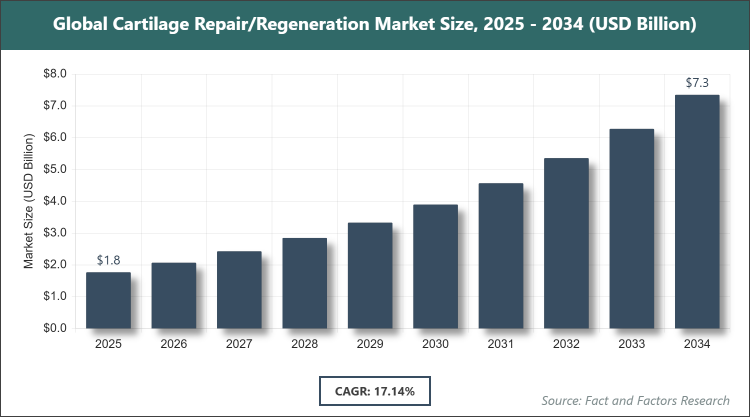
[220+ Pages Report] According to Facts & Factors, the global cartilage repair/regeneration market size was estimated at USD 1.77 billion in 2025 and is expected to reach USD 7.32 billion by the end of 2034. The cartilage repair/regeneration industry is anticipated to grow by a CAGR of 17.14% between 2026 and 2034. The cartilage repair/regeneration Market is driven by increasing prevalence of osteoarthritis and sports-related injuries.
 Market Overview
Cartilage repair/regeneration refers to medical procedures and technologies aimed at restoring damaged cartilage tissue, which lacks natural self-healing capabilities due to its avascular nature. This market encompasses a range of treatments including surgical interventions, biologics, and regenerative therapies designed to alleviate pain, improve joint function, and prevent further degeneration in conditions affecting joints like knees, hips, and ankles.
Key Insights
- As per the analysis shared by our research analyst, the global cartilage repair/regeneration market is estimated to grow annually at a CAGR of around 17.14% over the forecast period (2026-2034)
- In terms of revenue, the global cartilage repair/regeneration market size was valued at around USD 1.77 billion in 2025 and is predicted to grow to around USD 7.32 billion by 2034
- The market is driven by increasing prevalence of osteoarthritis, rising sports injuries, and advancements in regenerative medicine
- Based on the treatment modality, the cell-based segment dominated the market with a share of over 60% due to its superior ability to regenerate functional cartilage through autologous cell implantation and stem cell therapies
- Based on the application, the hyaline cartilage segment held the largest share of 54% because it is the primary cartilage type in weight-bearing joints prone to degeneration from aging and overuse
- Based on the end-user, the hospitals & clinics segment dominated with a significant share owing to access to advanced surgical infrastructure and high volumes of orthopedic procedures
- North America dominated the global market with a share of 41% attributed to high healthcare spending, technological innovations, and a large patient pool with joint disorders
Growth Drivers
- Aging Population and Rising Incidence of Osteoarthritis
The global increase in life expectancy has led to a surge in age-related joint conditions, particularly osteoarthritis, which erodes cartilage and causes chronic pain and mobility issues. This demographic shift is prompting greater demand for regenerative solutions that offer long-term relief without the need for invasive joint replacements.
Advancements in stem cell therapies and biologics are enabling more effective cartilage restoration, reducing recovery times and improving patient outcomes. These innovations are supported by ongoing research and clinical trials, further accelerating market adoption among healthcare providers.
Restraints
- High Treatment Costs and Limited Reimbursement Policies
The expense associated with advanced cartilage repair procedures, including cell-based therapies and scaffolds, often exceeds standard insurance coverage, making them inaccessible for a significant portion of the population. This financial barrier hinders widespread adoption, especially in developing regions with constrained healthcare budgets.
Regulatory hurdles and lengthy approval processes for new regenerative technologies also slow market entry, delaying the availability of innovative treatments and increasing development costs for manufacturers.
Opportunities
- Emerging Technologies like 3D Bioprinting and Injectable Hydrogels
The integration of 3D bioprinting allows for custom-engineered cartilage scaffolds tailored to individual patient anatomy, enhancing precision and efficacy in repairs. This technology holds potential for minimally invasive applications, expanding treatment options for early-stage cartilage damage.
Injectable hydrogels and nanomaterials are gaining traction for their ability to deliver targeted regeneration in situ, offering less invasive alternatives to surgery and opening new avenues in outpatient care settings.
Challenges
- Technical Limitations in Achieving Long-Term Durability
Despite progress, ensuring the longevity and integration of repaired cartilage remains a challenge, as regenerated tissue may not fully mimic natural properties, leading to potential re-injury or degradation over time. This issue requires continued investment in biomaterials research to improve biomechanical strength.
Clinical variability in patient responses to treatments, influenced by factors like age and comorbidities, complicates standardization and predictability, posing risks to treatment success rates and market confidence.
Report Scope
Report Attribute |
Details |
Market Size 2025 |
USD 1.77 Billion |
Projected Market Size in 2034 |
USD 7.32 Billion |
CAGR Growth Rate |
17.14% CAGR |
Base Year |
2025 |
Forecast Years |
2026-2034 |
Key Market Players |
Smith & Nephew, Zimmer Biomet, Stryker Corporation, Vericel Corporation, Anika Therapeutics, Arthrex Inc., B. Braun Melsungen AG, Medtronic Plc, Johnson & Johnson, and Others. |
Key Segment |
By Treatment Modality, By Application, By End-User, and By Region |
Major Regions Covered |
North America, Europe, Asia Pacific, Latin America, and the Middle East & Africa |
Purchase Options |
Request customized purchase options to meet your research needs. Explore purchase options |
Market Segmentation
The cartilage repair/regeneration market is segmented by treatment modality, application, end-user, and region.
Based on Treatment Modality Segment, the cartilage repair/regeneration market is divided into cell-based and non-cell-based. The cell-based segment is the most dominant, accounting for over 60% of the market share, primarily due to its effectiveness in promoting natural tissue regeneration through techniques like autologous chondrocyte implantation and stem cell therapies, which integrate well with existing cartilage and drive overall market growth by offering superior long-term outcomes compared to traditional methods. The non-cell-based segment follows as the second most dominant, benefiting from cost-effectiveness and ease of use in scaffolds and composites that provide structural support, aiding market expansion in regions with limited access to advanced cell culturing facilities.
Based on Application Segment, the cartilage repair/regeneration market is divided into hyaline cartilage and fibrocartilage. The hyaline cartilage segment dominates with a 54% share, as it covers the articular surfaces in major joints like knees and hips, where degeneration from osteoarthritis and injuries is most common, driving demand for repairs that restore smooth movement and prevent arthritis progression. The fibrocartilage segment is the second dominant, essential for shock absorption in areas like menisci and intervertebral discs, contributing to market growth through treatments addressing sports injuries and spinal issues.
Based on End-User Segment, the cartilage repair/regeneration market is divided into hospitals & clinics, ambulatory surgical centers, and others. The hospitals & clinics segment holds the largest share, driven by comprehensive facilities for complex surgeries and post-operative care, which facilitate high procedure volumes and adoption of advanced therapies, boosting market revenue. Ambulatory surgical centers are the second dominant, offering cost-effective outpatient options for minimally invasive procedures, enhancing accessibility and supporting market growth through shorter recovery times.
Recent Developments
- In January 2025, Zimmer Biomet announced its agreement to acquire Paragon 28 for USD 1.1 billion, aiming to expand its foot-and-ankle portfolio and strengthen its position in orthopedic solutions for cartilage-related injuries.
- In August 2024, Vericel Corporation launched MACI Arthro, an autologous cultured chondrocyte implant delivered arthroscopically, enhancing minimally invasive options for knee cartilage repair and improving patient recovery.
- In May 2025, Hy2Care secured €4.5 million in funding to advance its hydrogel implant technology for cartilage regeneration, preparing for U.S. clinical trials and commercial expansion.
- In April 2025, Arthrex received FDA 510(k) clearance for its Osteocel MarrowMend Plus allograft, expanding its cartilage repair offerings with advanced bone marrow-derived solutions.
- In January 2024, Smith+Nephew acquired CartiHeal, developer of the Agili-C implant, to bolster its regenerative sports medicine technologies for knee cartilage regeneration.
Regional Analysis
- North America to dominate the global market
North America leads the cartilage repair/regeneration market due to robust healthcare infrastructure, high prevalence of osteoarthritis, and significant investments in research. The United States dominates within the region, benefiting from advanced medical technologies, a large aging population, and favorable reimbursement policies that encourage adoption of innovative therapies. Strong collaborations between academic institutions and biotech firms further accelerate development, while increasing sports participation drives demand for effective joint repairs.
Europe holds a substantial market position, supported by growing awareness of regenerative medicine and government initiatives for orthopedic health. Germany stands out as the dominating country, with its strong pharmaceutical industry, skilled workforce, and emphasis on minimally invasive procedures. The region's focus on clinical trials and regulatory approvals fosters innovation, while rising cases of joint disorders among the elderly population contribute to sustained growth in cartilage restoration solutions.
Asia Pacific is experiencing rapid market expansion, fueled by improving healthcare access and rising disposable incomes. China emerges as the dominant country, driven by its massive population, increasing urbanization, and government efforts to enhance medical facilities. The surge in sports injuries and obesity-related joint issues, combined with adoption of Western medical practices, positions the region for significant advancements in affordable cartilage repair technologies.
Latin America is gradually emerging in the market, with growing medical tourism and investments in healthcare infrastructure. Brazil dominates, thanks to its large patient base, expanding private healthcare sector, and initiatives to address chronic joint conditions. Economic development and partnerships with global players are enabling access to advanced treatments, though challenges like uneven healthcare distribution persist in driving equitable growth.
The Middle East & Africa region shows potential for growth, supported by increasing healthcare expenditures and awareness of orthopedic treatments. South Africa leads as the dominant country, with its relatively advanced medical systems and focus on addressing trauma-related injuries. International collaborations and rising prevalence of degenerative diseases are key factors, although limited access in rural areas remains a hurdle to broader market penetration.
Competitive Analysis
The global cartilage repair/regeneration market is dominated by players:
- Smith & Nephew
- Zimmer Biomet
- Stryker Corporation
- Vericel Corporation
- Anika Therapeutics
- Arthrex Inc.
- B. Braun Melsungen AG
- Medtronic Plc
- Johnson & Johnson
- Others
The global cartilage repair/regeneration market is segmented as follows:
By Treatment Modality
- Cell-Based
- Non-Cell-Based
By Application
- Hyaline Cartilage
- Fibrocartilage
By End-User
- Hospitals & Clinics
- Ambulatory Surgical Centers
- Others
By Region
- North America
- The U.S.
- Canada
- Mexico
- Europe
- France
- The UK
- Spain
- Germany
- Italy
- Rest of Europe
- Asia Pacific
- China
- Japan
- India
- Australia
- Southeast Asia
- Rest of Asia Pacific
- The Middle East & Africa
- Saudi Arabia
- UAE
- Egypt
- Kuwait
- South Africa
- Rest of the Middle East & Africa
- Latin America
- Brazil
- Argentina
- Rest of Latin America
Table of Content
Industry Major Market Players
The global cartilage repair/regeneration market is dominated by players:
- Smith & Nephew
- Zimmer Biomet
- Stryker Corporation
- Vericel Corporation
- Anika Therapeutics
- Arthrex Inc.
- B. Braun Melsungen AG
- Medtronic Plc
- Johnson & Johnson
- Others



Copyright © 2025 - 2026, All Rights Reserved, Facts and Factors