
Search Market Research Report
Agricultural Waste Management Market Size, Share Global Analysis Report, 2026 - 2034

Agricultural Waste Management Market Size, Share, Growth Analysis Report By Waste Type (Animal Waste, Field Waste and Agro-industrial Waste), By Management Services (Transportation & Storage, Collection, Treatment Process and Disposal), By Treatment Process (Recycling, Composting and Incineration), And By Region - Global Industry Insights, Overview, Comprehensive Analysis, Trends, Statistical Research, Market Intelligence, Historical Data and Forecast 2026 - 2034
Industry Insights
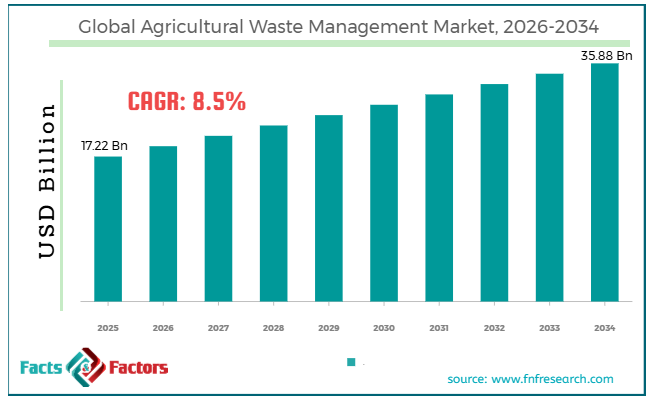
[222+ Pages Report] According to Facts & Factors, the global agricultural waste management market size was worth around USD 17.22 billion in 2025 and is predicted to grow to around USD 35.88 billion by 2034 with a compound annual growth rate (CAGR) of roughly 8.5% between 2026 and 2034.
 Market Overview
The techniques and strategies used to handle the leftovers and agricultural wastes generated during farming activities are referred to as agricultural waste management. Among these wastes include crop remnants, animal manure, agro-industrial effluents, and other organic and inorganic materials. Agricultural waste management aims to improve resource efficiency, encourage sustainability, and reduce harmful environmental effects as much as feasible. An increasing number of factors, including increased agricultural productivity, increased environmental awareness, technology improvements, and economic benefits, are driving the agriculture waste management market.
Key Insights
- As per the analysis shared by our research analyst, the global agricultural waste management market is estimated to grow annually at a CAGR of around 8.5% over the forecast period (2026-2034).
- In terms of revenue, the global agricultural waste management market size was valued at around USD 17.22 billion in 2025 and is projected to reach USD 35.88 billion, by 2034.
- The growing environmental concern is expected to drive market growth over the forecast period.
- Based on the waste type, the agro-industrial waste segment is expected to hold a prominent market share over the forecast period.
- Based on the management services, the collection segment is expected to capture a significant market share over the projected period.
- Based on the treatment process, the composting is expected to grow at a rapid rate over the forecast period.
- Based on region, the Asia Pacific is expected to dominate the market during the forecast period.
Growth Drivers
- Growing environmental concern drives market growth
Waste is a constant problem, and everyone must ensure that waste is as little as possible and that any garbage that is produced is disposed of properly. If not properly disposed of, agricultural waste poses a serious threat to the environment since rural trash can have a detrimental impact on the ecosystem. Aside from the risks associated with burning and landfills, the chemicals used in agriculture and gardening can contaminate areas if they wind up in the wrong places.
For instance, chemicals that promote agricultural growth can contaminate streams and rivers to a large extent. Drinking water can be harmed by contaminated water, which also harms the ecosystem and may cause animal deaths. Thus, the growing environmental concern drives the agricultural waste management market.
Restraints
- High capital allocation and limited awareness hinder market growth
Advanced waste management methods, such as composting facilities or anaerobic digesters, often need a substantial initial capital expenditure to be set up. For small and medium-sized farms, which might not have the financial means to implement such technology, this can be a major obstacle.
Furthermore, there is a lack of knowledge on the advantages and techniques of efficient agricultural waste management in many areas. Farmers and agricultural enterprises may be unaware of all the benefits, both financial and environmental, that come with the technology that is currently accessible. Advanced waste management practice adoption may be slowed by this lack of awareness.
Opportunities
- Government initiatives offer a lucrative opportunity for market growth
The growing government initiative is expected to offer a lucrative opportunity for market growth during the forecast period. For instance, in September 2025, to strengthen initiatives to stop and minimize food loss and waste, the U.S. Department of Agriculture (USDA) announced an additional $25 million commitment. The investment is part of a combined agency project between the USDA's Office of the Chief Economist (OCE) and the National Institute of Food and Agriculture (NIFA), which is funded by the American Rescue Plan Act (ARPA). More than one-third of the food that is available in the US is wasted or goes uneaten due to loss. Opportunities for increased food security, economic expansion, and environmental prosperity are lost when food goes wasted.
Challenges
- Waste Type
Logistical difficulties may arise during the collection, processing, and transportation of agricultural waste, especially in isolated or rural locations. Although it might be challenging to do in less accessible areas, effectively managing the logistics of waste collection and transportation is essential for the financial sustainability of waste management operations.
Report Scope
Report Attribute |
Details |
Market Size in 2025 |
USD 17.22 Billion |
Projected Market Size in 2034 |
USD 35.88 Billion |
CAGR Growth Rate |
8.50% CAGR |
Base Year |
2025 |
Forecast Years |
2026-2034 |
Key Market Players |
FrequentisMontauk Renewables Inc., PYREG systems, WasteFuel Agriculture, Enva, Celitron, Cleanaway, Harby Agriculture Ltd, Mantank Ltd, Advance Hydrau Tech Pvt Ltd., Anaergia, and others. |
Key Segment |
By Waste Type, By Management Services, By Treatment Process, and Region |
Major Regions Covered |
North America, Europe, Asia Pacific, Latin America, and the Middle East &, Africa |
Purchase Options |
Request customized purchase options to meet your research needs. Explore purchase options |
Segmentation Analysis
The global agricultural waste management industry is segmented based on waste type, management services, treatment process and region.
Based on the waste type, the global agricultural waste management market is bifurcated into animal waste, field waste and agro-industrial waste. The agro-industrial waste segment is expected to hold a prominent market share over the forecast period. Due to waste management technologies like anaerobic digestion, composting, and waste-to-energy, the processing of agro-industrial waste has grown more efficient. These technical developments facilitate the process of turning waste into useful byproducts like biogas, organic fertilizers, and bio-based products. Considerable cost reductions and the creation of new revenue streams can also result from the proper handling of agro-industrial waste. One potential source of clean, renewable electricity is waste-to-energy initiatives; another is composting, which can yield excellent nutrients for agricultural use. Thereby, driving the segment growth.
Based on the management services, the global agricultural waste management industry is bifurcated into transportation & storage, collection, treatment process and disposal. The collection segment is expected to capture a significant market share over the projected period. An increase in production levels results in an increase in agricultural waste due to the increased demand for food and agricultural goods worldwide. The growing amount of garbage generated is creating a demand for waste collecting services and systems, which can only be met with efficient collection methods.
Based on the treatment process, the global agricultural waste management market is bifurcated into recycling, composting and incineration. The composting is expected to grow at a rapid rate over the forecast period. One sustainable way to handle organic waste is by composting. By lowering greenhouse gas emissions, recycling nutrients back into the soil, and reducing the amount of waste transported to landfills, it promotes sustainable agriculture practices. The amount of organic waste produced rises along with agricultural productivity. For this waste to be managed and soil health to be improved—both necessary for excellent crop yields—composting offers an acceptable solution.
Regional Analysis
- The Asia Pacific is expected to dominate the market during the forecast period
The Asia Pacific is expected to dominate the market during the forecast period. The Asia Pacific region's agricultural waste management market is expected to grow significantly due to a sizable agricultural base, favorable government regulations, advances in technology, and rising environmental consciousness. The adoption of sophisticated waste management strategies and technology is anticipated to accelerate despite obstacles such as limited infrastructure, budgetary limits, and regulatory difficulties.
To ensure sustainable and effective management of agricultural waste in the area, key trends including the rise in biogas generation, the expansion of composting methods, the creation of integrated systems, and the adoption of smart technologies will continue to shape the industry. Besides, Europe is expected to hold a prominent market share during the forecast period. The increasing emphasis on sustainability is the major reason for the growth of the market in the region.
Competitive Analysis
The global agricultural waste management market is dominated by players like:
- Montauk Renewables Inc.
- PYREG systems
- WasteFuel Agriculture
- Enva
- Celitron
- Cleanaway
- Harby Agriculture Ltd
- Mantank Ltd
- Advance Hydrau Tech Pvt Ltd.
- Anaergia
The global agricultural waste management market is segmented as follows:
By Waste Type
- Animal Waste
- Field Waste
- Agro-industrial Waste
By Management Services
- Transportation & Storage
- Collection
- Treatment Process
- Disposal
By Treatment Process
- Recycling
- Composting
- Incineration
By Region
- North America
- The U.S.
- Canada
- Mexico
- Europe
- France
- The UK
- Spain
- Germany
- Italy
- Rest of Europe
- Asia Pacific
- China
- Japan
- India
- Australia
- Southeast Asia
- Rest of Asia Pacific
- The Middle East & Africa
- Saudi Arabia
- UAE
- Egypt
- Kuwait
- South Africa
- Rest of the Middle East & Africa
- Latin America
- Brazil
- Argentina
- Rest of Latin America
Table of Content
Industry Major Market Players
- Montauk Renewables Inc.
- PYREG systems
- WasteFuel Agriculture
- Enva
- Celitron
- Cleanaway
- Harby Agriculture Ltd
- Mantank Ltd
- Advance Hydrau Tech Pvt Ltd.
- Anaergia



Copyright © 2025 - 2026, All Rights Reserved, Facts and Factors