
Search Market Research Report
Abscisic Acid Market Size, Share Global Analysis Report, 2026-2034

Abscisic Acid Market Size, Share, Growth Analysis Report By Product Type (99% and Above Purity, No Greater Than 99% Purity, and Others), By Application (Fruits and Vegetables, Grains and Pulses, Ornamentals, and Others), By End-User (Farmers, Agricultural Cooperatives, Research Institutions, Agricultural Consultants, and Others), and By Region - Global Industry Insights, Overview, Comprehensive Analysis, Trends, Statistical Research, Market Intelligence, Historical Data and Forecast 2026-2034
Industry Insights
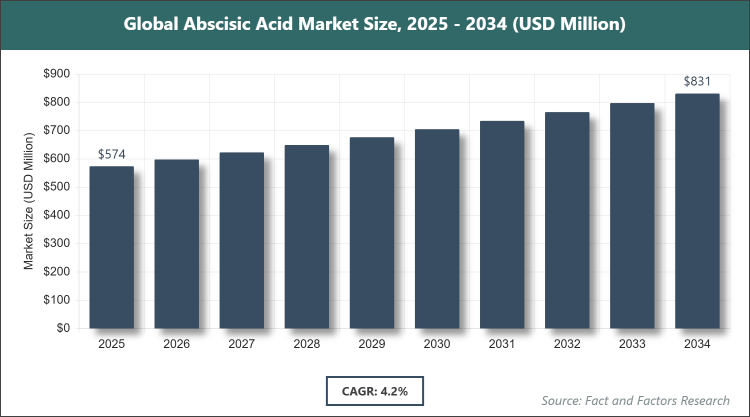
[180+ Pages Report] According to Facts & Factors, the global Abscisic Acid market size was estimated at USD 574 million in 2025 and is expected to reach USD 831 million by 2034, growing at a CAGR of 4.2% from 2026 to 2034. Abscisic Acid Market is driven by increasing adoption of sustainable farming practices and the need for crop stress management.
 Market Overview
The Abscisic Acid (ABA) market encompasses the production, distribution, and application of this plant hormone, which plays a crucial role in regulating plant growth, development, and responses to environmental stresses such as drought, salinity, and temperature fluctuations. ABA is naturally occurring in plants but is commercially synthesized or extracted for use in agriculture, horticulture, and biotechnology to enhance crop resilience, improve yield quality, and extend shelf life. This market serves as a vital component in modern farming techniques, supporting sustainable practices by reducing the reliance on traditional chemical inputs and promoting efficient resource utilization in crop management.
Key Insights
- The global Abscisic Acid market size in terms of revenue was estimated to be worth USD 574 million in 2025 and is poised to reach USD 831 million by 2034.
- Growing at a CAGR of 4.2% during the forecasted period from 2026 to 2034.
- The market is driven by rising demand for crop protection solutions amid climate change impacts and advancements in sustainable agriculture.
- Based on the Product Type segment, the 99% and Above Purity subsegment dominated the market with a share of 60% in 2025, due to its higher efficacy and suitability for precision agriculture applications.
- Based on the Application segment, the Fruits and Vegetables subsegment dominated the market with a share of 40% in 2025, owing to ABA's effectiveness in extending shelf life and reducing post-harvest losses.
- Based on the End-User segment, the Farmers subsegment dominated the market with a share of 70% in 2025, as they are the primary adopters for direct field applications to enhance crop yields.
- The North America region dominated the market with a share of 38.5% in 2025, attributed to advanced agricultural technologies and strong R&D investments.
Growth Drivers
- Increasing Demand for Sustainable Agriculture
The push towards sustainable farming practices has significantly boosted the Abscisic Acid market, as ABA helps in developing stress-tolerant crops without heavy reliance on synthetic chemicals. This hormone enables plants to better withstand abiotic stresses like drought and heat, which are increasingly prevalent due to climate change, thereby improving overall crop productivity and resource efficiency.
Furthermore, with global organic farmland expanding rapidly, ABA's role in promoting natural growth regulation aligns perfectly with eco-friendly initiatives, reducing environmental impact and supporting long-term soil health.
- Advancements in Biotechnology and R&D
Innovations in plant biotechnology have accelerated the adoption of ABA, with ongoing research focusing on its interactions with other hormones to optimize seed germination and crop resilience. Increased investments from governments and private sectors in developing ABA-based products are driving market growth by introducing more effective formulations.
This progress not only enhances ABA's stability and application methods but also expands its use in precision agriculture, where targeted delivery systems improve efficacy and minimize waste.
- Rising Crop Losses Due to Abiotic Stresses
Abiotic stresses such as floods, droughts, and salinity cause substantial crop losses worldwide, prompting farmers to utilize ABA for better stress management. By inducing stomatal closure and regulating water use, ABA helps mitigate these losses, ensuring stable yields even in adverse conditions.
As climate variability intensifies, the demand for ABA as a protective agent continues to rise, particularly in vulnerable agricultural regions, fostering market expansion through necessity-driven adoption.
Restraints
- High Production Costs and Limited Availability
The complex extraction and synthesis processes of ABA result in high production costs, restricting its accessibility for small-scale farmers and price-sensitive markets. This economic barrier hinders widespread adoption, especially in developing regions where cost-effective alternatives are preferred.
Additionally, supply chain limitations and dependency on specialized manufacturing further exacerbate availability issues, leading to inconsistent market penetration and slowed growth potential.
- Lack of Awareness and Education Among Farmers
Many farmers remain unfamiliar with ABA's benefits due to its specialized nature, leading to hesitation in shifting from traditional inputs like fertilizers. This knowledge gap, compounded by inadequate training programs, results in underutilization of ABA in key agricultural areas.
Efforts to bridge this through education are ongoing, but the slow pace of awareness-building continues to restrain market expansion in regions with low technological adoption.
Opportunities
- Expansion in Emerging Markets and Organic Farming
The growing focus on organic farming in emerging economies presents opportunities for ABA, as it supports chemical-free stress management and yield enhancement. Regions with expanding agricultural sectors can leverage ABA to meet rising food demands sustainably.
Moreover, partnerships with local cooperatives could facilitate distribution, tapping into untapped markets and driving revenue through tailored solutions for diverse crop types.
- Integration with Precision Agriculture Technologies
Advancements in precision farming, such as drone-based application and AI-driven monitoring, offer opportunities to optimize ABA usage for maximum efficiency. This integration can reduce application costs and improve outcomes, attracting tech-savvy farmers.
As these technologies become more accessible, the market stands to benefit from increased adoption rates and innovative product developments.
Challenges
- Regulatory and Formulation Stability Issues
Stringent regulations on plant hormones pose challenges, requiring extensive testing and compliance that delay product launches and increase costs. Variations in global standards further complicate market entry for manufacturers.
Additionally, ABA's sensitivity to environmental factors affects formulation stability, reducing its effectiveness in diverse climates and necessitating ongoing R&D to overcome these hurdles.
- Supply Chain Disruptions and Competition from Alternatives
Global supply chain vulnerabilities, including raw material shortages, impact ABA production and distribution, leading to price fluctuations and delivery delays. This instability challenges market reliability.
Competition from other plant growth regulators and traditional methods also pressures the ABA market, requiring differentiation through proven efficacy to maintain competitive edge.
Report Scope
Report Attribute |
Details |
Market Size in 2025 |
USD 574 Million |
Projected Market Size in 2034 |
USD 831 Million |
CAGR Growth Rate |
4.2% CAGR |
Base Year |
2025 |
Forecast Years |
2026-2034 |
Key Market Players |
BASF SE, Sumitomo Chemical Co., Ltd, Syngenta, DuPont, Nufarm, and Others. |
Key Segment |
By Product Type, By Application, By End-User, and By Region |
Major Regions Covered |
North America, Europe, Asia Pacific, Latin America, and the Middle East &, Africa |
Purchase Options |
Request customized purchase options to meet your research needs. Explore purchase options |
Market Segmentation
The Abscisic Acid market is segmented by product type, application, end-user, and region.
Based on Product Type Segment, the Abscisic Acid market is divided into 99% and Above Purity, No Greater Than 99% Purity, and others. The most dominant subsegment is 99% and Above Purity, which holds a significant market share due to its superior efficacy in precision applications and minimal impurities that ensure consistent performance in stress management. The second most dominant is No Greater Than 99% Purity, valued for its cost-effectiveness in bulk farming. These subsegments drive the market by catering to diverse needs; high-purity variants enable advanced biotechnological uses, boosting yields in high-value crops, while lower-purity options make ABA accessible for widespread agricultural adoption, collectively enhancing overall market growth through improved crop resilience and sustainability.
Based on Application Segment, the Abscisic Acid market is divided into Fruits and Vegetables, Grains and Pulses, Ornamentals, and others. The most dominant subsegment is Fruits and Vegetables, leading due to ABA's critical role in extending shelf life and maintaining quality post-harvest, which reduces losses in this perishable sector. The second most dominant is Grains and Pulses, driven by its application in enhancing drought tolerance for staple crops. Together, these drive market expansion by addressing key challenges like food waste and climate resilience, with Fruits and Vegetables pushing innovation in supply chain management and Grains and Pulses supporting global food security.
Based on the end-user segment, the Abscisic Acid market is divided into Farmers, Agricultural Cooperatives, Research Institutions, Agricultural Consultants, and others. The most dominant subsegment is Farmers, commanding the largest share as direct users who apply ABA to improve field-level crop performance and yields. The second most dominant is Agricultural Cooperatives, which facilitates bulk procurement and distribution. These subsegments propel the market by enabling scalable adoption; farmers drive demand through practical applications in everyday farming, while cooperatives enhance accessibility and education, fostering broader integration of ABA in sustainable practices.
Recent Developments
- In August 2020, researchers at IISER Bhopal conducted studies on ABA's interactions with other plant hormones during seed germination, offering potential advancements in agricultural techniques for better crop establishment.
- In 2023, agricultural cooperatives in Asia integrated ABA-based products into rice stress management programs, resulting in improved yields and reduced losses during dry periods.
- In 2022, the European Union launched support schemes for natural plant growth regulators, promoting research and commercial use of ABA to enhance sustainable farming across member states.
Regional Analysis
- North America to dominate the global market
North America holds the dominant position in the Abscisic Acid market, driven by its advanced agricultural infrastructure and substantial investments in biotechnology. The region's focus on precision farming and sustainable practices has accelerated ABA adoption, particularly in addressing climate-induced stresses. The United States, as the dominating country, leads with extensive R&D from institutions and companies, supported by favorable policies that encourage innovation in crop protection. This dominance is further bolstered by a robust supply chain and high awareness among farmers, enabling efficient distribution and application of ABA products across diverse crop types like fruits and grains.
Europe follows as a key market, with strong emphasis on organic and eco-friendly agriculture aligning with ABA's benefits in stress tolerance. Germany stands out as the dominating country, thanks to its leading chemical and agrochemical industries that drive ABA formulation advancements. The region's stringent environmental regulations promote ABA over synthetic alternatives, fostering growth in horticulture and ornamentals. Collaborative efforts between governments and private sectors enhance research, while increasing climate challenges like heatwaves boost demand for ABA in maintaining crop quality and yields.
Asia Pacific is the fastest-growing region, fueled by its vast agricultural base and rising need for resilient crops amid climate variability. China and India dominate, with China leading due to large-scale farming and government initiatives for food security. ABA's role in mitigating drought in rice and wheat production is pivotal, supported by expanding organic farming trends. Rapid urbanization and population growth intensify the focus on yield optimization, positioning the region for significant market expansion through localized production and adoption.
Latin America shows promising growth, driven by its export-oriented agriculture and vulnerability to abiotic stresses. Brazil dominates, leveraging ABA in soybean and fruit cultivation to combat droughts and improve export quality. The region's tropical climate necessitates stress management solutions, with increasing investments in biotech enhancing ABA accessibility. Challenges like supply chain issues persist, but opportunities in sustainable practices are drawing international partnerships.
The Middle East & Africa region is emerging, with ABA gaining traction in arid areas for water-efficient farming. South Africa dominates, applying ABA in vineyards and grains to address water scarcity. Limited infrastructure poses challenges, but international aid and research collaborations are promoting adoption, focusing on drought-tolerant crops to support food security in climate-stressed environments.
Competitive Analysis
The global Abscisic Acid market is dominated by players:
- BASF SE
- Sumitomo Chemical Co., Ltd
- Syngenta
- DuPont
- Nufarm
- Merck KGaA
- Shanghai Bangjing
- Cropenhancement
- Sichuan Longmang Fusheng Biotech
- And Others.
The global Abscisic Acid market is segmented as follows:
-
By Product Type
- 99% and Above Purity
- No Greater Than 99% Purity
-
By Application
- Fruits and Vegetables
- Grains and Pulses
- Ornamentals
- Others
-
By End-User
- Farmers
- Agricultural Cooperatives
- Research Institutions
- Agricultural Consultants
- Others
By Region
- North America
- The U.S.
- Canada
- Mexico
- Europe
- France
- The UK
- Spain
- Germany
- Italy
- Rest of Europe
- Asia Pacific
- China
- Japan
- India
- Australia
- Southeast Asia
- Rest of Asia Pacific
- The Middle East & Africa
- Saudi Arabia
- UAE
- Egypt
- Kuwait
- South Africa
- Rest of the Middle East & Africa
- Latin America
- Brazil
- Argentina
- Rest of Latin America
Table of Content
Industry Major Market Players



Copyright © 2025 - 2026, All Rights Reserved, Facts and Factors