
Search Market Research Report
Test Automation Market Size, Share Global Analysis Report, 2026-2034

Test Automation Market Size, Share, Growth Analysis Report By Component (Solutions, Services), By Testing Type (Functional Testing, Non-Functional Testing), By End-User (BFSI, IT & Telecom, Manufacturing, Retail, Healthcare, Government, Others), and By Region - Global Industry Insights, Overview, Comprehensive Analysis, Trends, Statistical Research, Market Intelligence, Historical Data and Forecast 2026-2034
Industry Insights
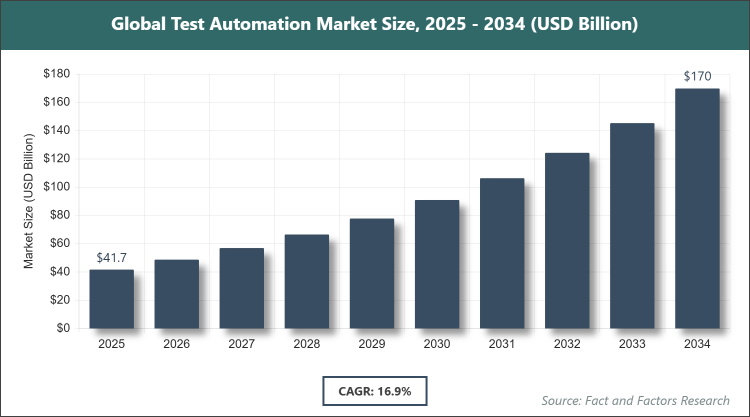
[235+ Pages Report] According to Facts & Factors, the global test automation market size was estimated at USD 41.67 billion in 2025 and is expected to reach USD 169.33 billion by the end of 2034. The test automation industry is anticipated to grow by a CAGR of 16.9% between 2026 and 2034. The test automation Market is driven by increasing adoption of agile and DevOps methodologies for faster software delivery.
 Market Overview
The test automation market encompasses the tools, frameworks, and services used to automate the execution of tests on software applications to ensure quality, efficiency, and reliability without manual intervention. It involves scripting and running repetitive test cases across various environments, such as web, mobile, and desktop applications, to detect defects early in the development lifecycle. This market supports continuous integration and delivery practices, reducing time-to-market and enhancing overall software performance.
Key Insights
- As per the analysis shared by our research analyst, the global test automation market is estimated to grow annually at a CAGR of around 16.9% over the forecast period (2026-2034).
- In terms of revenue, the global test automation market size was valued at around USD 41.67 billion in 2025 and is projected to reach USD 169.33 billion by 2034.
- The test automation market is driven by rising demand for faster software releases and quality assurance in agile environments.
- Based on the component, the services segment dominated the market with a share of 55% in 2025 owing to the growing need for managed and professional services to implement and maintain automation frameworks.
- Based on the testing type, the functional testing segment dominated the market with a share of 65% in 2025 owing to its essential role in verifying core application features and ensuring alignment with business requirements.
- Based on the end-user, the IT & telecom segment dominated the market with a share of 30% in 2025 owing to high software complexity and frequent updates in telecommunications infrastructure.
- North America dominated the global market with a share of 38% in 2025 owing to advanced technological adoption, presence of major players, and strong emphasis on innovation in software development.
Growth Drivers
- Increasing Adoption of Agile and DevOps Practices
The shift towards agile and DevOps methodologies has significantly boosted the test automation market by enabling continuous testing and integration, which accelerates development cycles and improves software quality.
This approach allows teams to detect and resolve issues early, reducing costs associated with late-stage fixes and enhancing collaboration between development and operations. As organizations prioritize speed and efficiency, the demand for automated testing tools that support these practices continues to rise, driving market expansion across industries.
Restraints
- High Initial Implementation Costs
The substantial upfront investment required for test automation tools, training, and infrastructure poses a barrier for small and medium-sized enterprises, limiting widespread adoption.
Organizations often face challenges in justifying these costs without immediate returns, especially when integrating automation into existing systems. Additionally, the need for skilled personnel to develop and maintain scripts further increases expenses, potentially slowing market growth in cost-sensitive regions or sectors.
Opportunities
- Integration of AI and Machine Learning in Testing
The incorporation of AI and ML technologies offers opportunities to enhance test automation by enabling intelligent test case generation, predictive analytics, and self-healing scripts that adapt to changes.
This innovation reduces manual effort, improves accuracy, and handles complex scenarios more effectively. As AI-driven tools become more accessible, they open new avenues for market players to develop advanced solutions, attracting industries seeking to optimize testing processes and achieve higher efficiency.
Challenges
- Skill Gaps and Talent Shortages
A shortage of skilled professionals proficient in automation tools and scripting languages hinders effective implementation and maintenance of test automation strategies.
This challenge is exacerbated by the rapid evolution of technologies, requiring continuous upskilling. Organizations struggle to find talent capable of managing sophisticated automation environments, which can lead to underutilization of tools and increased dependency on external services, impacting overall market progress.
Report Scope
Report Attribute |
Details |
Market Size 2025 |
USD 41.67 Billion |
Projected Market Size in 2034 |
USD 169.33 Billion |
CAGR Growth Rate |
16.9% CAGR |
Base Year |
2025 |
Forecast Years |
2026-2034 |
Key Market Players |
Accenture, IBM, Tricentis, Capgemini, Microsoft, SmartBear Software, Cognizant, Micro Focus, Parasoft, Cigniti Technologies, and Others. |
Key Segment |
By Component, By Testing Type, By End-User, and By Region |
Major Regions Covered |
North America, Europe, Asia Pacific, Latin America, and the Middle East & Africa |
Purchase Options |
Request customized purchase options to meet your research needs. Explore purchase options |
Market Segmentation
The test automation market is segmented by component, testing type, end-user, and region.
Based on Component Segment, the test automation market is divided into solutions and services. The solutions segment includes software tools and platforms that enable automated test execution, while services encompass consulting, implementation, and support. Solutions dominate due to their core functionality in providing reusable frameworks and integrations that streamline testing processes, driving market growth by reducing manual efforts and improving scalability. Services follow as the second dominant, aiding organizations in customizing and maintaining these solutions for optimal performance.
Based on Testing Type Segment, the test automation market is divided into functional testing and non-functional testing. Functional testing verifies that software features work as intended, while non-functional assesses aspects like performance and security. Functional testing is most dominant because it directly ensures application usability and requirement fulfillment, crucial for user satisfaction and market competitiveness. Non-functional testing ranks second, supporting reliability in high-load environments and contributing to overall quality assurance.
Based on End-User Segment, the test automation market is divided into BFSI, IT & telecom, manufacturing, retail, healthcare, government, and others. In BFSI, automation ensures secure and compliant transactions; IT & telecom focuses on network reliability; manufacturing tests embedded systems; retail optimizes e-commerce platforms; healthcare validates patient data systems; government enhances public service apps. IT & telecom dominates due to constant innovation and high-stakes connectivity needs, propelling market demand. BFSI is second dominant, driven by regulatory requirements and the need for error-free financial operations.
Recent Developments
- In December 2025, Perfecto by Perforce expanded its device lab with 300 IoT endpoints, including smart-home and industrial sensors, to support over-the-air firmware testing for edge deployments.
- In October 2025, Tricentis acquired Virtuoso QA, integrating natural-language test authoring into its Continuous Testing Platform to broaden accessibility for business analysts.
- In August 2025, IBM advanced its AI-enabled testing suite with new predictive analytics features to anticipate defects and optimize test coverage in cloud-native applications.
Regional Analysis
- North America to dominate the global market
North America leads the test automation market due to its robust technological ecosystem, with the United States as the dominating country, fostering innovation through major tech hubs like Silicon Valley. The region's emphasis on digital transformation, coupled with high investments in AI and cloud computing, accelerates adoption across industries. Strong regulatory frameworks and a skilled workforce further enhance implementation, ensuring efficient software development and quality assurance practices that drive sustained growth.
Europe exhibits strong growth in test automation, with Germany dominating through its engineering prowess and focus on Industry 4.0 initiatives. The region benefits from collaborative R&D efforts and stringent data privacy regulations like GDPR, which necessitate reliable testing solutions. Increasing adoption of agile methodologies among enterprises promotes automation, while diverse markets in the UK and France contribute to innovation, supporting comprehensive quality assurance in software deployment.
Asia Pacific is rapidly expanding in the test automation market, led by China with its massive tech manufacturing base and government-backed digital initiatives. The region's burgeoning startup ecosystem and rising mobile penetration drive demand for efficient testing tools. India's IT services dominance adds momentum through cost-effective solutions, while Japan's precision engineering influences high-quality automation adoption, collectively fostering a dynamic environment for market evolution.
Latin America shows emerging potential in test automation, with Brazil dominating via its growing fintech and e-commerce sectors. The region leverages increasing internet access and digitalization efforts to adopt automation for improved software reliability. Challenges like infrastructure gaps are offset by foreign investments and local talent development, enabling gradual integration of advanced testing practices across industries to enhance competitiveness.
The Middle East & Africa region is progressing in test automation, dominated by the UAE through its smart city projects and tech diversification strategies. Oil-rich economies invest in digital transformation to reduce dependency, promoting automation for secure and efficient software systems. Africa's rising mobile economy, particularly in South Africa, drives demand, while regional collaborations aim to build skills and infrastructure for broader adoption.
Competitive Analysis
The global test automation market is dominated by players:
- Accenture
- IBM
- Tricentis
- Capgemini
- Microsoft
- SmartBear Software
- Cognizant
- Micro Focus
- Parasoft
- Cigniti Technologies
- And Others
The global test automation market is segmented as follows:
By Component
- Solutions
- Services
By Testing Type
- Functional Testing
- Non-Functional Testing
By End-User
- BFSI
- IT & Telecom
- Manufacturing
- Retail
- Healthcare
- Government
- Others
By Region
- North America
- The U.S.
- Canada
- Mexico
- Europe
- France
- The UK
- Spain
- Germany
- Italy
- Rest of Europe
- Asia Pacific
- China
- Japan
- India
- Australia
- Southeast Asia
- Rest of Asia Pacific
- The Middle East & Africa
- Saudi Arabia
- UAE
- Egypt
- Kuwait
- South Africa
- Rest of the Middle East & Africa
- Latin America
- Brazil
- Argentina
- Rest of Latin America
Industry Major Market Players
The global test automation market is dominated by players:
- Accenture
- IBM
- Tricentis
- Capgemini
- Microsoft
- SmartBear Software
- Cognizant
- Micro Focus
- Parasoft
- Cigniti Technologies
- Others
Frequently Asked Questions



Copyright © 2025 - 2026, All Rights Reserved, Facts and Factors