
Search Market Research Report
Subscription and Billing Management Market Size, Share Global Analysis Report, 2026-2034

Subscription and Billing Management Market Size, Share, Growth Analysis Report By Component (Software and Services), By Deployment Mode (Cloud and On-Premises), By Organization Size (Large Enterprises and SMEs), By Vertical (IT and Telecom, Retail and eCommerce, BFSI, Media and Entertainment, Healthcare, and Others), and By Region - Global Industry Insights, Overview, Comprehensive Analysis, Trends, Statistical Research, Market Intelligence, Historical Data and Forecast 2026-2034
Industry Insights
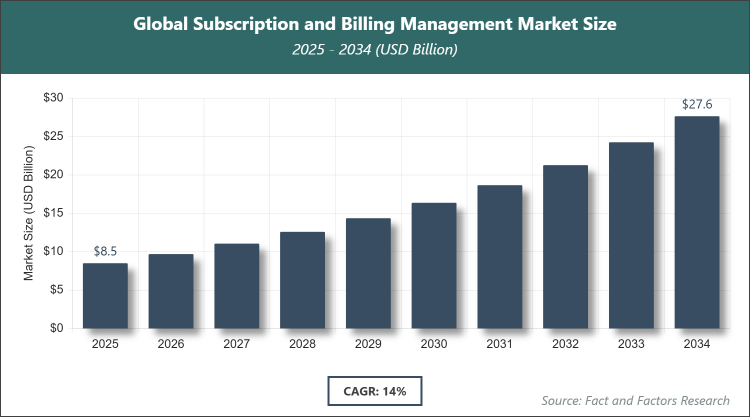
[225+ Pages Report] According to Facts & Factors, the global subscription and billing management market size was estimated at USD 8.5 billion in 2025 and is expected to reach USD 27.6 billion by the end of 2034. The subscription and billing management industry is anticipated to grow by a CAGR of 14% between 2026 and 2034. The subscription and billing management Market is driven by increasing adoption of subscription-based business models across various industries.
 Market Overview
Subscription and billing management encompasses the systems, processes, and technologies designed to handle recurring revenue models, including subscription enrollment, invoicing, payment processing, revenue recognition, and customer relationship management. It enables businesses to automate billing cycles, manage customer subscriptions efficiently, ensure compliance with financial regulations, and provide seamless experiences for subscribers across diverse industries. This market focuses on solutions that support the shift from one-time purchases to ongoing, predictable revenue streams, facilitating scalability and customer retention in a digital economy.
Key Insights
• As per the analysis shared by our research analyst, the global subscription and billing management market is estimated to grow annually at a CAGR of around 14% over the forecast period (2026-2034).
• In terms of revenue, the global subscription and billing management market size was valued at around USD 8.5 billion in 2025 and is projected to reach USD 27.6 billion by 2034.
• The market is driven by the rising adoption of subscription-based business models, increasing demand for cloud-based solutions, and the need for automated billing to reduce churn and enhance customer retention.
• Based on the component, the software segment dominated the market in 2025 with a share of 79% due to its essential role in automating core functions like order management and pricing, which are critical for efficient revenue operations.
• Based on the deployment mode, the cloud segment dominated the market in 2025 with a share of 75% due to its scalability, cost-effectiveness, and ease of integration with existing systems, appealing to businesses seeking flexible solutions.
• Based on the organization size, the large enterprises segment dominated the market in 2025 with a share of 65% due to their complex billing needs and ability to invest in advanced management platforms.
• Based on the vertical, the IT and telecom segment dominated the market in 2025 with a share of 30% due to the high volume of recurring services and the need for real-time billing in dynamic environments.
• North America dominated the global market in 2025 with a share of 31% due to advanced technological infrastructure, high adoption of subscription models, and presence of key players driving innovation.
Growth Drivers
- Rising Adoption of Subscription Business Models
The proliferation of subscription-based services across sectors such as media, software, and e-commerce has significantly boosted the demand for robust billing management solutions. Businesses are transitioning from traditional one-time sales to recurring revenue models to ensure steady cash flow and foster long-term customer relationships.
This shift necessitates advanced tools for handling complex pricing structures, automated renewals, and personalized offerings, thereby driving market growth. Additionally, the integration of AI and analytics in these systems enhances predictive capabilities, helping companies anticipate customer behavior and optimize revenue strategies.
Restraints
- Integration Complexities with Legacy Systems
Many organizations still rely on outdated infrastructure, making it challenging to integrate modern subscription and billing management solutions seamlessly. This can lead to increased implementation costs, prolonged deployment times, and potential disruptions in operations.
Furthermore, compatibility issues may result in data silos, hindering real-time visibility and accurate revenue reporting, which restrains broader adoption among enterprises hesitant to overhaul their existing setups.
Opportunities
- Emergence of AI and Machine Learning Innovations
The incorporation of AI-driven features, such as predictive analytics for churn reduction and dynamic pricing, presents substantial opportunities for market expansion. These technologies enable more intelligent billing processes, fraud detection, and customer personalization.
As businesses seek competitive edges, investing in AI-enhanced platforms can open new revenue streams and improve operational efficiency, particularly in emerging markets where digital transformation is accelerating.
Challenges
- Data Security and Compliance Concerns
With the handling of sensitive financial and customer data, ensuring robust security measures against breaches and adhering to varying global regulations like GDPR and PCI-DSS pose significant challenges. Non-compliance can lead to hefty fines and loss of trust.
Moreover, the rise in cyber threats targeting payment systems requires continuous investment in security protocols, which can strain resources for smaller players in the market.
Report Scope
Report Attribute |
Details |
Market Size 2025 |
USD 8.5 Billion |
Projected Market Size in 2034 |
USD 27.6 Billion |
CAGR Growth Rate |
14% CAGR |
Base Year |
2025 |
Forecast Years |
2026-2034 |
Key Market Players |
Zuora, Chargebee, Recurly, Stripe, Aria Systems, Oracle, SAP, BillingPlatform, Cleverbridge, Fusebill, and Others. |
Key Segment |
By Component, By Deployment Mode, By Organization Size, By Vertical, and By Region |
Major Regions Covered |
North America, Europe, Asia Pacific, Latin America, and the Middle East & Africa |
Purchase Options |
Request customized purchase options to meet your research needs. Explore purchase options |
Market Segmentation
The subscription and billing management market is segmented by component, deployment mode, organization size, vertical, and region.
Based on Component Segment, the subscription and billing management market is divided into software and services. The software segment is the most dominant, holding a significant market share due to its core functionality in automating billing, order management, and revenue recognition processes. It drives the market by providing scalable tools that reduce manual errors and support complex pricing models, essential for businesses managing high volumes of subscriptions. The services segment is the second most dominant, offering implementation, consulting, and maintenance support that ensures seamless integration and ongoing optimization, helping companies maximize the value from their software investments and adapt to evolving needs.
Based on Deployment Mode Segment, the subscription and billing management market is divided into cloud and on-premises. The cloud segment is the most dominant, capturing the largest share owing to its flexibility, lower upfront costs, and automatic updates, which enable rapid deployment and scalability for growing businesses. It propels market growth by facilitating remote access and integration with other cloud services, ideal for dynamic environments. The on-premises segment is the second most dominant, preferred by organizations requiring high data control and customization, contributing to the market by addressing security-sensitive industries while supporting legacy system compatibility.
Based on Organization Size Segment, the subscription and billing management market is divided into large enterprises and SMEs. The large enterprises segment is the most dominant, with a substantial share driven by their need for comprehensive, enterprise-grade solutions to handle complex, global subscription operations. It accelerates market expansion through investments in advanced features like multi-currency support and analytics, enhancing efficiency at scale. The SMEs segment is the second most dominant, growing rapidly as affordable cloud-based options lower entry barriers, aiding smaller businesses in adopting subscription models to compete effectively and drive overall market accessibility.
Based on Vertical Segment, the subscription and billing management market is divided into IT and telecom, retail and eCommerce, BFSI, media and entertainment, healthcare, and others. The IT and telecom segment is the most dominant, leading with its high reliance on recurring services and real-time billing, which fuels market growth by demanding innovative solutions for usage-based pricing and customer retention. The retail and eCommerce segment is the second most dominant, benefiting from the surge in online subscriptions and personalized offerings, contributing to the market by enabling seamless payment experiences that boost consumer loyalty and revenue predictability.
Recent Developments
- In June 2024, Aria Systems Inc. launched Aria Billing Studio for ServiceNow, an integrated solution that streamlines the customer revenue lifecycle by enabling ServiceNow users to manage order-to-cash-to-care processes across industries using Aria Billing Cloud.
- In April 2024, Recurly Inc. launched new dashboards with built-in benchmarking, using insights from 60+ million subscribers to help merchants identify growth opportunities and make data-driven decisions in the subscription market.
- In March 2024, Mastercard streamlined subscription management with an open banking-powered service called Smart Subscriptions, integrating effortlessly with financial institutions' consumer banking services to meet growing consumer demand for better control over subscriptions.
- In January 2024, BillingPlatform received a USD 90 million growth equity investment from FTV Capital, aimed at accelerating product innovation and expanding its enterprise revenue lifecycle management platform.
Regional Analysis
- North America to dominate the global market
North America stands out as a leading region in the subscription and billing management market, primarily due to its advanced technological ecosystem and early adoption of digital transformation initiatives. The United States, as the dominating country, benefits from a robust presence of tech giants and innovative startups that drive solution development. High consumer demand for subscription services in entertainment, software, and e-commerce further propels growth, supported by strong infrastructure and favorable regulatory environments that encourage investment in cloud and AI technologies.
Europe exhibits steady expansion, with a focus on compliance and data privacy driving the adoption of sophisticated billing solutions. Germany emerges as the dominating country, leveraging its industrial strength and emphasis on efficient business processes. The region's diverse markets foster innovation in multi-currency and localized billing, while increasing SME adoption of cloud platforms enhances accessibility. Collaborative efforts among EU countries to standardize regulations also contribute to a cohesive market landscape, promoting cross-border subscription models.
Asia Pacific is experiencing rapid growth, fueled by digitalization and a burgeoning e-commerce sector. China dominates as the key country, with its massive consumer base and tech-savvy population accelerating subscription adoption in media and telecom. The region's economic diversity allows for tailored solutions, from affordable cloud options for SMEs to enterprise-grade systems for large firms. Government initiatives promoting digital economies further amplify opportunities, positioning Asia Pacific as a high-potential area for market expansion.
Latin America shows promising development, driven by increasing internet penetration and mobile usage. Brazil leads as the dominating country, with its vibrant e-commerce and fintech scenes boosting demand for flexible billing management. Challenges like economic variability are offset by opportunities in emerging subscription services, particularly in retail and entertainment. Investments in cloud infrastructure are enhancing accessibility, enabling businesses to scale operations and improve customer engagement in this dynamic region.
The Middle East & Africa region is gradually advancing, with a focus on telecom and financial services leading the way. The United Arab Emirates dominates, thanks to its forward-thinking digital agenda and investments in smart cities. Adoption is spurred by the need for efficient revenue management in growing subscription economies, though infrastructure gaps pose hurdles. Opportunities arise from partnerships with global players, fostering innovation and helping bridge the digital divide across diverse markets.
Competitive Analysis
The global subscription and billing management market is dominated by players:
- Zuora
- Chargebee
- Recurly
- Stripe
- Aria Systems
- Oracle
- SAP
- BillingPlatform
- Cleverbridge
- Fusebill
The global subscription and billing management market is segmented as follows:
By Component
- Software
- Services
By Deployment Mode
- Cloud
- On-Premises
By Organization Size
- Large Enterprises
- SMEs
By Vertical
- IT and Telecom
- Retail and eCommerce
- BFSI
- Media and Entertainment
- Healthcare
- Others
By Region
- North America
- The U.S.
- Canada
- Mexico
- Europe
- France
- The UK
- Spain
- Germany
- Italy
- Rest of Europe
- Asia Pacific
- China
- Japan
- India
- Australia
- Southeast Asia
- Rest of Asia Pacific
- The Middle East & Africa
- Saudi Arabia
- UAE
- Egypt
- Kuwait
- South Africa
- Rest of the Middle East & Africa
- Latin America
- Brazil
- Argentina
- Rest of Latin America
Industry Major Market Players
The global subscription and billing management market is dominated by players:
- Zuora
- Chargebee
- Recurly
- Stripe
- Aria Systems
- Oracle
- SAP
- BillingPlatform
- Cleverbridge
- Fusebill
Frequently Asked Questions



Copyright © 2025 - 2026, All Rights Reserved, Facts and Factors