
Search Market Research Report
Sports Betting Market Size, Share Global Analysis Report, 2026-2034

Sports Betting Market Size, Share, Growth Analysis Report By Platform (Online, Offline, and Others), By Betting Type (Fixed Odds Wagering, Exchange Betting, Live/In-Play Betting, eSports Betting, and Others), By Sports Type (Football, Basketball, Baseball, Horse Racing, Cricket, Hockey, and Others), and By Region - Global Industry Insights, Overview, Comprehensive Analysis, Trends, Statistical Research, Market Intelligence, Historical Data and Forecast 2026-2034
Industry Insights
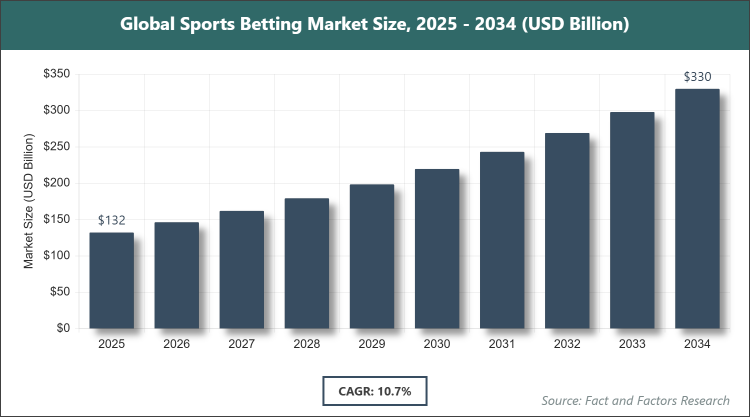
[250+ Pages Report] According to Facts & Factors, the global Sports Betting market size was estimated at USD 132.1 billion in 2025 and is expected to reach USD 329.6 billion by 2034, growing at a CAGR of 10.7% from 2026 to 2034. Sports Betting Market is driven by increasing legalization, technological advancements in mobile platforms, and rising popularity of live betting.
 Market Overview
The sports betting market encompasses the industry involved in wagering on the outcomes of various sporting events, including traditional sports like football and basketball, as well as emerging categories such as eSports, through both online and offline platforms. It involves a range of betting types, from fixed odds to live in-play wagers, facilitated by operators who provide odds, manage risks, and ensure regulatory compliance to offer secure and engaging experiences for bettors seeking entertainment and potential financial gains.
Key Insights
- The global Sports Betting market was valued at USD 132.1 billion in 2025 and is projected to reach USD 329.6 billion by 2034.
- The market is expected to grow at a CAGR of 10.7% during the forecast period from 2026 to 2034.
- The market is driven by regulatory reforms enabling legalization, surge in mobile and online platforms, and integration of advanced technologies like AI and blockchain.
- Based on the Platform segment, Online subsegment dominated with 78% share due to convenience, accessibility via smartphones, and real-time betting features.
- Based on the Betting Type segment, Fixed Odds Wagering subsegment dominated with 40% share owing to its simplicity, transparency, and widespread adoption among casual bettors.
- Based on the Sports Type segment, Football subsegment dominated with 35% share because of its global fan base and frequent international tournaments.
- Europe dominated the global market with 48% share attributed to established regulatory frameworks and high consumer engagement in countries like the UK and Germany.
Growth Drivers
- Legalization and Regulatory Reforms
The progressive legalization of sports betting in regions like North America and parts of Asia-Pacific has opened new markets, attracting investments and increasing consumer participation through licensed operators. This shift from illicit to regulated betting enhances trust and generates tax revenues, fostering a stable environment for growth.
Moreover, partnerships between betting firms and sports leagues for data rights and sponsorships amplify visibility and integration, driving user acquisition. As more jurisdictions recognize economic benefits, the market expands with innovative offerings tailored to local preferences.
Restraints
- Concerns Over Gambling Addiction and Regulatory Scrutiny
Rising awareness of problem gambling leads to stricter regulations, including advertising bans and mandatory responsible gaming tools, which increase operational costs for operators. These measures can limit marketing reach and slow user growth in mature markets.
Additionally, varying compliance requirements across jurisdictions create barriers for global expansion, with potential fines for non-adherence deterring investments. Economic downturns may also reduce disposable income for betting, further constraining market potential.
Opportunities
- Technological Advancements in AI and VR
Integration of AI for personalized odds and predictive analytics, alongside VR for immersive betting experiences, presents opportunities to enhance user engagement and differentiate platforms. This appeals to tech-savvy millennials and Gen Z, expanding the demographic base.
Furthermore, blockchain for secure, transparent transactions and cryptocurrency payments can attract international users, bypassing traditional banking hurdles. As eSports gains traction, specialized betting on virtual events offers untapped revenue streams.
Challenges
- Competition from Illegal Betting and Fraud Risks
Persistent underground betting markets in unregulated regions undercut legal operators by offering better odds without taxes, eroding market share. Cybersecurity threats, including fraud and data breaches, undermine user confidence and require costly defenses.
In addition, fluctuating sports event schedules due to external factors like pandemics disrupt betting volumes, while ethical concerns over match-fixing scandals pose reputational risks. Balancing innovation with robust security remains a key challenge.
Report Scope
Report Attribute |
Details |
Market Size in 2025 |
USD 132.1 Billion |
Projected Market Size in 2034 |
USD 329.6 Billion |
CAGR Growth Rate |
10.7% CAGR |
Base Year |
2025 |
Forecast Years |
2026-2034 |
Key Market Players |
Flutter Entertainment, Bet365, DraftKings, MGM Resorts, Caesars Entertainment, Entain, Kindred Group, 888 Holdings, Aristocrat, Betsson AB, Churchill Downs Incorporated, IGT, Sportech Plc, William Hill Plc, and Others. |
Key Segment |
By Platform, By Betting Type, By Sports Type, and By Region |
Major Regions Covered |
North America, Europe, Asia Pacific, Latin America, and the Middle East &, Africa |
Purchase Options |
Request customized purchase options to meet your research needs. Explore purchase options |
Market Segmentation
The Sports Betting market is segmented by platform, betting type, sports type, and region.
Based on Platform Segment, the Sports Betting market is divided into Online, Offline, and Others. The most dominant subsegment is Online, holding approximately 78% market share, primarily due to its convenience, 24/7 accessibility, and features like live streaming and instant payouts that attract a digital-native audience; this dominance drives the market by enabling global reach and data-driven personalization that boosts user retention and revenue. The second most dominant is Offline, with around 22% share, favored for its social atmosphere in casinos and betting shops, providing trust through physical interactions; it contributes to market growth by serving demographics less comfortable with technology and complementing online channels in hybrid models.
Based on Betting Type Segment, the Sports Betting market is divided into Fixed Odds Wagering, Exchange Betting, Live/In-Play Betting, eSports Betting, and Others. Fixed Odds Wagering dominates with about 40% share, driven by its straightforward structure where bettors know potential returns upfront, making it accessible for beginners; it propels market expansion by building user confidence and encouraging frequent participation across various sports. Live/In-Play Betting follows as the second dominant with 30% share, offering dynamic wagering during events with real-time odds adjustments; this helps drive the market through heightened excitement and higher bet volumes, especially with mobile integration.
Based on the Sports Type Segment, the Sports Betting market is divided into Football, Basketball, Baseball, Horse Racing, Cricket, Hockey, and Others. Football leads with roughly 35% share, attributed to its massive global following and year-round leagues that generate consistent betting interest; this segment boosts the overall market by attracting diverse bettors and facilitating cross-promotions with media. Basketball ranks second with 20% share, benefiting from fast-paced action and in-play opportunities in leagues like the NBA; it drives growth by appealing to younger audiences through analytics and prop bets that enhance engagement.
Recent Developments
- In September 2025, Flutter Entertainment expanded its FanDuel platform with new AI-driven personalization features, enhancing user experience and reporting a 25% increase in engagement metrics.
- In July 2025, DraftKings acquired a smaller prediction market operator to integrate non-sports betting options, aiming to diversify revenue amid regulatory changes in the US.
- In January 2026, Bet365 launched blockchain-based wagering in select European markets, focusing on secure crypto transactions to attract tech-savvy users.
Regional Analysis
- Europe to dominate the global market
Europe maintains dominance with over 48% market share, supported by mature regulatory environments that promote fair play and innovation, with the UK leading through its Gambling Commission oversight that ensures consumer protection and operator accountability. Germany's Interstate Treaty on Gambling facilitates a structured market, emphasizing responsible betting and driving growth in online platforms amid high football wagering.
North America exhibits rapid expansion, with the US as the dominating country following statewide legalizations post-PASPA repeal, where states like New Jersey and Pennsylvania generate billions in revenue through mobile apps, bolstered by partnerships with leagues like the NFL for data integrity and fan engagement.
Asia-Pacific grows swiftly, led by Australia with its established betting culture and regulatory body AUSTRAC enforcing anti-money laundering, while India's emerging market benefits from cricket's popularity, though navigating state-level restrictions to tap into a vast mobile user base.
Latin America progresses steadily, with Brazil dominating via recent federal regulations enabling licensed operators, focusing on football betting in urban centers like Sao Paulo to combat illegal markets and boost tax revenues.
The Middle East & Africa remains nascent, with South Africa leading through its National Gambling Board, emphasizing horse racing and casino integrations in Johannesburg, supported by tourism-driven initiatives despite cultural and regulatory hurdles.
Competitive Analysis
The global Sports Betting market is dominated by players:
- Flutter Entertainment
- Bet365
- DraftKings
- MGM Resorts
- Caesars Entertainment
- Entain
- Kindred Group
- 888 Holdings
- Aristocrat
- Betsson AB
- Churchill Downs Incorporated
- IGT
- Sportech Plc
- William Hill Plc
The global Sports Betting market is segmented as follows:
By Platform
- Online
- Offline
- Others
By Betting Type
- Fixed Odds Wagering
- Exchange Betting
- Live/In-Play Betting
- eSports Betting
- Others
By Sports Type
- Football
- Basketball
- Baseball
- Horse Racing
- Cricket
- Hockey
- Others
By Regional
- North America
- The U.S.
- Canada
- Mexico
- Europe
- France
- The UK
- Spain
- Germany
- Italy
- Rest of Europe
- Asia Pacific
- China
- Japan
- India
- Australia
- Southeast Asia
- Rest of Asia Pacific
- The Middle East & Africa
- Saudi Arabia
- UAE
- Egypt
- Kuwait
- South Africa
- Rest of the Middle East & Africa
- Latin America
- Brazil
- Argentina
- Rest of Latin America
Industry Major Market Players
Frequently Asked Questions



Copyright © 2025 - 2026, All Rights Reserved, Facts and Factors