
Search Market Research Report
Speed Doors Market Size, Share Global Analysis Report, 2026-2034

Speed Doors Market Size, Share, Growth Analysis Report By Type (High-Speed Roll-Up Doors, High-Speed Folding Doors, High-Speed Spiral Doors, High-Speed Sectional Doors, High-Speed Freezer Doors, and Others), By Application (Logistics & Warehousing, Food & Beverage, Pharmaceuticals & Cleanrooms, Automotive, Cold Storage Facilities, and Others), By End-User (Industrial Facilities, Commercial Buildings, Logistics Providers, Food Processing Plants, Healthcare & Laboratories, and Others), and By Region - Global Industry Insights, Overview, Comprehensive Analysis, Trends, Statistical Research, Market Intelligence, Historical Data and Forecast 2026-2034
Industry Insights
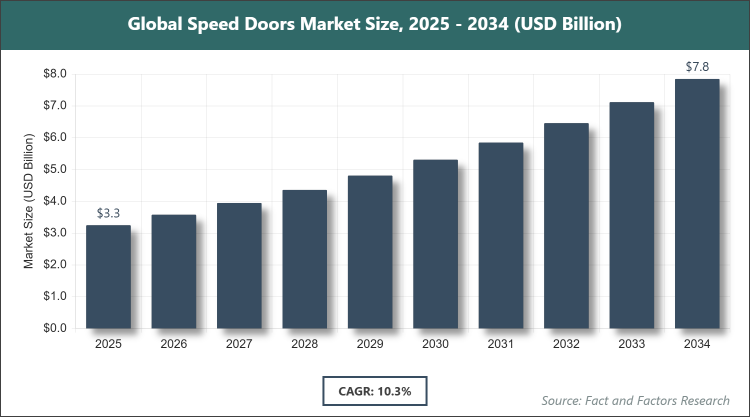
[241 + Pages Report] According to Facts & Factors, the global Speed Doors market size was estimated at USD 3.25 billion in 2025 and is expected to reach USD 7.85 billion by the end of 2034. The Speed Doors industry is anticipated to grow by a CAGR of 10.3% between 2026 and 2034. The Speed Doors Market is driven by booming e-commerce logistics, stringent hygiene and energy-efficiency regulations in food/pharma industries, and the need for rapid, automated access in high-traffic industrial environments.
 Market Overview
The Speed Doors market covers high-performance, automated industrial doors engineered to open and close at speeds of 1–4 meters per second, minimizing air exchange, reducing energy loss, improving workflow efficiency, and enhancing safety in temperature-controlled or high-traffic facilities. These doors are constructed with flexible PVC curtains, rigid panels, or spiral designs and incorporate sensors, frequency inverters, and safety light grids for contactless operation. They are widely deployed where conventional doors would cause downtime, contamination, or excessive heating/cooling costs, serving as critical infrastructure in modern logistics, food processing, pharmaceutical cleanrooms, cold storage, and automotive assembly lines.
Key Insights
- As per the analysis shared by our research analyst, the Speed Doors market is estimated to grow annually at a CAGR of around 10.3% over the forecast period (2026-2034).
- In terms of revenue, the Speed Doors market size was valued at around USD 3.25 billion in 2025 and is projected to reach USD 7.85 billion by 2034.
- The Speed Doors Market is driven by rapid e-commerce growth and hygiene requirements in the food & pharma sectors.
- Based on the Type, the High-Speed Roll-Up Doors segment dominated the market in 2025 with a share of 52% due to their versatility, lower cost, and suitability for the majority of logistics and industrial doorways.
- Based on the Application, the Logistics & Warehousing segment dominated the market in 2025 with a share of 47%, owing to explosive e-commerce volume requiring fast, energy-efficient access points.
- Based on the End-User, the Industrial Facilities segment dominated the market in 2025 with a share of 61% because manufacturing plants and distribution centers prioritize operational uptime and safety.
- Asia Pacific dominated the global Speed Doors market in 2025 with a share of 44% attributed to massive warehouse expansion, manufacturing growth, and rising adoption of automation in China, India, and Southeast Asia.
Growth Drivers
- E-commerce and Logistics Boom
The surge in online retail has multiplied the number of distribution centers and cross-docking facilities, where speed doors reduce cycle times, maintain temperature zones, and improve forklift safety.
Stringent hygiene regulations in food processing and pharmaceutical plants mandate rapid, contactless door operation to minimize airborne contamination and energy loss.
Restraints
- High Initial Installation Cost
Premium high-speed doors with advanced safety systems and automation require significant capital expenditure, deterring small and medium enterprises in price-sensitive markets.
Complex integration with existing building management systems and the need for specialized installation expertise extend project timelines and raise total ownership costs.
Opportunities
- Smart and Energy-Efficient Innovations
Integration of IoT sensors, predictive maintenance, and variable-frequency drives enables real-time performance monitoring and up to 40% energy savings, appealing to ESG-focused corporations.
Growth of cold-chain logistics and pharmaceutical cleanroom standards is creating demand for specialized freezers and airtight high-speed doors with antimicrobial coatings.
Challenges
- Maintenance and Downtime Risks
Frequent high-cycle operation in dusty or humid environments can lead to curtain or motor failures, requiring regular servicing that disrupts operations in 24/7 facilities.
Lack of standardized safety norms across regions creates compliance complexity for global manufacturers and installers.
Report Scope
Report Attribute |
Details |
Market Size 2025 |
USD 3.25 Billion |
Projected Market Size in 2034 |
USD 7.85 Billion |
CAGR Growth Rate |
10.3% CAGR |
Base Year |
2025 |
Forecast Years |
2026-2034 |
Key Market Players |
ASSA ABLOY Entrance Systems, Hörmann Group, Rite-Hite Holding Corporation, Dynaco Europe NV, Chase Industries Inc., Rytec Corporation, TNR Doors, Gandhi Automation Pvt. Ltd., Angel Mir, EFAFLEX Tor- und Sicherheitssysteme GmbH and Others. |
Key Segment |
By Type, By Application, By End-User, and By Region |
Major Regions Covered |
North America, Europe, Asia Pacific, Latin America, and the Middle East & Africa |
Purchase Options |
Request customized purchase options to meet your research needs. Explore purchase options |
Market Segmentation
The Speed Doors market is segmented by type, application, end-user, and region.
Based on Type Segment, the Speed Doors market is divided into high-speed roll-up doors, high-speed folding doors, high-speed spiral doors, high-speed sectional doors, high-speed freezer doors, and others. The most dominant segment is High-Speed Roll-Up Doors, followed by High-Speed Spiral Doors. High-Speed Roll-Up Doors dominate because they offer the best combination of speed, compact design, and affordability for the widest range of door openings in logistics and manufacturing facilities, enabling rapid throughput while maintaining excellent wind resistance and safety features that drive the highest installation volumes and encourage continuous material and control system improvements across the industry.
Based on Application Segment, the Speed Doors market is divided into logistics & warehousing, food & beverage, pharmaceuticals & cleanrooms, automotive, cold storage facilities, and others. The most dominant segment is Logistics & Warehousing, followed by Food & Beverage. Logistics & Warehousing leads the segment due to the unprecedented growth of e-commerce fulfillment centers and cross-docking operations that require doors capable of thousands of cycles per day while preserving internal temperature and air quality, generating the largest order volumes and pushing manufacturers to develop more durable, faster, and energy-efficient models that sustain long-term market momentum.
Based on End-User Segment, the Speed Doors market is divided into industrial facilities, commercial buildings, logistics providers, food processing plants, healthcare & laboratories, and others. The most dominant segment is Industrial Facilities, followed by Logistics Providers. Industrial Facilities dominate because factories, automotive plants, and heavy manufacturing sites operate around the clock and demand zero-downtime, high-cycle doors that protect against dust, temperature fluctuations, and safety risks, creating steady high-volume demand that drives standardization, cost optimization, and technological upgrades benefiting the entire ecosystem.
Recent Developments
- In March 2025, ASSA ABLOY Entrance Systems launched the Megadoor high-speed folding door with integrated IoT predictive maintenance for large industrial openings.
- In June 2025, Hörmann Group introduced the new SPU 40 freezer door series with antimicrobial curtain material for pharmaceutical cold-chain applications.
- In September 2025, Rite-Hite unveiled the Fast-Seal spiral door with 3.0 m/s opening speed and enhanced wind resistance for North American distribution centers.
- In November 2025, Dynaco Europe expanded production of its cleanroom high-speed roll-up doors to meet surging demand in Asian semiconductor facilities.
- In January 2026, Chase Industries received UL certification for its energy-efficient high-speed fabric doors designed for cold storage warehouses.
Regional Analysis
- Asia Pacific to dominate the global market
Asia Pacific leads the Speed Doors market through the explosive growth of e-commerce fulfillment centers, rapid industrialization, and massive investments in modern logistics infrastructure across China, India, Vietnam, and Indonesia. The region benefits from cost-competitive local manufacturing, government support for warehouse automation, and increasing adoption of international hygiene and safety standards in the food and pharma sectors. Strong domestic demand combined with export-oriented production creates a self-reinforcing ecosystem. China dominates within Asia Pacific with the world’s largest logistics real estate pipeline, a dominant share of global manufacturing, and aggressive automation policies that drive widespread deployment of high-speed doors in new and upgraded facilities.
Europe maintains a technologically advanced position in the Speed Doors market, supported by strict food-safety and energy-efficiency regulations, mature pharmaceutical and automotive industries, and leadership in sustainable building practices. The region excels in high-cycle, energy-saving designs and benefits from strong after-sales service networks. Germany dominates within Europe through its engineering excellence, concentration of global door manufacturers, and central role in supplying premium high-speed solutions to food, automotive, and logistics customers across the continent.
North America holds a significant share in the Speed Doors market, driven by e-commerce giants expanding fulfillment networks, cold-chain growth, and a focus on worker safety and operational efficiency. The region leads in the integration of smart controls and IoT monitoring. The United States dominates within North America with its vast warehouse footprint, high labor costs pushing automation, and leadership in developing durable, high-speed doors for extreme temperature and high-traffic applications.
Latin America is witnessing accelerating growth in the Speed Doors market, fueled by expanding retail and food processing industries, improving logistics infrastructure, and rising foreign investment in modern manufacturing. Brazil dominates the region with its large food and beverage sector, growing e-commerce logistics, and increasing emphasis on energy-efficient and hygienic door solutions.
The Middle East & Africa region shows promising development in the Speed Doors market, supported by modern warehouse and cold-storage projects, growth in food processing, and smart-city initiatives in Gulf countries. The United Arab Emirates dominates within the region through its logistics hub status, advanced cold-chain infrastructure, and the government's focus on food security and temperature-controlled facilities.
Competitive Analysis
The global Speed Doors market is dominated by players:
- ASSA ABLOY Entrance Systems
- Hörmann Group
- Rite-Hite Holding Corporation
- Dynaco Europe NV
- Chase Industries Inc.
- Rytec Corporation
- TNR Doors
- Gandhi Automation Pvt. Ltd.
- Angel Mir
- EFAFLEX Tor- und Sicherheitssysteme GmbH
The global Speed Doors market is segmented as follows:
By Type
- High-Speed Roll-Up Doors
- High-Speed Folding Doors
- High-Speed Spiral Doors
- High-Speed Sectional Doors
- High-Speed Freezer Doors
- Others
By Application
- Logistics & Warehousing
- Food & Beverage
- Pharmaceuticals & Cleanrooms
- Automotive
- Cold Storage Facilities
- Others
By End-User
- Industrial Facilities
- Commercial Buildings
- Logistics Providers
- Food Processing Plants
- Healthcare & Laboratories
- Others
By Region
- North America
- The U.S.
- Canada
- Mexico
- Europe
- France
- The UK
- Spain
- Germany
- Italy
- Rest of Europe
- Asia Pacific
- China
- Japan
- India
- Australia
- Southeast Asia
- Rest of Asia Pacific
- The Middle East & Africa
- Saudi Arabia
- UAE
- Egypt
- Kuwait
- South Africa
- Rest of the Middle East & Africa
- Latin America
- Brazil
- Argentina
- Rest of Latin America
Industry Major Market Players
- ASSA ABLOY Entrance Systems
- Hörmann Group
- Rite-Hite Holding Corporation
- Dynaco Europe NV
- Chase Industries Inc.
- Rytec Corporation
- TNR Doors
- Gandhi Automation Pvt. Ltd.
- Angel Mir
- EFAFLEX Tor- und Sicherheitssysteme GmbH
Frequently Asked Questions



Copyright © 2025 - 2026, All Rights Reserved, Facts and Factors