
Search Market Research Report
Solar Tracker (Single Axis and Dual Axis) Market Size, Share Global Analysis Report, 2026-2034

Solar Tracker (Single Axis and Dual Axis) Market Size, Share, Growth Analysis Report By Type (Horizontal Single Axis Tracker, Vertical Single Axis Tracker, Tilted Single Axis Tracker, Dual Axis Tracker, and Others), By Application (Utility-Scale, Commercial, Residential, Agricultural, and Others), By End-User (Solar Developers, EPC Contractors, Utilities, Industrial Companies, Government & Public Sector, and Others), and By Region - Global Industry Insights, Overview, Comprehensive Analysis, Trends, Statistical Research, Market Intelligence, Historical Data and Forecast 2026-2034
Industry Insights
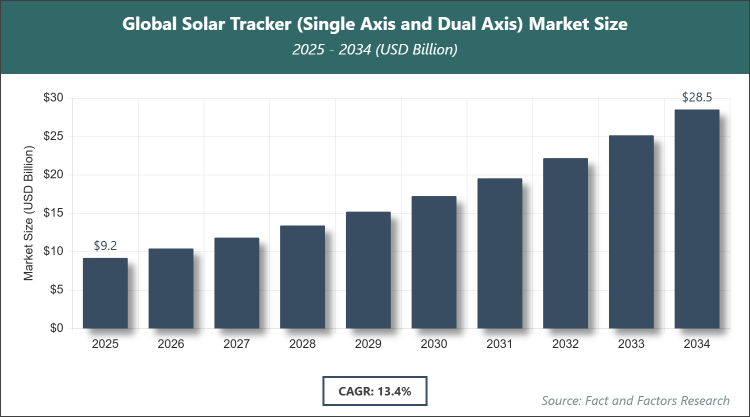
[243+ Pages Report] According to Facts & Factors, the global Solar Tracker (Single Axis and Dual Axis) market size was estimated at USD 9.2 billion in 2025 and is expected to reach USD 28.5 billion by the end of 2034. The Solar Tracker (Single Axis and Dual Axis) industry is anticipated to grow by a CAGR of 13.4% between 2026 and 2034. The Solar Tracker (Single Axis and Dual Axis) Market is driven by the global acceleration of utility-scale solar PV deployments and the proven 15-40% energy yield improvement delivered by tracking systems over fixed-tilt installations.
 Market Overview
The Solar Tracker (Single Axis and Dual Axis) market includes motorized mounting systems that dynamically orient solar photovoltaic modules to follow the sun’s path throughout the day, maximizing irradiance capture and electricity generation. Single-axis trackers rotate panels along one axis (typically east-west), while dual-axis trackers adjust both azimuth and elevation for optimal alignment in all seasons. These systems integrate advanced sensors, motors, controllers, and software for real-time tracking, backtracking algorithms, and weather-adaptive operation, delivering higher capacity factors and lower levelized cost of energy for large-scale solar farms, commercial rooftops, and specialized applications. The market covers both new installations and retrofits, emphasizing durability in extreme weather, compatibility with bifacial modules, and integration with SCADA and plant-level optimization platforms.
Key Insights
- As per the analysis shared by our research analyst, the Solar Tracker (Single Axis and Dual Axis) market is estimated to grow annually at a CAGR of around 13.4% over the forecast period (2026-2034).
- In terms of revenue, the Solar Tracker (Single Axis and Dual Axis) market size was valued at around USD 9.2 billion in 2025 and is projected to reach USD 28.5 billion by 2034.
- The Solar Tracker (Single Axis and Dual Axis) Market is driven by surging utility-scale solar deployments and higher energy yield requirements.
- Based on the Type, the Horizontal Single Axis Tracker segment dominated the market in 2025 with a share of 56% due to its optimal balance of cost, reliability, and 15-25% yield gain on flat utility sites.
- Based on the Application, the Utility-Scale segment dominated the market in 2025 with a share of 81%, owing to massive ground-mount projects prioritizing LCOE reduction and higher capacity factors.
- Based on the End-User, the Solar Developers segment dominated the market in 2025 with a share of 68% because independent power producers and large developers standardize trackers in project bids to maximize long-term revenue.
- Asia Pacific dominated the global Solar Tracker (Single Axis and Dual Axis) market in 2025 with a share of 46% attributed to explosive solar capacity additions in China and India, supportive policies, and cost-competitive local manufacturing.
Growth Drivers
- Utility-Scale Solar Boom and Yield Optimization
Global renewable energy targets and falling solar module prices have triggered a surge in gigawatt-scale projects where single- and dual-axis trackers deliver 15-40% more annual energy than fixed-tilt arrays, directly lowering LCOE and improving project bankability.
Policy support through tax credits, auctions with yield-based bidding, and corporate PPAs increasingly favors tracker-equipped plants, accelerating deployment in high-irradiance regions.
Restraints
- High Capital Cost and Land Requirements
Tracker systems add 10-20% to project capex compared with fixed-tilt, including foundations, motors, and controls, which can deter smaller developers or projects with tight budgets in emerging markets.
Larger row spacing required for tracker movement increases land footprint, raising acquisition costs and limiting suitability in densely populated or high-value agricultural areas.
Opportunities
- Bifacial Modules and Smart Tracking Algorithms
The rapid adoption of bifacial panels, which gain extra rear-side generation when paired with trackers, is creating premium demand for optimized single- and dual-axis designs with backtracking and diffuse-light algorithms.
Integration of AI, digital twins, and predictive maintenance is enabling fleet-level optimization, remote diagnostics, and higher availability, opening new service-based revenue models for manufacturers and EPCs.
Challenges
- Supply Chain Volatility and Extreme Weather Resilience
Dependence on steel, motors, and electronic components exposes the industry to raw-material price swings and geopolitical supply risks, while projects in cyclone-prone or high-wind areas require costly reinforced designs.
Evolving grid codes and curtailment rules in high-penetration solar markets demand smarter inverters and hybrid plant designs, requiring continuous tracker software and hardware upgrades.
Report Scope
Report Attribute |
Details |
Market Size 2025 |
USD 9.2 Billion |
Projected Market Size in 2034 |
USD 28.5 Billion |
CAGR Growth Rate |
13.4% CAGR |
Base Year |
2025 |
Forecast Years |
2026-2034 |
Key Market Players |
Nextracker Inc., Array Technologies, Inc., Arctech Solar Holding Co., Ltd., Soltec Power Holdings S.A., PV Hardware Solutions S.L.U. (PVH), STI Norland, Trina Solar Co., Ltd., Convert Italia S.p.A., GameChange Solar, FTC Solar, Inc., and Others. |
Key Segment |
By Type, By Application, By End-User, and By Region |
Major Regions Covered |
North America, Europe, Asia Pacific, Latin America, and the Middle East & Africa |
Purchase Options |
Request customized purchase options to meet your research needs. Explore purchase options |
Market Segmentation
The Solar Tracker (Single Axis and Dual Axis) market is segmented by type, application, end-user, and region.
Based on Type Segment, the Solar Tracker (Single Axis and Dual Axis) market is divided into horizontal single axis tracker, vertical single axis tracker, tilted single axis tracker, dual axis tracker, and others. The most dominant segment is the Horizontal Single Axis Tracker, followed by the Dual Axis Tracker. Horizontal Single Axis Tracker dominates because it provides the best cost-performance ratio for the vast majority of flat or gently sloped utility-scale sites, delivering reliable 15-25% yield uplift at significantly lower capex and maintenance than dual-axis systems, which drives the largest project pipeline volumes and encourages manufacturers to scale production and innovate cost-reduction features that propel overall market expansion.
Based on Application Segment, the Solar Tracker (Single Axis and Dual Axis) market is divided into utility-scale, commercial, residential, agricultural, and others. The most dominant segment is Utility-Scale, followed by Commercial. Utility-Scale leads the segment because gigawatt-scale solar parks represent the highest volume installations, where even small percentage yield gains translate into millions of dollars in additional revenue over the project lifetime, creating overwhelming demand for standardized, bankable tracker solutions that accelerate financing, EPC standardization, and rapid global capacity additions.
Based on End-User Segment, the Solar Tracker (Single Axis and Dual Axis) market is divided into solar developers, epc contractors, utilities, industrial companies, government & public sector, and others. The most dominant segment is Solar Developers, followed by EPC Contractors. Solar Developers dominate because they evaluate projects on long-term IRR and LCOE, consistently selecting trackers to maximize energy production and secure power-purchase agreements, which generate the largest order sizes and stimulate continuous technology improvements that benefit the entire downstream value chain.
Recent Developments
- In February 2025, Nextracker Inc. launched the NX Horizon XTR low-carbon tracker with recycled steel and AI-optimized backtracking, securing multi-gigawatt orders across India and the United States.
- In May 2025, Array Technologies completed the acquisition of APA Solar and introduced the DuraTrack HZ v3 with enhanced wind resilience for high-wind utility projects in Australia and Latin America.
- In August 2025, Arctech Solar unveiled its new dual-row single-axis tracker system, reducing land use by 12% while maintaining high yield for space-constrained sites in Europe and Southeast Asia.
- In November 2025, Soltec expanded its SF7 tracker portfolio with integrated bifacial optimization software, winning major contracts in Spain’s 5 GW pipeline.
- In January 2026, PV Hardware commissioned the world’s largest single-axis tracker installation (1.2 GW) in Saudi Arabia’s NEOM solar park using its high-torque drive system.
Regional Analysis
- Asia Pacific to dominate the global market
Asia Pacific leads the Solar Tracker (Single Axis and Dual Axis) market through unmatched scale of new solar capacity additions, aggressive renewable targets in China and India, abundant low-cost manufacturing of steel structures and motors, and favorable government policies, including land allocation and viability gap funding for tracker-equipped projects. The region benefits from vertically integrated supply chains that reduce costs and delivery times while supporting both domestic megaprojects and exports. Rapid digitalization of grid management further favors trackers with advanced SCADA integration. China dominates within Asia Pacific with the world’s largest solar pipeline, state-backed developers, and domestic tracker manufacturers that have achieved technological parity with global leaders while maintaining the lowest production costs, enabling the country to serve both internal demand and international markets across Southeast Asia, the Middle East, and Africa.
North America maintains a strong premium segment in the Solar Tracker (Single Axis and Dual Axis) market, supported by the Inflation Reduction Act tax credits, high corporate PPA demand, and focus on maximizing energy production on constrained land. The region leads in bifacial and smart-tracker adoption and benefits from established EPC expertise. The United States dominates within North America through its massive utility-scale pipeline in sunbelt states, leadership in innovative financing models, and concentration of technology companies developing next-generation AI-optimized tracking solutions.
Europe exhibits steady growth in the Solar Tracker (Single Axis and Dual Axis) market, driven by REPowerEU targets, repowering of older fixed-tilt parks, and emphasis on agrivoltaics and floating solar, where trackers provide additional yield. The region excels in high-wind and low-temperature engineering solutions. Spain dominates within Europe with its mature solar industry, large pipeline of tracker retrofits, and central role in exporting advanced dual-axis technology to North Africa and the Middle East.
Latin America is experiencing robust expansion in the Solar Tracker (Single Axis and Dual Axis) market, fueled by abundant sunshine, falling module prices, and growing utility and corporate renewable procurement in Brazil, Chile, and Mexico. Auction mechanisms increasingly reward higher capacity factors achieved with trackers. Brazil dominates the region with its vast land resources, ambitious solar targets, and increasing number of hybrid and utility-scale projects incorporating single-axis trackers for optimal performance.
The Middle East & Africa region shows high-growth potential in the Solar Tracker (Single Axis and Dual Axis) market, supported by mega solar projects under Vision 2030 initiatives, excellent irradiance, and the need to maximize output from limited water and land resources. Saudi Arabia and the UAE are pioneering large-scale deployments. Saudi Arabia dominates within the region through its multi-gigawatt solar tenders that mandate trackers, local content requirements that stimulate manufacturing, anda strategic ambition to become a global exporter of renewable energy technology.
Competitive Analysis
The global Solar Tracker (Single Axis and Dual Axis) market is dominated by players:
- Nextracker Inc.
- Array Technologies, Inc.
- Arctech Solar Holding Co., Ltd.
- Soltec Power Holdings S.A.
- PV Hardware Solutions S.L.U. (PVH)
- STI Norland
- Trina Solar Co., Ltd.
- Convert Italia S.p.A.
- GameChange Solar
- FTC Solar, Inc.
The global Solar Tracker (Single Axis and Dual Axis) market is segmented as follows:
By Type
- Horizontal Single Axis Tracker
- Vertical Single Axis Tracker
- Tilted Single Axis Tracker
- Dual Axis Tracker
- Others
By Application
- Utility-Scale
- Commercial
- Residential
- Agricultural
- Others
By End-User
- Solar Developers
- EPC Contractors
- Utilities
- Industrial Companies
- Government & Public Sector
- Others
By Region
- North America
- The U.S.
- Canada
- Mexico
- Europe
- France
- The UK
- Spain
- Germany
- Italy
- Rest of Europe
- Asia Pacific
- China
- Japan
- India
- Australia
- Southeast Asia
- Rest of Asia Pacific
- The Middle East & Africa
- Saudi Arabia
- UAE
- Egypt
- Kuwait
- South Africa
- Rest of the Middle East & Africa
- Latin America
- Brazil
- Argentina
- Rest of Latin America
Industry Major Market Players
Nextracker Inc.
Array Technologies, Inc.
Arctech Solar Holding Co., Ltd.
Soltec Power Holdings S.A.
PV Hardware Solutions S.L.U. (PVH)
STI Norland
Trina Solar Co., Ltd.
Convert Italia S.p.A.
GameChange Solar
FTC Solar, Inc.
Frequently Asked Questions



Copyright © 2025 - 2026, All Rights Reserved, Facts and Factors