
Search Market Research Report
Social Media Analytics Market Size, Share Global Analysis Report, 2026-2034

Social Media Analytics Market Size, Share, Growth Analysis Report By Type (Descriptive Analytics, Predictive Analytics, Prescriptive Analytics, Diagnostic Analytics, Real-time Analytics, and Others), By Application (Sentiment Analysis, Customer Behavior Analysis, Campaign Management, Competitive Intelligence, Influencer Analysis, and Others), By End-User (BFSI, Retail & E-commerce, Healthcare, Media & Entertainment, IT & Telecom, Government, and Others), and By Region - Global Industry Insights, Overview, Comprehensive Analysis, Trends, Statistical Research, Market Intelligence, Historical Data and Forecast 2026-2034
Industry Insights
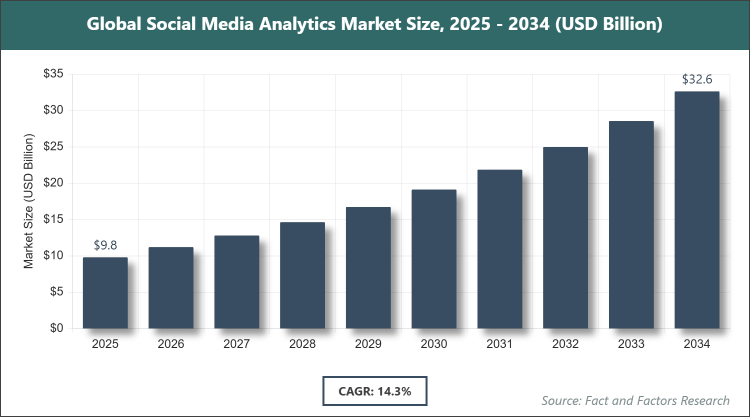
[246+ Pages Report] According to Facts & Factors, the global Social Media Analytics market size was estimated at USD 9.8 billion in 2025 and is expected to reach USD 32.6 billion by the end of 2034. The Social Media Analytics industry is anticipated to grow by a CAGR of 14.3% between 2026 and 2034. The Social Media Analytics Market is driven by the explosive growth of social media platforms and the urgent need for real-time consumer insights to drive data-backed marketing strategies.
 Market Overview
The Social Media Analytics market encompasses advanced software platforms, tools, and services that collect, process, and interpret vast amounts of unstructured data generated across social networks to deliver actionable business intelligence. These solutions utilize natural language processing, machine learning, sentiment analysis, and predictive modeling to track brand mentions, measure campaign performance, understand customer sentiment, identify influencers, monitor competitors, and optimize marketing spend in real time. The market serves enterprises seeking to transform raw social conversations into strategic advantages through dashboards, reports, and automated recommendations, supporting decisions in marketing, customer service, product development, and crisis management across industries.
Key Insights
- As per the analysis shared by our research analyst, the Social Media Analytics market is estimated to grow annually at a CAGR of around 14.3% over the forecast period (2026-2034).
- In terms of revenue, the Social Media Analytics market size was valued at around USD 9.8 billion in 2025 and is projected to reach USD 32.6 billion by 2034.
- The Social Media Analytics Market is driven by exploding social media data volume and demand for real-time consumer insights.
- Based on the Type, the Descriptive Analytics segment dominated the market in 2025 with a share of 41% due to its foundational role in summarizing historical social data and providing essential performance dashboards used by every marketing team.
- Based on the Application, the Sentiment Analysis segment dominated the market in 2025 with a share of 38%, owing to its critical importance in brand reputation management and immediate crisis detection across all industries.
- Based on the End-User, the Retail & E-commerce segment dominated the market in 2025 with a share of 34% because retailers rely heavily on social listening to track product feedback, influence purchasing decisions, and optimize omnichannel campaigns in real time.
- North America dominated the global Social Media Analytics market in 2025 with a share of 37% attributed to early technology adoption, presence of major social platforms and analytics vendors, and high marketing budgets focused on data-driven strategies.
Growth Drivers
- Explosive Growth of Social Media Data
The unprecedented daily volume of posts, comments, stories, and videos across platforms has made manual monitoring impossible, forcing brands to adopt automated analytics tools for real-time visibility and competitive advantage.
Integration of social analytics with CRM, marketing automation, and e-commerce platforms has created closed-loop systems that directly link social insights to revenue outcomes, encouraging higher investment.
Restraints
- Data Privacy Regulations and Ethical Concerns
Strict laws such as GDPR, CCPA, and emerging global regulations limit the scope of data collection and cross-border processing, increasing compliance costs and restricting certain analytics capabilities.
Growing consumer backlash against invasive tracking and demand for transparent data usage have forced vendors to redesign features and slowed feature rollout in privacy-sensitive markets.
Opportunities
- AI-Powered Predictive and Prescriptive Analytics
Advancements in generative AI and large language models enable predictive trend forecasting and automated recommendation engines that move beyond reporting to prescriptive action suggestions for marketing teams.
Expansion into emerging verticals such as healthcare patient engagement, government citizen feedback, and influencer economy creates new high-growth use cases and premium pricing opportunities.
Challenges
- Platform Algorithm Changes and Data Access Limitations
Frequent changes in social media APIs and restrictions on data access by platforms like Meta, X, and TikTok disrupt analytics accuracy and require constant platform-specific updates, raising development costs.
Talent shortage of skilled data scientists who understand both social context and advanced analytics techniques limits effective deployment and value realization for many organizations.
Report Scope
Report Attribute |
Details |
Market Size 2025 |
USD 9.8 Billion |
Projected Market Size in 2034 |
USD 32.6 Billion |
CAGR Growth Rate |
14.3% CAGR |
Base Year |
2025 |
Forecast Years |
2026-2034 |
Key Market Players |
Sprinklr, Inc., Brandwatch (Cision), Hootsuite Inc., Meltwater, Talkwalker, Digimind, NetBase Quid, Mention, Awario, Keyhole, and Others. |
Key Segment |
By Type, By Application, By End-User, and By Region |
Major Regions Covered |
North America, Europe, Asia Pacific, Latin America, and the Middle East & Africa |
Purchase Options |
Request customized purchase options to meet your research needs. Explore purchase options |
Market Segmentation
The Social Media Analytics market is segmented by type, application, end-user, and region.
Based on Type Segment, the Social Media Analytics market is divided into descriptive analytics, predictive analytics, prescriptive analytics, diagnostic analytics, real-time analytics, and others. The most dominant segment is Descriptive Analytics, followed by Predictive Analytics. Descriptive Analytics dominates because it forms the essential foundation for all social media reporting by summarizing historical performance metrics such as reach, engagement, and impressions in easy-to-understand dashboards, enabling every marketing team to establish baselines and justify budgets, which in turn drives higher adoption of advanced predictive and prescriptive layers and accelerates overall market revenue growth.
Based on Application Segment, the Social Media Analytics market is divided into sentiment analysis, customer behavior analysis, campaign management, competitive intelligence, influencer analysis, and others. The most dominant segment is Sentiment Analysis, followed by Customer Behavior Analysis. Sentiment Analysis leads the segment because brands across every industry require immediate, accurate detection of positive, negative, and neutral mentions to protect reputation, manage crises, and measure true consumer perception, creating the largest and most consistent demand volume while pushing vendors to invest in multilingual NLP improvements that further expand the addressable market.
Based on End-User Segment, the Social Media Analytics market is divided into BFSI, retail & e-commerce, healthcare, media & entertainment, it & telecom, government, and others. The most dominant segment is Retail & E-commerce, followed by Media & Entertainment. Retail & E-commerce dominate because these sectors operate in highly competitive, real-time environments where social listening directly influences product launches, pricing decisions, personalized promotions, and customer service, generating the highest spending and fastest ROI validation that encourages continuous platform upgrades and broader industry adoption.
Recent Developments
- In March 2025, Sprinklr launched its next-generation Unified-CXM platform with generative AI-powered sentiment and trend prediction, securing multi-year contracts with several Fortune 500 retail brands.
- In June 2025, Brandwatch (Cision) introduced real-time visual analytics and TikTok deep listening capabilities, expanding its footprint in the Asia-Pacific media and entertainment sector.
- In September 2025, Hootsuite acquired a leading predictive analytics startup to enhance its social listening suite with prescriptive campaign recommendations.
- In November 2025, Meltwater expanded its enterprise offering with ESG and sustainability-focused social analytics modules for BFSI and government clients.
- In February 2026, Talkwalker unveiled its new AI Agent for automated influencer discovery and ROI measurement, gaining rapid adoption among global consumer goods companies.
Regional Analysis
- North America to dominate the global market
North America leads the Social Media Analytics market through the highest concentration of social media users, early adoption of advanced AI tools, presence of global technology giants and analytics vendors, and substantial marketing budgets allocated to data-driven strategies by enterprises. The region benefits from a mature ecosystem of agencies, strong venture capital support for proptech and martech startups, and regulatory frameworks that encourage ethical data usage while fostering innovation. Corporate headquarters of major brands drive demand for sophisticated multi-platform solutions. The United States dominates within North America with its unmatched scale of digital advertising spend, headquarters of leading platforms (Meta, X, TikTok US operations), and concentration of Fortune 500 companies that treat social analytics as a core competitive differentiator.
Europe exhibits strong and regulation-compliant growth in the Social Media Analytics market, supported by GDPR-driven demand for privacy-first solutions, high digital maturity, and focus on ethical AI in marketing. The region leads in multilingual and cross-border analytics capabilities essential for pan-European campaigns. The United Kingdom dominates within Europe due to its vibrant digital marketing ecosystem, London as a global advertising hub, and leadership in adopting advanced sentiment and influencer analytics tools across retail, media, and financial services sectors.
Asia Pacific is the fastest-growing region in the Social Media Analytics market, fueled by massive social media user bases in China, India, Indonesia, and Southeast Asia, rapid e-commerce expansion, and increasing sophistication of local brands shifting from basic posting to data-driven strategies. Government digital economy initiatives and booming influencer economies further accelerate demand. China dominates within Asia Pacific with its unique super-app ecosystem (WeChat, Douyin), massive domestic data volume, and rapid development of indigenous analytics platforms that serve both local giants and international brands entering the market.
Latin America shows accelerating adoption in the Social Media Analytics market, driven by growing digital transformation, rising e-commerce penetration, and increasing marketing sophistication among regional brands and multinational subsidiaries. Social commerce growth in Brazil and Mexico is a key catalyst. Brazil dominates the region through its large population, vibrant social media culture, and leadership in adopting analytics for political campaigning, retail, and entertainment industries.
The Middle East & Africa region demonstrates promising growth in the Social Media Analytics market, supported by young, digitally native populations, rapid social media penetration, and government investments in smart nation initiatives. Luxury retail and tourism sectors are early adopters. The United Arab Emirates dominates within the region through its vision fora knowledge-based economy, high social media engagement among expatriates and locals, and role as a regional hub for marketing technology innovation serving the broader GCC and African markets.
Competitive Analysis
The global Social Media Analytics market is dominated by players:
- Sprinklr, Inc.
- Brandwatch (Cision)
- Hootsuite Inc.
- Meltwater
- Talkwalker
- Digimind
- NetBase Quid
- Mention
- Awario
- Keyhole
The global Social Media Analytics market is segmented as follows:
By Type
- Descriptive Analytics
- Predictive Analytics
- Prescriptive Analytics
- Diagnostic Analytics
- Real-time Analytics
- Others
By Application
- Sentiment Analysis
- Customer Behavior Analysis
- Campaign Management
- Competitive Intelligence
- Influencer Analysis
- Others
By End-User
- BFSI
- Retail & E-commerce
- Healthcare
- Media & Entertainment
- IT & Telecom
- Government
- Others
By Region
- North America
- The U.S.
- Canada
- Mexico
- Europe
- France
- The UK
- Spain
- Germany
- Italy
- Rest of Europe
- Asia Pacific
- China
- Japan
- India
- Australia
- Southeast Asia
- Rest of Asia Pacific
- The Middle East & Africa
- Saudi Arabia
- UAE
- Egypt
- Kuwait
- South Africa
- Rest of the Middle East & Africa
- Latin America
- Brazil
- Argentina
- Rest of Latin America
Industry Major Market Players
- Sprinklr, Inc.
- Brandwatch (Cision)
- Hootsuite Inc.
- Meltwater
- Talkwalker
- Digimind
- NetBase Quid
- Mention
- Awario
- Keyhole
Frequently Asked Questions



Copyright © 2025 - 2026, All Rights Reserved, Facts and Factors