
Search Market Research Report
Smart Scale Market Size, Share Global Analysis Report, 2026-2034

Smart Scale Market Size, Share, Growth Analysis Report By Type (Bluetooth Enabled Scales, Wi-Fi Enabled Scales, App-Integrated Scales, and Others), By Application (Residential, Gym, Health Facilities, and Others), By End-User (Fitness Enthusiasts, Health-Conscious Individuals, Healthcare Professionals, and Others), and By Region - Global Industry Insights, Overview, Comprehensive Analysis, Trends, Statistical Research, Market Intelligence, Historical Data and Forecast 2026-2034
Industry Insights
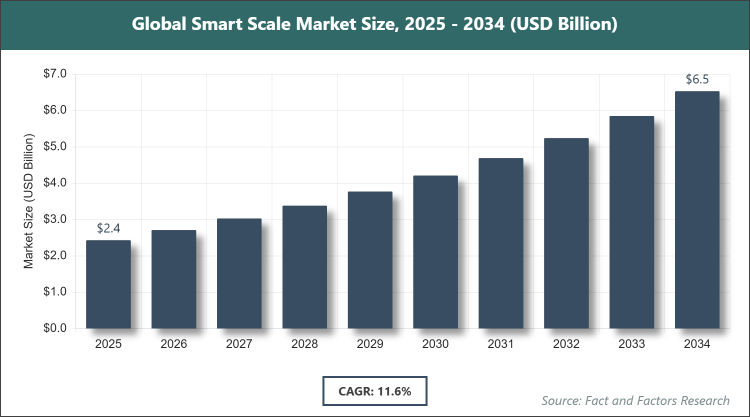
[220 + Pages Report] According to Facts & Factors, the global Smart Scale market size was estimated at USD 2.43 billion in 2025 and is expected to reach USD 7.21 billion by the end of 2034. The Smart Scale industry is anticipated to grow by a CAGR of 11.6% between 2026 and 2034. The Smart Scale Market is driven by increasing health awareness and demand for connected fitness devices.
 Market Overview
The Smart Scale market encompasses devices that go beyond traditional weighing, integrating advanced sensors and connectivity features to measure body composition metrics such as body fat percentage, muscle mass, bone density, and water content. These scales connect to smartphones or other devices via Bluetooth or Wi-Fi, allowing users to track health data over time through dedicated apps. They represent a fusion of consumer electronics and health technology, catering to individuals seeking precise, data-driven insights into their physical well-being without relying on professional medical equipment.
Key Insights
- As per the analysis shared by our research analyst, the Smart Scale market is estimated to grow annually at a CAGR of around 11.6% over the forecast period (2026-2034).
- In terms of revenue, the Smart Scale market size was valued at around USD 2.43 billion in 2025 and is expected to reach USD 7.21 billion by 2034.
- The market is driven by rising obesity rates, growing adoption of smart home ecosystems, and advancements in sensor technology.
- Based on the Type, the Bluetooth Enabled Scales segment dominated with a 55% share due to its affordability, ease of use, and widespread compatibility with mobile devices.
- Based on the Application, the Residential segment dominated with a 65% share owing to increasing consumer focus on personal health monitoring at home.
- Based on the End-User, the Fitness Enthusiasts segment dominated with a 50% share because of their need for detailed performance tracking and integration with fitness apps.
- North America dominated the global market with a 40% share, attributed to high technological adoption, strong health and fitness culture, and the presence of key manufacturers.
Growth Drivers
- Rising Health Awareness and Fitness Trends
The surge in global health consciousness, fueled by the prevalence of lifestyle diseases like obesity and diabetes, has propelled demand for smart scales. These devices provide users with comprehensive body metrics, enabling proactive health management and personalized fitness plans.
Additionally, integration with popular health apps and wearables enhances user engagement, making smart scales an essential tool in home-based wellness routines. This trend is further amplified by social media influencers promoting body positivity and fitness goals.
Restraints
- High Initial Costs and Data Privacy Concerns
Premium smart scales often come with a higher price tag compared to traditional scales, limiting accessibility in price-sensitive markets. This cost barrier can deter potential buyers, especially in developing regions where basic health tools suffice.
Moreover, concerns over data security arise as these devices collect sensitive health information, potentially leading to hesitancy among users wary of breaches or unauthorized sharing with third parties.
Opportunities
- Expansion in Emerging Markets and Technological Innovations
Rapid urbanization and increasing disposable incomes in Asia-Pacific and Latin America present untapped opportunities for market penetration. Localizing products with affordable pricing and region-specific features could drive adoption.
Furthermore, advancements like AI-driven insights and seamless integration with telemedicine platforms open new avenues, allowing smart scales to evolve into comprehensive health monitoring systems.
Challenges
- Intense Competition and Regulatory Hurdles
The market is crowded with numerous players, leading to price wars and innovation pressures that can strain smaller companies' resources. Differentiating products becomes crucial amid commoditization risks.
Additionally, varying international regulations on health data handling and device accuracy standards pose compliance challenges, potentially delaying product launches and increasing operational costs.
Report Scope
Report Attribute |
Details |
Market Size 2025 |
USD 2.43 Billion |
Projected Market Size in 2034 |
USD 7.21 Billion |
CAGR Growth Rate |
11.6% CAGR |
Base Year |
2025 |
Forecast Years |
2026-2034 |
Key Market Players |
Fitbit LLC, Garmin Ltd., Withings, Tanita Corporation, Qardio Inc., iHealth Labs Inc., Pyle Audio, Taylor Precision Products, Blipcare, Arboleaf Corp., and Others. |
Key Segment |
By Type, By Application, By End-User, and By Region |
Major Regions Covered |
North America, Europe, Asia Pacific, Latin America, and the Middle East & Africa |
Purchase Options |
Request customized purchase options to meet your research needs. Explore purchase options |
Market Segmentation
The Smart Scale market is segmented by type, application, end-user, and region.
Based on Type Segment, the Smart Scale market is divided into Bluetooth-enabled scales, Wi-Fi-enabled scales, app-integrated scales, and others. The most dominant subsegment is Bluetooth Enabled Scales, holding a significant market share due to its straightforward connectivity without needing constant internet access, making it ideal for everyday users. The second most dominant is Wi-Fi-enabled scales, which offer advanced features like automatic data syncing to cloud services. Bluetooth-enabled scales drive the market by providing cost-effective, battery-efficient solutions that appeal to a broad consumer base, while Wi-Fi Enabled Scales contribute through enhanced data analysis capabilities that support long-term health tracking.
Based on Application Segment, the Smart Scale market is divided into residential, gym, health facilities, and others. The most dominant subsegment is Residential, capturing the largest portion because of the growing trend of home fitness and self-monitoring. The second most dominant is Gym, which benefits from professional training environments. Residential applications drive the market by empowering individuals with convenient, daily health insights, fostering consistent usage, whereas Gym applications enhance it by integrating with group fitness programs and trainer-led analytics.
Based on End-User Segment, the Smart Scale market is divided into fitness enthusiasts, health-conscious individuals, healthcare professionals, and others. The most dominant subsegment is Fitness Enthusiasts, leading due to their demand for precise performance metrics. The second most dominant is Health-Conscious Individuals, who prioritize preventive health measures. Fitness Enthusiasts propel market growth through high adoption rates and willingness to invest in premium features, while Health-Conscious Individuals sustain it by incorporating scales into routine wellness practices.
Recent Developments
- In 2023, Withings launched the Body Scan smart scale, featuring segmental body composition analysis and vascular age measurement, enhancing user health insights with clinical-grade accuracy.
- In 2024, Garmin updated its Index S2 scale with improved Wi-Fi connectivity and integration with the Garmin Connect app, allowing seamless data sharing across its ecosystem of wearables.
- In 2025, Fitbit introduced a new AI-powered smart scale that provides personalized nutrition recommendations based on body metrics, partnering with health apps for comprehensive wellness tracking.
Regional Analysis
- North America to dominate the global market
North America leads the Smart Scale market, driven by advanced technological infrastructure and a strong emphasis on health and fitness. The United States, as the dominating country, benefits from high consumer spending on wellness products and widespread adoption of smart home devices. This region's innovation hub status, with major companies investing in R&D, further solidifies its position. Cultural shifts towards preventive healthcare and integration with telehealth services amplify demand, making North America a benchmark for market trends. The prevalence of gym culture and fitness memberships encourages the use of connected devices for tracking progress, while collaborations between tech giants and health organizations promote widespread availability and user education.
Europe follows closely, with robust growth in countries like Germany and the UK, where stringent health regulations and rising awareness of chronic diseases fuel adoption. The region's focus on data privacy aligns well with smart scale features, encouraging trust and usage. Collaborative efforts between tech firms and healthcare providers enhance market penetration, particularly in aging populations seeking home monitoring solutions. Emphasis on sustainable living and wellness initiatives supports the integration of smart scales into daily routines. Government-backed health campaigns further boost demand by highlighting the importance of body composition monitoring for long-term well-being.
Asia Pacific is experiencing the fastest growth, led by China and India, due to expanding middle-class populations and increasing smartphone penetration. China's dominance stems from its manufacturing prowess and government initiatives promoting digital health. Rapid urbanization and rising disposable incomes drive demand for affordable, connected devices, positioning the region as a key future contributor. Awareness campaigns addressing malnutrition and lifestyle diseases encourage adoption among diverse demographics. Local innovations and partnerships with international brands tailor products to cultural preferences, enhancing accessibility and user engagement in bustling urban environments.
Latin America shows promising potential, with Brazil at the forefront, thanks to improving economic conditions and growing fitness culture. The region's emphasis on affordable health tech addresses accessibility issues, while partnerships with global brands introduce advanced products. Rising interest in personal wellness amid urbanization trends supports market expansion. Community health programs and social media influences promote smart scales as tools for family health management. Brazil's vibrant sports and fitness scene, coupled with increasing e-commerce penetration, facilitates easier access to these devices for a broader audience.
The Middle East & Africa lag but are gaining traction, primarily in the UAE and South Africa, where urban elites adopt smart devices. Investments in healthcare infrastructure and rising obesity concerns are key drivers, though challenges like economic disparities limit broader adoption. The UAE leads with its focus on luxury wellness and smart city initiatives, integrating health tech. Efforts to combat lifestyle diseases through public health strategies encourage gradual uptake. South Africa's growing middle class and emphasis on preventive care contribute to emerging demand, supported by international aid and local distribution networks.
Competitive Analysis
The global Smart Scale market is dominated by players:
- Fitbit LLC
- Garmin Ltd.
- Withings
- Tanita Corporation
- Qardio Inc.
- iHealth Labs Inc.
- Pyle Audio
- Taylor Precision Products
- Blipcare
- Arboleaf Corp.
The global Smart Scale market is segmented as follows:
By Type
- Bluetooth Enabled Scales
- Wi-Fi Enabled Scales
- App-Integrated Scales
- Others
By Application
- Residential
- Gym
- Health Facilities
- Others
By End-User
- Fitness Enthusiasts
- Health-Conscious Individuals
- Healthcare Professionals
- Others
By Region
- North America
- The U.S.
- Canada
- Mexico
- Europe
- France
- The UK
- Spain
- Germany
- Italy
- Rest of Europe
- Asia Pacific
- China
- Japan
- India
- Australia
- Southeast Asia
- Rest of Asia Pacific
- The Middle East & Africa
- Saudi Arabia
- UAE
- Egypt
- Kuwait
- South Africa
- Rest of the Middle East & Africa
- Latin America
- Brazil
- Argentina
- Rest of Latin America
Industry Major Market Players
- Fitbit LLC
- Garmin Ltd.
- Withings
- Tanita Corporation
- Qardio Inc.
- iHealth Labs Inc.
- Pyle Audio
- Taylor Precision Products
- Blipcare
- Arboleaf Corp.
Frequently Asked Questions



Copyright © 2025 - 2026, All Rights Reserved, Facts and Factors