
Search Market Research Report
Slip Ring Market Size, Share Global Analysis Report, 2026-2034

Slip Ring Market Size, Share, Growth Analysis Report By Type (Pancake Slip Rings, Capsule Slip Rings, Wireless Slip Rings, and Others), By End-User (Aerospace & Defense, Industrial & Commercial, Wind Turbines, Robotics, and Others), and By Region - Global Industry Insights, Overview, Comprehensive Analysis, Trends, Statistical Research, Market Intelligence, Historical Data and Forecast 2026-2034
Industry Insights
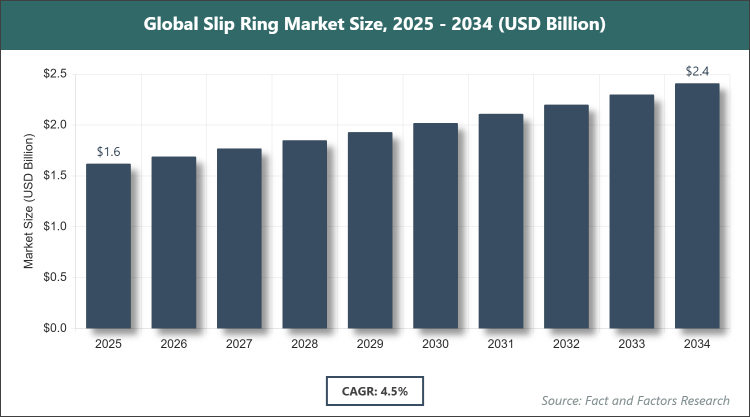
[220+ Pages Report] According to Facts & Factors, the global Slip Ring market size was estimated at USD 1.62 billion in 2025 and is expected to reach USD 2.41 billion by the end of 2034. The Slip Ring industry is anticipated to grow by a CAGR of 4.5% between 2026 and 2034. The Slip Ring Market is driven by rising demand in industrial automation and renewable energy sectors.
 Market Overview
Slip rings are electromechanical devices designed to transmit power, electrical signals, or data from a stationary structure to a rotating one, enabling continuous rotation without tangling wires. They are essential in applications where unrestricted movement is required, such as in rotating machinery, robotics, and wind turbines. These components consist of conductive rings and brushes that maintain electrical connections during rotation, ensuring reliable performance in dynamic environments.
Key Insights
- As per the analysis shared by our research analyst, the global Slip Ring market is estimated to grow annually at a CAGR of around 4.5% over the forecast period (2026-2034).
- In terms of revenue, the global Slip Ring market size was valued at around USD 1.62 billion in 2025 and is projected to reach USD 2.41 billion, by 2034.
- The market is driven by increasing adoption of automation in industries and growth in renewable energy applications.
- Based on the type, the Pancake Slip Rings segment dominated the market with a share of 30% due to their compact and flat design, which is ideal for space-constrained applications like robotics and medical equipment, allowing for efficient integration without compromising performance.
- Based on the end-user, the Aerospace & Defense segment dominated the market with a share of 35% as it requires high-reliability slip rings for critical systems in aircraft, satellites, and military vehicles, where uninterrupted power and signal transmission are vital for operational safety and efficiency.
- North America dominated the global market with a share of 31% owing to its advanced aerospace, defense, and industrial sectors, supported by significant investments in technology and infrastructure.
Growth Drivers
- Increasing Industrial Automation
The surge in industrial automation across manufacturing, packaging, and robotics sectors is a primary driver for the slip ring market. As industries adopt Industry 4.0 principles, the need for reliable components that enable seamless power and data transmission in rotating machinery has escalated. Slip rings facilitate this by allowing continuous operation without wire entanglement, enhancing productivity and reducing downtime in automated systems.
This trend is particularly evident in smart factories where robotic arms and conveyor systems rely on slip rings for precise control. The integration of IoT and AI further amplifies demand, as these technologies require robust connectivity in dynamic environments, positioning slip rings as indispensable for modern industrial setups.
- Rising Demand in Renewable Energy
The global push towards renewable energy, especially wind power, significantly boosts the slip ring market. Wind turbines require slip rings to transfer power from rotating blades to stationary grids, ensuring efficient energy generation. With governments investing in green energy initiatives, the installation of wind farms is accelerating, driving the need for durable and high-performance slip rings.
Advancements in offshore wind projects, which operate in harsh conditions, further emphasize the importance of weather-resistant slip rings. This driver not only expands market reach but also encourages innovation in materials and designs to withstand extreme environments, contributing to sustainable energy goals.
- Expansion in Aerospace and Defense
Growing defense budgets and space exploration activities propel the demand for slip rings in aerospace and defense applications. These sectors utilize slip rings in radar systems, satellite communications, and aircraft controls, where reliability under high-speed rotation is crucial. Technological advancements in unmanned aerial vehicles (UAVs) and missiles also rely on compact slip rings for signal integrity.
The emphasis on national security and space missions fosters R&D investments, leading to specialized slip rings that meet stringent standards. This driver sustains market growth by catering to high-value, mission-critical applications that prioritize performance and durability.
Restraints
- High Maintenance and Replacement Costs
Slip rings are prone to wear and tear due to continuous friction between brushes and rings, leading to high maintenance requirements. This can result in frequent replacements, increasing operational costs for end-users in industries like manufacturing and energy. The need for regular inspections and downtime for repairs poses a significant restraint, particularly in cost-sensitive sectors.
Moreover, in harsh environments, accelerated degradation exacerbates these issues, deterring adoption in budget-constrained applications. Manufacturers are challenged to balance durability with affordability, as failure to address this can limit market penetration in emerging economies.
- Competition from Wireless Alternatives
The emergence of wireless technologies, such as fiber optic rotary joints, presents a restraint by offering contactless transmission options. These alternatives reduce wear and improve signal quality, appealing to industries seeking low-maintenance solutions. As wireless systems advance, they threaten traditional slip ring demand in data-intensive applications like telecommunications.
This shift requires slip ring producers to innovate hybrid solutions to remain competitive. However, the higher initial costs of wireless options may temper immediate impact, but long-term adoption could erode market share if not addressed through technological integration.
Opportunities
- Technological Advancements in Materials
Innovations in contact materials and designs offer opportunities to enhance slip ring performance, such as reducing friction and extending lifespan. Developments like maintenance-free and IP-rated slip rings cater to demanding environments in deep-sea and food processing industries, opening new market segments.
These advancements allow penetration into niche applications, fostering partnerships with tech firms for customized solutions. By focusing on R&D, companies can capitalize on the demand for high-reliability components, driving revenue growth in evolving industrial landscapes.
- Growth in Emerging Markets
Rapid industrialization in Asia-Pacific and Latin America presents opportunities for market expansion. Increasing infrastructure projects and manufacturing hubs in these regions boost demand for slip rings in automation and energy sectors. Favorable government policies and foreign investments further support this growth.
Companies can leverage local partnerships to tailor products to regional needs, such as cost-effective designs for small-scale industries. This opportunity enables diversification beyond mature markets, enhancing global presence and resilience against economic fluctuations.
Challenges
- Signal Interference in High-Frequency Applications
Maintaining signal integrity in high-speed and high-frequency environments poses a challenge, as interference can disrupt data transmission. This is critical in sectors like aerospace and medical imaging, where precision is paramount. Addressing this requires advanced shielding and materials, increasing production complexity.
Ongoing R&D is essential to mitigate these issues, but it demands significant investment. Failure to overcome this challenge could limit adoption in cutting-edge technologies, affecting market competitiveness.
- Environmental and Regulatory Compliance
Adhering to stringent environmental regulations and sustainability standards is a challenge for slip ring manufacturers. The use of certain materials, like mercury in some types, faces scrutiny due to toxicity concerns, necessitating eco-friendly alternatives. Compliance increases costs and complicates supply chains.
Navigating diverse regional regulations adds complexity, particularly for global players. This challenge requires proactive innovation in green manufacturing to maintain market position and avoid penalties.
Report Scope
Report Attribute |
Details |
Market Size 2025 |
USD 1.62 Billion |
Projected Market Size in 2034 |
USD 2.41 Billion |
CAGR Growth Rate |
4.5% CAGR |
Base Year |
2025 |
Forecast Years |
2026-2034 |
Key Market Players |
Moog Inc., Schleifring, Cobham, United Equipment Accessories, Foxtac Electric, and Others. |
Key Segment |
By Type, By End-User, and By Region |
Major Regions Covered |
North America, Europe, Asia Pacific, Latin America, and the Middle East & Africa |
Purchase Options |
Request customized purchase options to meet your research needs. Explore purchase options |
Market Segmentation
The Slip Ring market is segmented by type, end-user, and region.
Based on Type Segment, the Slip Ring market is divided into Pancake Slip Rings, Capsule Slip Rings, Wireless Slip Rings, and others. The Pancake Slip Rings segment is the most dominant, followed by Capsule Slip Rings as the second most dominant. Pancake Slip Rings lead due to their flat, compact structure that fits seamlessly into applications with limited axial space, such as robotics and wind turbines, driving market growth by enabling efficient power transmission in constrained environments and supporting the expansion of automation technologies.
Based on End-User Segment, the Slip Ring market is divided into Aerospace & Defense, Industrial & Commercial, Wind Turbines, Robotics, and others. The Aerospace & Defense segment is the most dominant, followed by Industrial & Commercial as the second most dominant. Aerospace & Defense dominates because of the critical need for reliable, high-performance slip rings in rotating systems like radar and aircraft controls, which drives the market by ensuring operational integrity in high-stakes environments and fostering innovations that spill over to other sectors.
Recent Developments
- In August 2024, Amphenol Corporation launched its new Hyperion series of high-performance slip rings tailored for renewable energy applications, offering enhanced power handling and efficiency for wind turbines and solar systems. This development addresses the growing need for durable components in sustainable energy infrastructure.
- In November 2024, TE Connectivity partnered with Siemens Energy to supply slip rings for next-generation gas turbines, strengthening its foothold in the energy sector and enabling advanced power transmission solutions.
- On March 20, 2024, HOERBIGER acquired Diamond-Roltran to expand into maintenance-free slip rings, reducing friction and noise for industrial applications that demand high reliability.
- Orbex introduced IP65-rated slip rings for washdown environments in food, beverage, and pharmaceutical industries, meeting hygiene standards and enhancing durability in sensitive settings.
- Moflon developed IP68-rated slip rings for deep-sea applications, capable of operating up to 3000 meters underwater, representing a breakthrough in high-pressure sealing technology.
Regional Analysis
- North America to dominate the global market
North America leads the slip ring market, primarily driven by the United States, which hosts advanced aerospace and defense industries. The region's strong focus on technological innovation and substantial investments in military and space programs create a robust demand for high-quality slip rings. Additionally, the presence of leading manufacturers and a mature industrial base support widespread adoption across automation and renewable energy sectors. The U.S. benefits from a skilled workforce and extensive R&D facilities, enabling the development of customized solutions that cater to diverse applications. This dominance is further reinforced by strategic partnerships between industry players and government agencies, fostering a competitive ecosystem that drives continuous improvement in product performance.
Europe holds a significant position, with Germany as the dominating country due to its powerhouse manufacturing and automotive sectors. The emphasis on precision engineering and industrial automation in Germany propels the use of slip rings in robotics and machinery. Countries like Italy and the UK contribute through their strong defense and aerospace industries, promoting innovation in slip ring designs. The region's commitment to sustainability and EU regulations encourage the adoption of eco-friendly technologies, enhancing market growth. Overall, Europe's collaborative industrial landscape and focus on high-tech exports solidify its role in the global market.
Asia Pacific is experiencing rapid growth, led by China as the dominating country, fueled by massive industrialization and infrastructure development. China's expanding manufacturing hubs and renewable energy projects, such as wind farms, increase the demand for reliable slip rings. Japan and India also play key roles with their advancements in electronics and robotics, driving regional innovation. The area's cost-effective production capabilities attract global investments, boosting local markets. This dynamic environment positions Asia Pacific as a hub for emerging technologies and market expansion.
Latin America shows promising potential, with Brazil dominating through its growing industrial and energy sectors. Brazil's investments in renewable energy and mining operations require durable slip rings for rotating equipment. Mexico contributes via its automotive manufacturing base, integrating slip rings in assembly lines. The region's economic diversification and foreign investments support gradual market penetration. Challenges like infrastructure gaps are being addressed, paving the way for increased adoption.
The Middle East & Africa region is emerging, dominated by South Africa and the UAE, driven by oil & gas and renewable energy initiatives. The UAE's focus on diversification into high-tech industries like aerospace enhances slip ring usage. South Africa's mining sector relies on robust components for heavy machinery. Regional investments in infrastructure and energy transition create opportunities for growth. Despite challenges like political instability, the area's resource wealth supports market development.
Competitive Analysis
The global Slip Ring market is dominated by players:
- Moog Inc.
- Schleifring
- Cobham
- United Equipment Accessories
- Foxtac Electric
The global Slip Ring market is segmented as follows:
By Type
- Pancake Slip Rings
- Capsule Slip Rings
- Wireless Slip Rings
- Others
By End-User
- Aerospace & Defense
- Industrial & Commercial
- Wind Turbines
- Robotics
- Others
By Region
- North America
- The U.S.
- Canada
- Mexico
- Europe
- France
- The UK
- Spain
- Germany
- Italy
- Rest of Europe
- Asia Pacific
- China
- Japan
- India
- Australia
- Southeast Asia
- Rest of Asia Pacific
- The Middle East & Africa
- Saudi Arabia
- UAE
- Egypt
- Kuwait
- South Africa
- Rest of the Middle East & Africa
- Latin America
- Brazil
- Argentina
- Rest of Latin America
Industry Major Market Players
The global Slip Ring market is dominated by players:
- Moog Inc.
- Schleifring
- Cobham
- United Equipment Accessories
- Foxtac Electric
Frequently Asked Questions



Copyright © 2025 - 2026, All Rights Reserved, Facts and Factors