
Search Market Research Report
Rotary Tillers Market Size, Share Global Analysis Report, 2026-2034

Rotary Tillers Market Size, Share, Growth Analysis Report By Type (Front Tine, Rear Tine, Mid Tine, Cultivators, and Others), By Application (Agriculture, Horticulture, Gardening, Landscaping, and Others), and By Region - Global Industry Insights, Overview, Comprehensive Analysis, Trends, Statistical Research, Market Intelligence, Historical Data and Forecast 2026-2034
Industry Insights
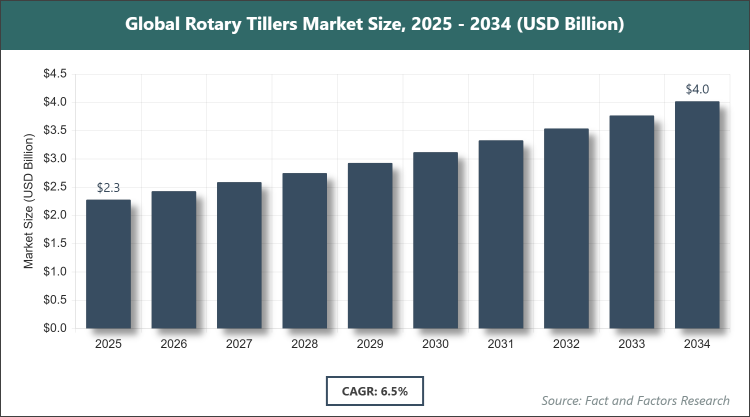
[225+ Pages Report] According to Facts & Factors, the global Rotary Tillers market size was estimated at USD 2.28 billion in 2025 and is expected to reach USD 4.0 billion by the end of 2034. The Rotary Tillers industry is anticipated to grow by a CAGR of 6.5% between 2026 and 2034. The Rotary Tillers Market is driven by increasing mechanization in agriculture and rising demand for efficient soil preparation equipment.
 Market Overview
The rotary tillers market encompasses agricultural machinery designed to prepare soil for planting by breaking up and aerating the ground using rotating tines or blades. These machines are essential tools in farming and gardening, facilitating tasks such as seedbed preparation, weed control, and soil mixing without the need for extensive manual labor. Rotary tillers vary in size and power, catering to small-scale gardens to large commercial farms, and play a crucial role in enhancing soil structure and promoting better crop yields through efficient tillage practices.
Key Insights
- As per the analysis shared by our research analyst, the global Rotary Tillers market is estimated to grow annually at a CAGR of around 6.5% over the forecast period (2026-2034).
- In terms of revenue, the global Rotary Tillers market size was valued at around USD 2.28 billion in 2025 and is projected to reach USD 4.0 billion, by 2034.
- The market is driven by the increasing adoption of mechanized farming practices and the need for enhanced agricultural productivity amid rising global food demand.
- Based on the Type, the Rear Tine segment dominated the market in 2025 with a share of approximately 40% due to its superior performance in heavy-duty soil preparation and ability to handle tougher terrains effectively.
- Based on the Application, the Agriculture segment dominated the market in 2025 with a share of around 60% owing to its widespread use in large-scale farming operations that require efficient and time-saving tillage solutions.
- Based on the region, Asia Pacific dominated the market in 2025 with a share of over 45% attributed to extensive agricultural activities, government subsidies for farm mechanization, and a large farming population in countries like India and China.
Growth Drivers
- Increasing Mechanization in Agriculture
The shift towards mechanized farming is a primary driver for the rotary tillers market, as farmers seek to reduce labor costs and improve operational efficiency. With global population growth exerting pressure on food production, rotary tillers enable quicker soil preparation, allowing for multiple cropping cycles and higher yields. Technological advancements, such as integration with tractors and adjustable tine depths, further enhance their appeal, making them indispensable in modern agriculture.
This trend is particularly evident in developing regions where traditional manual methods are being replaced by machinery to boost productivity. Government initiatives promoting farm mechanization through subsidies and loans are accelerating adoption, ensuring sustained market growth as farmers invest in durable and versatile equipment to meet evolving agricultural demands.
- Rising Demand for Efficient Soil Management
Efficient soil management practices are gaining traction due to concerns over soil degradation and the need for sustainable farming. Rotary tillers aid in incorporating organic matter, controlling weeds, and improving soil aeration, which contributes to better crop health and reduced reliance on chemical inputs. This driver is supported by the increasing awareness among farmers about the long-term benefits of proper tillage in maintaining soil fertility.
As environmental regulations encourage eco-friendly farming, rotary tillers with features like reduced fuel consumption and minimal soil disturbance are becoming popular. This not only helps in conserving resources but also aligns with global sustainability goals, driving market expansion as more stakeholders prioritize equipment that supports regenerative agriculture techniques.
Restraints
- High Initial Investment Costs
The substantial upfront cost of rotary tillers poses a significant restraint, particularly for small-scale farmers in emerging economies who may lack access to financing options. This financial barrier limits market penetration in price-sensitive regions, where manual or rented equipment remains a more affordable alternative despite lower efficiency.
Maintenance and repair expenses further compound this issue, as specialized parts and services can be costly and unavailable in rural areas. As a result, adoption rates slow down, impacting overall market growth and necessitating strategies like affordable leasing models to mitigate these constraints and broaden accessibility.
- Limited Awareness in Underdeveloped Regions
In many underdeveloped areas, there is a lack of awareness about the benefits of rotary tillers, leading to continued reliance on traditional farming methods. This restraint is exacerbated by inadequate training and demonstration programs, which hinder farmers from understanding how to operate and maintain these machines effectively.
Cultural preferences for manual labor and skepticism towards new technology also play a role, delaying market expansion. Efforts to educate through extension services and partnerships with local governments are essential to overcome this, but progress remains gradual, affecting the pace of market development in these regions.
Opportunities
- Technological Advancements in Equipment
Innovations such as electric and battery-powered rotary tillers present opportunities by addressing environmental concerns and reducing operational costs. These advancements cater to the growing demand for sustainable machinery, opening new market segments in eco-conscious farming communities and urban gardening.
Integration of smart features like GPS and automated controls enhances precision, attracting tech-savvy farmers. This opportunity allows manufacturers to differentiate their products, fostering growth through R&D investments and collaborations that bring cutting-edge solutions to market.
- Expansion in Emerging Markets
Rapid agricultural development in emerging economies offers substantial opportunities, driven by increasing farm sizes and mechanization initiatives. As these markets invest in infrastructure, demand for rotary tillers rises to support commercial farming and export-oriented agriculture.
Partnerships with local distributors and customized products tailored to regional needs can capitalize on this, expanding market reach and driving revenue growth through untapped potential in high-growth areas.
Challenges
- Intense Market Competition
The rotary tillers market faces challenges from fierce competition among established and new entrants, leading to price wars and margin pressures. Differentiating products in a crowded space requires continuous innovation, which can strain resources for smaller players.
Quality variations and counterfeit products further complicate the landscape, eroding trust and market stability. Navigating this requires strong branding and customer loyalty strategies to maintain competitive edges.
- Environmental and Regulatory Pressures
Stringent environmental regulations on emissions and soil conservation challenge manufacturers to develop compliant products, increasing R&D costs. Adapting to these standards while keeping prices competitive is difficult, especially in regions with varying regulatory frameworks.
Consumer preferences for green technologies add pressure, necessitating shifts in production that could disrupt supply chains. Balancing compliance with profitability remains a key challenge for sustained market presence.
Report Scope
Report Attribute |
Details |
Market Size 2025 |
USD 2.28 Billion |
Projected Market Size in 2034 |
USD 4.0 Billion |
CAGR Growth Rate |
6.5% CAGR |
Base Year |
2025 |
Forecast Years |
2026-2034 |
Key Market Players |
John Deere, Husqvarna, Honda Motor Company, Kubota Corporation, Yanmar Co., Ltd., VST Tillers Tractors, MTD Products, Caterpillar, ECHO, Benassi S.p.A, and Others. |
Key Segment |
By Type, By Application, and By Region |
Major Regions Covered |
North America, Europe, Asia Pacific, Latin America, and the Middle East & Africa |
Purchase Options |
Request customized purchase options to meet your research needs. Explore purchase options |
Market Segmentation
The Rotary Tillers market is segmented by type, application, and region.
Based on Type Segment, the Rotary Tillers market is divided into Front Tine, Rear Tine, Mid Tine, Cultivators, and Others. The Rear Tine segment emerged as the most dominant in 2025, commanding a significant market share due to its robustness and suitability for heavy-duty tasks in challenging soil conditions, which enhances productivity in commercial agriculture. This dominance stems from its self-propelled design that provides better control and deeper tillage, driving market growth by meeting the needs of large-scale farmers seeking durable equipment. The Front Tine segment followed as the second most dominant, favored for its affordability and ease of use in smaller plots, contributing to market expansion through accessibility for residential and small-farm users who prioritize maneuverability and cost-effectiveness.
Based on Application Segment, the Rotary Tillers market is divided into Agriculture, Horticulture, Gardening, Landscaping, and Others. The Agriculture segment was the most dominant in 2025, holding the largest share because of its critical role in large-scale crop production where efficient soil preparation directly impacts yield and operational timelines, propelling market growth amid global food security demands. This segment's leadership is bolstered by the integration of rotary tillers with tractors, enabling extensive field coverage and reducing labor dependencies. The Horticulture segment ranked second, driven by the need for precise soil cultivation in orchards and nurseries, fostering market development through specialized applications that support diverse plant growth and sustainable practices.
Recent Developments
- In 2025, leading manufacturers like Husqvarna introduced advanced rotary tiller models equipped with GPS guidance systems and variable depth control, aimed at improving precision and fuel efficiency in farming operations. This development reflects a broader industry shift towards smart agriculture technologies.
- During 2024-2025, sustainable equipment initiatives gained momentum as companies such as John Deere launched reduced-till systems and conservation-focused rotary tillers to address environmental concerns and promote soil health, aligning with global sustainability trends.
- In early 2026, equipment rental and service networks expanded across Asia-Pacific, with firms like VST Tillers Tractors enhancing accessibility for small farmers through affordable leasing options, boosting market penetration in rural areas.
Regional Analysis
- Asia Pacific to dominate the global market
The Asia Pacific region stands out as the leading area in the rotary tillers market, primarily due to its vast agricultural landscape and ongoing mechanization efforts. Countries like India dominate within this region, benefiting from a large farming population and government programs that subsidize machinery purchases to enhance productivity. The region's tropical climate and diverse soil types necessitate versatile tillage equipment, fostering widespread adoption. Additionally, rapid urbanization and the need to maximize arable land efficiency further propel demand, making Asia Pacific a hub for innovation and market expansion in agricultural tools.
North America exhibits strong growth in the rotary tillers market, with the United States as the dominating country owing to its advanced farming infrastructure and emphasis on precision agriculture. Large-scale commercial farms drive the adoption of high-tech tillers, integrating them with automated systems for optimal soil management. The region's focus on sustainable practices, including reduced tillage to prevent erosion, supports market development. Moreover, robust distribution networks and access to financing options enable farmers to upgrade equipment regularly, ensuring steady progress in efficiency and yield enhancement.
Europe maintains a mature position in the rotary tillers market, led by Germany as the dominant country with its engineering prowess and commitment to eco-friendly farming. Strict environmental regulations encourage the use of low-emission tillers, aligning with the region's sustainability goals. Diverse agricultural practices across countries like France and Italy contribute to varied demand, from vineyards to grain fields. Investments in research for innovative tillage solutions further strengthen Europe's role, promoting resilient and productive farming systems.
Latin America is emerging as a key player in the rotary tillers market, with Brazil dominating due to its expansive agribusiness sector and export-oriented crops like soybeans. The region's fertile lands and increasing mechanization to replace manual labor drive equipment uptake. Government incentives for farm modernization play a crucial role, enabling smallholders to access affordable tillers. This supports broader economic growth through improved agricultural outputs and efficiency.
The Middle East & Africa region shows potential in the rotary tillers market, with South Africa as the leading country leveraging its diverse farming environments from arid zones to fertile valleys. Challenges like water scarcity prompt the adoption of tillers that minimize soil disturbance and conserve resources. International aid and partnerships introduce modern equipment, aiding small-scale farmers in boosting productivity. Gradual infrastructure improvements further facilitate market growth in this developing area.
Competitive Analysis
The global Rotary Tillers market is dominated by players:
- John Deere
- Husqvarna
- Honda Motor Company
- Kubota Corporation
- Yanmar Co., Ltd.
- VST Tillers Tractors
- MTD Products
- Caterpillar
- ECHO
- Benassi S.p.A
- Others
The global Rotary Tillers market is segmented as follows:
By Type
- Front Tine
- Rear Tine
- Mid Tine
- Cultivators
- Others
By Application
- Agriculture
- Horticulture
- Gardening
- Landscaping
- Others
By Region
- North America
- The U.S.
- Canada
- Mexico
- Europe
- France
- The UK
- Spain
- Germany
- Italy
- Rest of Europe
- Asia Pacific
- China
- Japan
- India
- Australia
- Southeast Asia
- Rest of Asia Pacific
- The Middle East & Africa
- Saudi Arabia
- UAE
- Egypt
- Kuwait
- South Africa
- Rest of the Middle East & Africa
- Latin America
- Brazil
- Argentina
- Rest of Latin America
Industry Major Market Players
The global Rotary Tillers market is dominated by players:
- John Deere
- Husqvarna
- Honda Motor Company
- Kubota Corporation
- Yanmar Co., Ltd.
- VST Tillers Tractors
- MTD Products
- Caterpillar
- ECHO
- Benassi S.p.A
- Others
Frequently Asked Questions



Copyright © 2025 - 2026, All Rights Reserved, Facts and Factors