
Search Market Research Report
Residential Air Purifiers Market Size, Share Global Analysis Report, 2026-2034

Residential Air Purifiers Market Size, Share, Growth Analysis Report By Type (Standalone/Portable, In-Duct, and Others), By Technology (HEPA, Activated Carbon, Ionic Filters, UV Air Purifiers, and Others), By Distribution Channel (Online, Offline, and Others), and By Region - Global Industry Insights, Overview, Comprehensive Analysis, Trends, Statistical Research, Market Intelligence, Historical Data and Forecast 2026-2034
Industry Insights
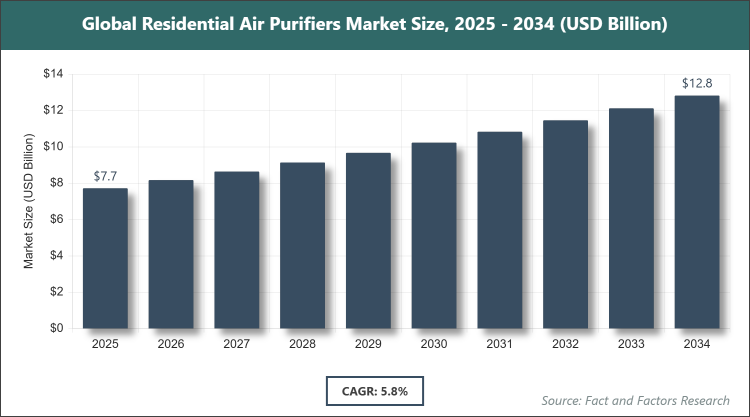
[237 Pages Report] According to Facts & Factors, the global residential air purifiers market size was estimated at USD 7.72 billion in 2025 and is expected to reach USD 10.78 billion by the end of 2034. The Residential Air Purifiers industry is anticipated to grow by a CAGR of 5.8% between 2026 and 2034. The Residential Air Purifiers Market is driven by increasing awareness of indoor air pollution and rising health concerns related to respiratory diseases.
 Market Overview
The residential air purifiers market encompasses devices designed for home use to remove contaminants such as dust, pollen, pet dander, smoke particles, volatile organic compounds, and microorganisms from indoor air through various filtration technologies like mechanical filters, electrostatic precipitation, or ultraviolet light. These appliances, available in portable standalone units or integrated in-duct systems, aim to improve indoor air quality by circulating and purifying air in living spaces, bedrooms, or entire households, addressing health concerns without relying on external ventilation alone. The market includes the production, distribution, and innovation of these products tailored for consumer preferences in energy efficiency, noise levels, and smart connectivity to enhance everyday living environments.
Key Insights
- As per the analysis shared by our research analyst, the Residential Air Purifiers market is estimated to grow annually at a CAGR of around 5.8% over the forecast period (2026-2034).
- In terms of revenue, the Residential Air Purifiers market size was valued at around USD 7.72 billion in 2025 and is projected to reach USD 10.78 billion by 2034.
- The market is driven by increasing awareness of indoor air pollution and rising health concerns related to respiratory diseases.
- Based on the type, the standalone/portable segment dominated the market in 2025 with a market share of 66% due to its flexibility, ease of installation, and suitability for renters and small spaces.
- Based on the technology, the HEPA segment dominated the market in 2025 with a market share of 41% due to its high efficiency in capturing fine particles and allergens, making it ideal for health-conscious consumers.
- Based on the distribution channel, the online segment dominated the market in 2025 with a market share of 55% due to convenience, wide product variety, and competitive pricing through e-commerce platforms.
- Asia Pacific dominated the global market in 2025 with a market share of 42% due to severe air pollution in urban areas of China and India, coupled with rising disposable incomes and health awareness.
Market Dynamics
Growth Drivers
- Rising Health Awareness and Indoor Pollution Concerns
Increasing recognition of the health risks posed by indoor pollutants such as allergens, VOCs, and pathogens has spurred demand for residential air purifiers, particularly in urban households where external air quality infiltrates indoors. This awareness is amplified by media coverage of respiratory issues and pandemics, prompting consumers to invest in devices that promise cleaner breathing environments. Government campaigns and health organizations advocating for better indoor air quality further reinforce this trend, leading to widespread adoption.
Technological advancements, including integration with smart home systems for real-time monitoring, enhance user engagement and efficacy, driving sales among tech-savvy demographics. As lifestyles shift towards more time spent indoors, the need for reliable purification solutions grows, supporting market expansion through innovative, user-friendly products.
Restraints
- High Initial and Maintenance Costs
The upfront expense of advanced air purifiers, especially those with multiple filtration stages or smart features, can deter budget-conscious consumers, limiting penetration in lower-income segments. Ongoing costs for filter replacements and electricity add to the total ownership burden, making alternatives like natural ventilation more appealing in mild climates.
This restraint hampers broader market growth, as price sensitivity in emerging economies restricts volume sales. Manufacturers are countering with affordable models, but quality compromises may affect long-term trust and repeat purchases.
Opportunities
- Technological Innovations in Smart Purifiers
The integration of IoT and AI in air purifiers offers opportunities for automated, app-controlled devices that optimize energy use and provide air quality insights, appealing to connected households. This innovation can expand into premium segments, with features like voice control and integration with home assistants.
Emerging markets with rising middle classes present untapped potential for localized, cost-effective smart models. Partnerships with tech firms could accelerate development, creating new revenue from subscriptions for advanced analytics.
Challenges
- Market Saturation in Developed Regions
High penetration in mature markets like North America leads to slower growth, as replacement cycles lengthen and competition intensifies among established brands. Differentiating products becomes difficult without significant innovation.
Addressing this requires focus on emerging features like virus neutralization, but regulatory hurdles for claims can delay launches. Diversifying into adjacent products or services may help sustain growth.
Report Scope
Report Attribute |
Details |
Market Size 2025 |
USD 7.72 Billion |
Projected Market Size in 2034 |
USD 10.78 Billion |
CAGR Growth Rate |
5.8% CAGR |
Base Year |
2025 |
Forecast Years |
2026-2034 |
Key Market Players |
Daikin Industries, Ltd., Sharp Home (Sharp Corporation), Honeywell International Inc., Panasonic Corporation, LG Electronics, Philips, Dyson, Samsung Electronics, Whirlpool Corporation, Blueair (Unilever), and Others. |
Key Segment |
By Type, By Technology, By Distribution Channel, and By Region |
Major Regions Covered |
North America, Europe, Asia Pacific, Latin America, and the Middle East & Africa |
Purchase Options |
Request customized purchase options to meet your research needs. Explore purchase options |
Market Segmentation
The Residential Air Purifiers market is segmented by type, technology, distribution channel, and region.
Based on Type Segment, the Residential Air Purifiers market is divided into standalone/portable, in-duct, and others. The most dominant is the standalone/portable, and the second most dominant is the in-duct. The standalone/portable segment leads due to its versatility, no-installation requirement, and ability to target specific rooms, driving the market by catering to urban dwellers and renters seeking immediate air quality improvements; this dominance accelerates growth through accessibility and affordability in diverse housing types.
Based on Technology Segment, the Residential Air Purifiers market is divided into HEPA, activated carbon, ionic filters, UV air purifiers, and others. The most dominant is HEPA, and the second most dominant is activated carbon. HEPA dominates owing to its superior particle capture efficiency up to 99.97%, essential for allergen and dust removal in homes, propelled by health trends; this drives the market by meeting stringent consumer demands for proven filtration. Activated carbon ranks second, excelling in odor and gas absorption, contributing to growth through complementary use in multi-stage systems for comprehensive purification.
Based on Distribution Channel Segment, the Residential Air Purifiers market is divided into online, offline, and others. The most dominant is online, and the second most dominant is offline. The online channel prevails due to ease of comparison, reviews, and home delivery, fueled by the e-commerce boom; this fuels market growth via global reach and promotions. Offline ranks second, offering hands-on demos in stores, driving growth through trust-building for high-value purchases.
Recent Developments
- In August 2023, Daikin opened a new AC production facility in Tsukubamirai, Ibaraki, Japan, enhancing capacity for air purifiers integrated with cooling systems.
- In August 2023, Honeywell and Recipharm collaborated to accelerate inhaler development with low-GWP propellants, indirectly boosting air purification tech awareness.
- In July 2023, Panasonic Kurashi Visionary Fund invested in SAKA NO TOCHU for eco-friendly agriculture, aligning with sustainable air quality initiatives.
- In May 2023, Dyson increased its focus on indoor air with the Purifier Big+Quiet, capable of purifying large spaces quietly up to 10 meters.
- In March 2025, Coway introduced Airmega 350 and 450 in Canada, featuring HyperVortex filters removing 99.999% of 0.01-micron particles.
- In January 2025, LG launched PuriCare AeroBooster, a compact solution blending design with strong purification for indoor comfort.
Regional Analysis
- Asia Pacific to dominate the global market
Asia Pacific commands the residential air purifiers market, with China as the dominating country owing to severe urban pollution from industrialization, prompting widespread adoption for health protection in densely populated cities. India's growing middle class and smog issues in metros like Delhi fuel demand, while Japan's tech-savvy consumers prefer advanced models for allergy control. The region's manufacturing prowess ensures affordable options, attracting investments and sustaining dominance through export and policy incentives for clean air.
North America exhibits strong growth in the residential air purifiers market, led by the United States, with high awareness of allergens and wildfires impacting air quality, driving smart device uptake. Canada's cold climates emphasize indoor purification, while Mexico's urbanization boosts demand. Focus on health tech integration positions the region for expansion amid wellness trends.
Europe maintains a mature residential air purifier market, dominated by Germany's emphasis on energy-efficient models compliant with strict EU standards. The United Kingdom's urban pollution concerns and France's health initiatives promote adoption. Regulatory support for sustainability enhances market resilience through innovation in eco-friendly tech.
Latin America shows emerging potential in the residential air purifiers market, with Brazil leading via rising urban middle-class awareness of pollution in São Paulo. Mexico's industrial growth and Argentina's health focus increase uptake. Regional trade facilitates access, driving gradual growth via affordable imports.
The Middle East & Africa region gains traction in the residential air purifiers market, spearheaded by Saudi Arabia's Vision 2030, promoting health in dusty environments. South Africa's urban pollution and the UAE's luxury homes demand premium models. Partnerships enhance availability, fostering expansion through climate-specific solutions.
Competitive Analysis
The global Residential Air Purifiers market is dominated by players:
- Daikin Industries, Ltd.
- Sharp Home (Sharp Corporation)
- Honeywell International Inc.
- Panasonic Corporation
- LG Electronics
- Philips
- Dyson
- Samsung Electronics
- Whirlpool Corporation
- Blueair (Unilever)
The global Residential Air Purifiers market is segmented as follows:
By Type
- Standalone/Portable
- In-Duct
- Others
By Technology
- HEPA
- Activated Carbon
- Ionic Filters
- UV Air Purifiers
- Others
By Distribution Channel
- Online
- Offline
- Others
By Region
- North America
- The U.S.
- Canada
- Mexico
- Europe
- France
- The UK
- Spain
- Germany
- Italy
- Rest of Europe
- Asia Pacific
- China
- Japan
- India
- Australia
- Southeast Asia
- Rest of Asia Pacific
- The Middle East & Africa
- Saudi Arabia
- UAE
- Egypt
- Kuwait
- South Africa
- Rest of the Middle East & Africa
- Latin America
- Brazil
- Argentina
- Rest of Latin America
Industry Major Market Players
The global Residential Air Purifiers market is dominated by players:
Daikin Industries, Ltd.
Sharp Home (Sharp Corporation)
Honeywell International Inc.
Panasonic Corporation
LG Electronics
Philips
Dyson
Samsung Electronics
Whirlpool Corporation
Blueair (Unilever)
Frequently Asked Questions



Copyright © 2025 - 2026, All Rights Reserved, Facts and Factors