
Search Market Research Report
Quartz Crystal Microbalance (QCM) Market Size, Share Global Analysis Report, 2026-2034

Quartz Crystal Microbalance (QCM) Market Size, Share, Growth Analysis Report By Type (Metal Sensors, Oxide Sensors, Carbide Sensors, Polymer Sensors, and Others), By Application (Academic Research, Life Science Applications, Environmental Monitoring, Food Safety Testing, and Others), By End-User (Universities, Research Institutes, Pharmaceutical Companies, Biotechnology Firms, and Others), and By Region - Global Industry Insights, Overview, Comprehensive Analysis, Trends, Statistical Research, Market Intelligence, Historical Data and Forecast 2026-2034
Industry Insights
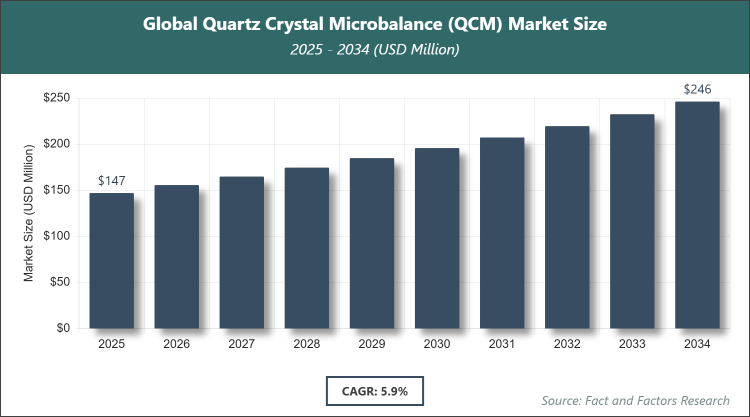
[218+ Pages Report] According to Facts & Factors, the global Quartz Crystal Microbalance (QCM) market size was estimated at USD 0.147 billion in 2025 and is expected to reach USD 0.234 billion by the end of 2034. The Quartz Crystal Microbalance (QCM) industry is anticipated to grow by a CAGR of 5.9% between 2026 and 2034. The Quartz Crystal Microbalance (QCM) Market is driven by growing demand in healthcare and pharmaceutical R&D.
 Market Overview
The Quartz Crystal Microbalance (QCM) market encompasses sensors that utilize the piezoelectric properties of quartz crystals to measure minute mass changes on their surfaces through frequency shifts, enabling applications in real-time monitoring of thin films, biomolecular interactions, and environmental contaminants. This technology is pivotal in research and industrial settings for its high sensitivity and label-free detection capabilities, involving the production, integration, and deployment of QCM devices across various sectors without relying on quantitative metrics.
Key Insights
- As per the analysis shared by our research analyst, the global Quartz Crystal Microbalance (QCM) market is estimated to grow annually at a CAGR of around 5.9% over the forecast period (2026-2034).
- In terms of revenue, the global Quartz Crystal Microbalance (QCM) market size was valued at around USD 0.147 billion in 2025 and is projected to reach USD 0.234 billion by 2034.
- The market is driven by technological advancements in material science and increasing adoption in life sciences.
- Based on the type, the metal sensors segment dominated with a 45% share due to its high sensitivity and versatility in various coatings.
- Based on the application, the life science applications segment dominated with a 45% share owing to its critical role in biomolecular interaction studies and drug discovery.
- Based on the end-user, the universities segment dominated with a major share because of extensive use in academic research activities.
- Based on the region, North America dominated with a 38% share attributed to high technological adoption in biomedical sectors and strong R&D infrastructure.
Growth Drivers
- Technological Advancements in Material Science
Innovations such as high-frequency quartz sensors and advanced coatings like graphene oxide have significantly enhanced the sensitivity and applicability of QCM devices, enabling detection at parts-per-billion levels and expanding their use in precise measurements. This driver is fueled by ongoing R&D investments in nanotechnology and biosensors, which improve performance and open new avenues in real-time monitoring.
Furthermore, integration with IoT and AI for data analysis streamlines operations, reducing manual intervention and increasing efficiency in industrial and research settings, thereby accelerating market adoption across diverse applications.
Restraints
- High Initial Investment and Maintenance Costs
The substantial upfront costs for QCM systems, often exceeding significant thresholds, coupled with the need for climate-controlled environments and regular calibration, limit accessibility for smaller research facilities and emerging markets. This restraint hampers widespread adoption, particularly in budget-constrained sectors.
Additionally, the complexity of integration requiring multidisciplinary expertise poses barriers, leading to extended setup times and potential operational disruptions, further constraining market growth.
Opportunities
- Emerging Applications in Environmental Monitoring
The rising focus on pollution control and water quality assessment presents opportunities for QCM sensors in detecting contaminants with high precision, supported by public sector funding and regulatory mandates. This can drive expansion through specialized pilots that demonstrate cost reductions and efficiency gains.
Moreover, growth in pharmaceutical R&D, with increasing global investments, offers potential for QCM in drug discovery and biomolecular studies, fostering partnerships and customized solutions.
Challenges
- Integration Complexities and Calibration Issues
The need for precise calibration and multidisciplinary knowledge for system integration affects a notable portion of users, leading to inaccuracies and downtime. This challenge necessitates advanced training and standardized protocols to mitigate risks.
In addition, competition from alternative sensing technologies with lower costs challenges QCM's position, requiring continuous innovation to maintain relevance in evolving markets.
Report Scope
Report Attribute |
Details |
Market Size 2025 |
USD 0.147 Billion |
Projected Market Size in 2034 |
USD 0.234 Billion |
CAGR Growth Rate |
5.9% CAGR |
Base Year |
2025 |
Forecast Years |
2026-2034 |
Key Market Players |
INFICON, Biolin Scientific, AWSensors, Gamry Instruments, 3T Analytik, MicroVacuum, MS Technologies, Quartz Pro, and Others. |
Key Segment |
By Type, By Application, By End-User, and By Region |
Major Regions Covered |
North America, Europe, Asia Pacific, Latin America, and the Middle East & Africa |
Purchase Options |
Request customized purchase options to meet your research needs. Explore purchase options |
Market Segmentation
The Quartz Crystal Microbalance (QCM) market is segmented by type, application, end-user, and region.
Based on Type Segment, the Quartz Crystal Microbalance (QCM) market is divided into metal sensors, oxide sensors, carbide sensors, polymer sensors, and others. The most dominant segment is metal sensors, followed by polymer sensors as the second most dominant. Metal sensors dominate due to their superior sensitivity, durability, and compatibility with various coatings like gold and silver, making them ideal for high-precision applications in research and industry, driving the market by enabling advanced measurements that support innovation in material science and biosensing; polymer sensors, with subtypes like acrylic and polystyrene offering flexibility in biomolecular detection, contribute to growth by catering to specialized life science needs, enhancing versatility and expanding adoption.
Based on Application Segment, the Quartz Crystal Microbalance (QCM) market is divided into academic research, life science applications, environmental monitoring, food safety testing, and others. The most dominant segment is life science applications, followed by academic research as the second most dominant. Life science applications lead owing to their essential role in studying biomolecular interactions and drug discovery processes, propelling market expansion through high demand in pharmaceutical R&D; academic research, utilizing QCM for material science experiments, drives growth by fostering foundational innovations and training future experts.
Based on End-User Segment, the Quartz Crystal Microbalance (QCM) market is divided into universities, research institutes, pharmaceutical companies, biotechnology firms, and others. The most dominant segment is universities, followed by pharmaceutical companies as the second most dominant. Universities dominate as they extensively adopt QCM for diverse research activities, boosting the market via educational and experimental applications that advance technology; pharmaceutical companies, employing QCM in drug development, support growth by integrating sensors into high-stakes R&D for efficient outcomes.
Recent Developments
- INFICON and Biolin Scientific expanded their portfolios through acquisitions, strengthening their positions in semiconductor and life science applications.
- Gamry Instruments launched an integrated QCM-electrochemistry system, enhancing capabilities for combined measurements.
- MicroVacuum expanded into Asian markets via distribution partnerships, increasing global accessibility.
- Innovations in multi-channel systems and AI integration for data analysis improved monitoring efficiency.
Regional Analysis
- North America to Dominate the Global Market
North America dominates the Quartz Crystal Microbalance (QCM) market, led by the United States, where high technological adoption in life sciences and biomedical sectors, coupled with substantial R&D investments and presence of key players like Gamry Instruments, drive innovation and market leadership, supported by advanced infrastructure that facilitates widespread integration in research and industry.
Europe holds a significant share, with Germany at the forefront, benefiting from strict regulatory frameworks in pharmaceuticals and strong manufacturers like 3T Analytik, emphasizing precision in environmental and material applications that align with EU sustainability goals.
Asia Pacific is the fastest-growing region, dominated by China, fueled by rapid industrialization, expanding life science research, and government initiatives in Japan and India promoting sensor technologies for quality control and monitoring.
Latin America exhibits modest growth, led by Brazil, through increasing biomedical sectors and adoption in environmental monitoring, supported by emerging R&D collaborations.
The Middle East & Africa region is nascent but promising, with South Africa leading via focus on biomedical research and UAE's investments in advanced technologies for pollution and health applications.
Competitive Analysis
The global Quartz Crystal Microbalance (QCM) market is dominated by players:
- INFICON
- Biolin Scientific
- AWSensors
- Gamry Instruments
- 3T Analytik
- MicroVacuum
- MS Technologies
- Quartz Pro
- Others
The global Quartz Crystal Microbalance (QCM) market is segmented as follows:
By Type
- Metal Sensors
- Oxide Sensors
- Carbide Sensors
- Polymer Sensors
By Application
- Academic Research
- Life Science Applications
- Environmental Monitoring
- Food Safety Testing
By End-User
- Universities
- Research Institutes
- Pharmaceutical Companies
- Biotechnology Firms
By Region
- North America
- The U.S.
- Canada
- Mexico
- Europe
- France
- The UK
- Spain
- Germany
- Italy
- Rest of Europe
- Asia Pacific
- China
- Japan
- India
- Australia
- Southeast Asia
- Rest of Asia Pacific
- The Middle East & Africa
- Saudi Arabia
- UAE
- Egypt
- Kuwait
- South Africa
- Rest of the Middle East & Africa
- Latin America
- Brazil
- Argentina
- Rest of Latin America
Industry Major Market Players
- INFICON
- Biolin Scientific
- AWSensors
- Gamry Instruments
- 3T Analytik
- MicroVacuum
- MS Technologies
- Quartz Pro
Frequently Asked Questions
What are the emerging trends and innovations impacting the Quartz Crystal Microbalance (QCM) market?



Copyright © 2025 - 2026, All Rights Reserved, Facts and Factors