
Search Market Research Report
Pneumatic Tools Market Size, Share Global Analysis Report, 2026-2034

Pneumatic Tools Market Size, Share, Growth Analysis Report By Type (Impact Wrenches, Ratchet Wrenches, Hammers, Sanders, Grinders, Screwdrivers, Drills, and Others), By Tool Type (Handheld and Stationary), By Application (Automotive, Construction, Manufacturing, Aerospace, Oil & Gas, and Others), By End-user (Industrial, Commercial, and Residential), and By Region - Global Industry Insights, Overview, Comprehensive Analysis, Trends, Statistical Research, Market Intelligence, Historical Data and Forecast 2026-2034
Industry Insights
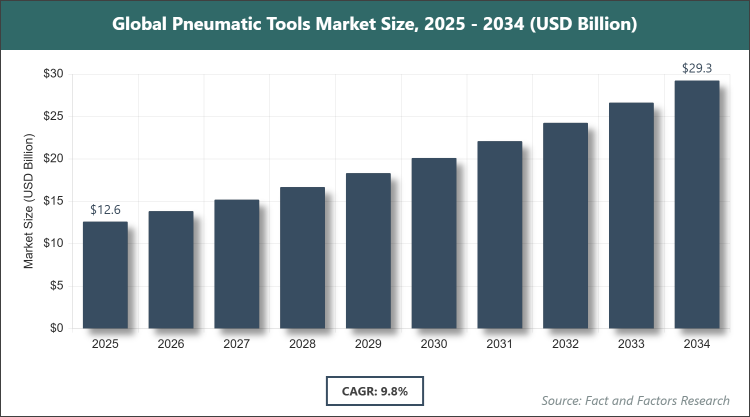
[232+ Pages Report] According to Facts & Factors, the global pneumatic tools market size was estimated at USD 12.61 billion in 2025 and is expected to reach USD 31.71 billion by the end of 2034. The pneumatic tools industry is anticipated to grow by a CAGR of 9.8% between 2026 and 2034. The pneumatic tools Market is driven by increasing industrial automation and rising demand from the construction and automotive sectors.
 Market Overview
Pneumatic tools, also known as air-powered tools, are mechanical devices that utilize compressed air as their primary energy source to perform various tasks such as drilling, grinding, fastening, and hammering. These tools are widely employed across industries due to their reliability, high power-to-weight ratio, and ability to operate in hazardous environments where electric tools may pose risks. The market encompasses a broad range of handheld and stationary equipment designed for precision and efficiency in manufacturing, construction, and maintenance applications.
Key Insights
- As per the analysis shared by our research analyst, the pneumatic tools market is estimated to grow annually at a CAGR of around 9.8% over the forecast period (2026-2034).
- In terms of revenue, the pneumatic tools market size was valued at around USD 12.61 billion in 2025 and is projected to reach USD 31.71 billion by 2034.
- The pneumatic tools market is primarily driven by the surge in industrial automation, expanding construction activities worldwide, and the growing automotive sector's need for efficient assembly and repair tools.
- Based on the type, the impact wrenches segment accounted for the largest market share of 38% in 2025.
- Impact wrenches dominate due to their high torque output and versatility in automotive repair and heavy-duty fastening applications, enabling faster operations and reducing operator fatigue in high-volume production environments.
- Based on the tool type, the handheld segment accounted for the largest market share of 65% in 2025.
- Handheld tools lead the market owing to their portability, ease of use in confined spaces, and widespread adoption in construction and DIY projects, which drive efficiency and accessibility across diverse user bases.
- Based on the application, the automotive segment accounted for the largest market share of 35% in 2025.
- The automotive sector dominates as pneumatic tools provide precise control and durability for assembly lines, tire changing, and bodywork, supporting the industry's push toward faster production cycles and cost-effective maintenance.
- Based on the end-user, the industrial segment accounted for the largest market share of 55% in 2025.
- Industrial users prevail because of the tools' robustness in continuous operations, safety in explosive atmospheres, and integration with automated systems, which enhance productivity in manufacturing and oil & gas facilities.
- Based on region, Asia Pacific dominated the global pneumatic tools market in 2025 with a 40% share, driven by rapid industrialization, booming construction projects, and the presence of major manufacturing hubs in countries like China and India.
Growth Drivers
- Rising Industrial Automation
The increasing adoption of automation in manufacturing processes has significantly boosted the demand for pneumatic tools, as they offer reliable performance and seamless integration with robotic systems. These tools enable precise control in assembly lines, reducing human error and enhancing operational efficiency across sectors like automotive and electronics.
Furthermore, advancements in smart manufacturing, including Industry 4.0 initiatives, have led to the development of IoT-enabled pneumatic tools that provide real-time monitoring and predictive maintenance, further driving their uptake in modern industrial setups.
Restraints
- High Initial Setup and Maintenance Costs
The requirement for compressed air systems, including compressors and air lines, adds to the upfront investment for pneumatic tools, which can deter small-scale operations or budget-constrained users. Additionally, regular maintenance to prevent air leaks and ensure system efficiency increases ongoing expenses.
This cost barrier is particularly challenging in emerging economies where infrastructure for compressed air supply may be underdeveloped, limiting market penetration and favoring alternatives like electric tools in certain applications.
Opportunities
- Expansion in Emerging Markets
Rapid urbanization and infrastructure development in regions like Asia Pacific and Latin America present lucrative opportunities for pneumatic tool manufacturers to expand their footprint. Government investments in construction and manufacturing sectors are creating demand for durable, high-performance tools.
Moreover, the shift toward sustainable practices is opening avenues for energy-efficient pneumatic solutions, allowing companies to innovate and capture market share by addressing environmental concerns and regulatory requirements in these growing economies.
Challenges
- Competition from Electric and Battery-Powered Tools
The rise of cordless electric tools with improved battery life and power output poses a significant challenge to pneumatic tools, as they offer greater mobility without the need for air compressors. This shift is evident in residential and light industrial applications where convenience is prioritized.
Additionally, advancements in electric tool technology, such as brushless motors for better efficiency, are eroding the traditional advantages of pneumatic tools in terms of power and durability, requiring ongoing innovation to maintain market relevance.
Report Scope
Report Attribute |
Details |
Market Size 2025 |
USD 12.61 Billion |
Projected Market Size in 2034 |
USD 31.71 Billion |
CAGR Growth Rate |
9.8% CAGR |
Base Year |
2025 |
Forecast Years |
2026-2034 |
Key Market Players |
Atlas Copco, Ingersoll Rand, Stanley Black & Decker, Makita Corporation, Bosch Power Tools, Chicago Pneumatic, Desoutter Industrial Tools, Dynabrade, Snap-on, Metabo, Nitto Kohki, Husky, HITACHI Industrial Equipment Systems Co., GISON Machinery, SP AIR Corporation, Kobe Steel, and Others. |
Key Segment |
By Type, By Tool Type, By Application, By End-user, and By Region |
Major Regions Covered |
North America, Europe, Asia Pacific, Latin America, and the Middle East & Africa |
Purchase Options |
Request customized purchase options to meet your research needs. Explore purchase options |
Market Segmentation
The pneumatic tools market is segmented by type, tool type, application, end-user, and region.
Based on Type Segment, the pneumatic tools market is divided into impact wrenches, ratchet wrenches, hammers, sanders, grinders, screwdrivers, drills, and others. The impact wrenches segment is the most dominant, holding a significant share due to its essential role in heavy-duty fastening and loosening tasks, particularly in automotive and construction industries where high torque is required. This dominance drives the market by enabling faster workflows and reducing downtime in assembly processes. The grinders segment is the second most dominant, valued for its precision in material removal and surface preparation, which supports manufacturing efficiency and quality control, contributing to overall market growth through versatile industrial applications.
Based on Tool Type Segment, the pneumatic tools market is divided into handheld and stationary. The handheld segment is the most dominant, capturing the majority share owing to its flexibility and ease of use in dynamic work environments like construction sites and repair shops, where mobility enhances productivity. This leads market expansion by facilitating on-the-go operations across various sectors. The stationary segment is the second most dominant, preferred in fixed manufacturing setups for consistent performance in repetitive tasks, driving the market through improved automation and precision in high-volume production lines.
Based on Application Segment, the pneumatic tools market is divided into automotive, construction, manufacturing, aerospace, oil & gas, and others. The automotive segment is the most dominant, with a large share attributed to the tools' reliability in vehicle assembly, maintenance, and repair, where speed and power are critical. This propels market growth by aligning with the automotive industry's demand for efficient production. The construction segment is the second most dominant, benefiting from the tools' durability in harsh conditions for tasks like drilling and fastening, which accelerates infrastructure projects and boosts market demand.
Based on End-user Segment, the pneumatic tools market is divided into industrial, commercial, and residential. The industrial segment is the most dominant, commanding a substantial share due to the tools' robustness in continuous heavy-duty operations across factories and plants, enhancing operational efficiency. This drives the market by supporting large-scale manufacturing needs. The commercial segment is the second most dominant, utilized in professional services like workshops and maintenance, where reliability aids in service delivery, contributing to market growth through widespread adoption in business environments.
Recent Developments
- In October 2025, Atlas Copco acquired SUTO iTEC, a specialist in measurement and monitoring for compressed air and gases, to enhance its pneumatic tool ecosystem with advanced diagnostic capabilities.
- In August 2024, Dynabrade launched Autobrade, an innovative robotic integration solution for automated surface conditioning, expanding the application of pneumatic tools in industrial automation.
- In May 2024, Bobcat introduced the PA12.7v Portable Air Compressor with FlexAir Technology, offering versatile pressure ranges to support a wider array of pneumatic tools in construction and field operations.
- In March 2024, Chicago Pneumatic released the CP8609 series of eBlueTork battery-operated heavy-duty torque wrenches, bridging pneumatic performance with cordless convenience for commercial vehicle maintenance.
Regional Analysis
- Asia Pacific to dominate the global market
Asia Pacific stands out as the leading region in the pneumatic tools market, primarily due to its robust manufacturing base and rapid industrialization. Countries like China and India are at the forefront, with China serving as the dominant player through its massive automotive and electronics sectors that rely heavily on efficient air-powered equipment for assembly and fabrication. The region's emphasis on cost-effective production and infrastructure expansion further solidifies its position, fostering innovation in tool design to meet diverse industrial needs.
North America follows as a key market, characterized by advanced technological integration and a strong focus on automation. The United States dominates here, driven by its thriving aerospace and automotive industries that demand high-precision pneumatic tools for maintenance and production. The region's investment in smart manufacturing and stringent safety standards enhances tool adoption, while ongoing R&D efforts lead to ergonomic advancements that improve worker productivity and reduce operational risks.
Europe exhibits steady growth, supported by its established industrial heritage and commitment to sustainability. Germany leads the region, excelling in engineering excellence and the integration of pneumatic tools in machinery and construction sectors. The emphasis on energy-efficient solutions and regulatory compliance drives market evolution, with innovations in low-noise and vibration-reduced tools addressing worker health concerns and aligning with environmental goals.
Latin America is emerging as a promising market, fueled by increasing infrastructure projects and mining activities. Brazil dominates, leveraging pneumatic tools in construction and oil & gas exploration for their durability in challenging environments. The region's economic recovery and foreign investments are accelerating tool demand, with a focus on affordable, reliable options to support local industries and workforce development.
The Middle East & Africa region is gaining traction through oil & gas and construction booms. Saudi Arabia stands out as the dominant country, utilizing pneumatic tools for heavy-duty applications in energy extraction and urban development projects. The area's harsh climatic conditions favor air-powered tools' reliability, while initiatives for economic diversification are promoting skill training and tool adoption in new sectors like manufacturing.
Competitive Analysis
The global pneumatic tools market is dominated by players:
- Atlas Copco
- Ingersoll Rand
- Stanley Black & Decker
- Makita Corporation
- Bosch Power Tools
- Chicago Pneumatic
- Desoutter Industrial Tools
- Dynabrade
- Snap-on
- Metabo
- Nitto Kohki
- Husky
- HITACHI Industrial Equipment Systems Co.
- GISON Machinery
- SP AIR Corporation
- Kobe Steel
The global pneumatic tools market is segmented as follows:
By Type
- Impact Wrenches
- Ratchet Wrenches
- Hammers
- Sanders
- Grinders
- Screwdrivers
- Drills
- Others
By Tool Type
- Handheld
- Stationary
By Application
- Automotive
- Construction
- Manufacturing
- Aerospace
- Oil & Gas
- Others
By End-user
- Industrial
- Commercial
- Residential
By Region
- North America
- The U.S.
- Canada
- Mexico
- Europe
- France
- The UK
- Spain
- Germany
- Italy
- Rest of Europe
- Asia Pacific
- China
- Japan
- India
- Australia
- Southeast Asia
- Rest of Asia Pacific
- The Middle East & Africa
- Saudi Arabia
- UAE
- Egypt
- Kuwait
- South Africa
- Rest of the Middle East & Africa
- Latin America
- Brazil
- Argentina
- Rest of Latin America
Industry Major Market Players
The global pneumatic tools market is dominated by players:
- Atlas Copco
- Ingersoll Rand
- Stanley Black & Decker
- Makita Corporation
- Bosch Power Tools
- Chicago Pneumatic
- Desoutter Industrial Tools
- Dynabrade
- Snap-on
- Metabo
- Nitto Kohki
- Husky
- HITACHI Industrial Equipment Systems Co.
- GISON Machinery
- SP AIR Corporation
- Kobe Steel
Frequently Asked Questions



Copyright © 2025 - 2026, All Rights Reserved, Facts and Factors