
Search Market Research Report
Online Gambling and Betting Market Size, Share Global Analysis Report, 2026-2034

Online Gambling and Betting Market Size, Share, Growth Analysis Report By Game Type (Sports Betting, Casino, Lottery, Bingo, and Others), By Device (Desktop, Mobile, and Others), and By Region - Global Industry Insights, Overview, Comprehensive Analysis, Trends, Statistical Research, Market Intelligence, Historical Data and Forecast 2026-2034
Industry Insights
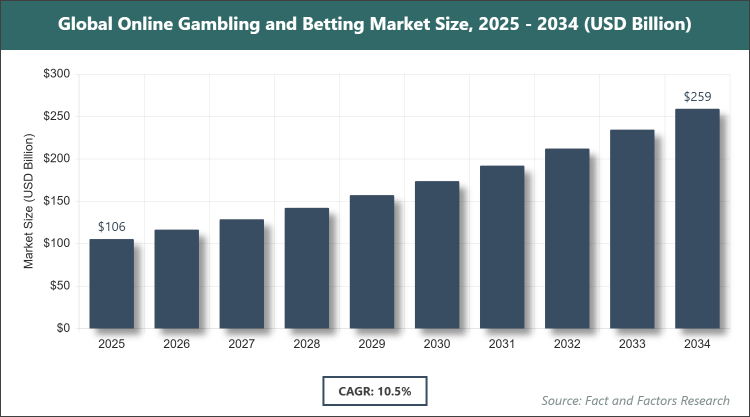
[250+ Pages Report] According to Facts & Factors, the global Online Gambling and Betting market size was estimated at USD 105.5 billion in 2025 and is expected to reach USD 286.4 billion by 2034, growing at a CAGR of 10.5% from 2026 to 2034. The online gambling and Betting Market is driven by the increasing legalization of online gambling and rising smartphone penetration.
 Market Overview
Online gambling and betting refer to the digital platforms and services that enable individuals to wager money on games of chance, skill-based events, or sports outcomes through internet-enabled devices, encompassing a wide array of activities from virtual casinos and poker rooms to sportsbooks and lotteries. This market operates within a framework of virtual environments where users can participate in real-time betting, leveraging random number generators for fairness in games like slots or roulette, while sports betting involves predicting results based on odds provided by bookmakers, all facilitated by secure payment gateways and user interfaces designed for accessibility and engagement without the need for physical presence at traditional venues.
Key Insights
- The Online Gambling and Betting market was valued at USD 105.5 billion in 2025 and is projected to reach USD 286.4 billion by the end of 2034.
- The market is expected to grow at a CAGR of 10.5% between 2026 and 2034.
- The Online Gambling and Betting market is driven by the increasing legalization of online gambling and rising smartphone penetration.
- Based on the Game Type segment, the Sports Betting subsegment dominated the market in 2025 with a share of 48.0% because of its appeal through live events, skill perception, and integration with major sports leagues.
- Based on the Device segment, the Mobile subsegment dominated the market in 2025 with a share of 57.0% because of widespread smartphone adoption and convenience for on-the-go betting.
- Europe held the largest market share of 41.0% in 2025 due to mature regulatory frameworks and high internet penetration.
Growth Drivers
- Increasing Legalization and Regulatory Support
The progressive legalization of online gambling in various regions has opened new markets, allowing operators to expand legally and attract a broader user base with compliant platforms. This driver is bolstered by governments recognizing revenue potential through taxes, leading to structured regulations that enhance user trust and stimulate investment in the sector.
- Rising Smartphone Penetration and Mobile Accessibility
The proliferation of affordable smartphones and improved mobile internet has made online gambling accessible anytime, driving user engagement through app-based platforms. This trend supports growth by enabling features like live betting and notifications, aligning with consumer preferences for convenience and real-time interaction.
- Technological Advancements in Gaming Platforms
Innovations such as VR, AI-driven personalization, and secure payment systems have enhanced user experiences, attracting tech-savvy demographics. These advancements reduce barriers like trust issues, fostering loyalty and expanding the market into new segments like esports betting.
Restraints
- Stringent Regulatory Compliance and Bans in Some Regions
Varying and often restrictive regulations, including outright bans in certain countries, limit market entry and operational freedom for providers. This restraint increases compliance costs and risks penalties, deterring investment and slowing expansion in high-potential but regulated areas.
- Concerns Over Gambling Addiction and Social Issues
Rising awareness of addiction risks leads to stricter age verification and responsible gaming mandates, impacting user acquisition. This challenge necessitates additional resources for harm prevention tools, potentially reducing profitability and facing public backlash.
Opportunities
- Expansion into Emerging Markets with Liberalizing Laws
Opportunities exist in regions like Latin America and Asia-Pacific, where regulations are easing, allowing entry into untapped populations. This can be capitalized on through localized platforms and partnerships, driving rapid user growth in high-population areas.
- Integration of Cryptocurrencies and Blockchain for Security
Adopting crypto payments offers anonymity and faster transactions, appealing to privacy-conscious users and reducing fraud. This innovation opens niches in blockchain-based fair play systems, enhancing trust and attracting a global, tech-forward audience.
Challenges
- Cybersecurity Threats and Data Privacy Concerns
Increasing cyber attacks on platforms pose risks to user data and funds, eroding trust and leading to potential losses. This requires ongoing investments in security infrastructure, challenging smaller operators and complicating compliance with data laws.
- Intense Competition and Market Saturation in Mature Regions
High competition in established markets like Europe forces aggressive marketing and promotions, squeezing margins. This dynamic demands continuous innovation to retain users, posing challenges for new entrants and sustaining growth.
Report Scope
Report Attribute |
Details |
Market Size in 2025 |
USD 105.5 Billion |
Projected Market Size in 2034 |
USD 286.4 Billion |
CAGR Growth Rate |
10.5% CAGR |
Base Year |
2025 |
Forecast Years |
2026-2034 |
Key Market Players |
Bet365 Group Ltd., Entain Plc, Flutter Entertainment Plc, DraftKings Inc., Betsson AB, 888 Holdings Plc, The Stars Group, Paddy Power Betfair Plc, Fortuna Entertainment Group, GVC Holdings Plc, Playtika, SciGames, Zynga, Betfred Ltd., The Betway Group, William Hill Plc, Kindred Group, Rank Group, Playtech, Hong Kong Jockey Club, and Others. |
Key Segment |
By Game Type, By Device, and By Region |
Major Regions Covered |
North America, Europe, Asia Pacific, Latin America, and the Middle East &, Africa |
Purchase Options |
Request customized purchase options to meet your research needs. Explore purchase options |
Market Segmentation
The Online Gambling and Betting market is segmented by type, application, end-user, and region.
Based on Game Type Segment, the Online Gambling and Betting market is divided into Sports Betting, Casino, Lottery, Bingo, and Others. The most dominant segment is Sports Betting, holding 48.0% share, due to its integration with popular sports events, real-time betting options, and perceived skill element that attracts a wide demographic, driving market growth through increased engagement and revenue from major leagues; the second most dominant is Casino, which propels the market by offering diverse games like slots and table games with high retention through live dealer features and bonuses, catering to entertainment seekers and boosting overall platform usage.
Based on Device Segment, the Online Gambling and Betting market is divided into Desktop, Mobile, and Others. The most dominant segment is Mobile, with 57.0% share, owing to its convenience, app-based accessibility, and alignment with rising smartphone usage, fueling market expansion via on-the-go betting and push notifications; the second most dominant is Desktop, contributing to growth by providing immersive experiences with larger screens and multi-tasking capabilities, appealing to serious bettors in regulated environments.
Recent Developments
- In March 2024, Betsson AB diversified its presence by acquiring a majority stake in a European sportsbook business, strengthening its B2B operations and expanding into new regulated markets.
- In February 2024, Entain Plc's BetMGM extended its partnership with NBC Sports for the 2024 NFL season, enhancing user engagement through exclusive digital integrations.
- In July 2025, the California Attorney General issued an opinion that daily fantasy sports violate state law, impacting operators and prompting regulatory reviews.
- In 2024, DraftKings acquired 888 Holdings, combining U.S. strengths with European assets to boost market share.
Regional Analysis
- Europe to dominate the global market
Europe dominates the Online Gambling and Betting market with a 41.0% share, driven by well-established regulations, high internet penetration, and a culture of gambling; the United Kingdom leads within the region, with its Gambling Commission overseeing a mature market featuring operators like Bet365 and William Hill, where innovations in mobile betting and live streaming in cities like London enhance user adoption amid favorable tax structures.
North America exhibits rapid growth, fueled by state-level legalizations and sports partnerships; the United States dominates, with states like New Jersey and Pennsylvania leading through platforms like DraftKings and FanDuel, supported by Supreme Court rulings enabling expansion, particularly in urban hubs like New York and Las Vegas where online sports betting integrates with professional leagues.
Asia-Pacific shows emerging potential with increasing digital access, though fragmented regulations; China influences through offshore platforms, while India drives growth via fantasy sports in cities like Mumbai and Delhi, leveraging cricket popularity and rising middle-class incomes despite national gambling restrictions.
Latin America is expanding with regulatory reforms; Brazil leads, legalizing sports betting in 2024, attracting investments in Sao Paulo and Rio de Janeiro for mobile platforms amid economic growth and football enthusiasm.
The Middle East and Africa remain nascent but promising; South Africa dominates in Africa with licensed operators, while the UAE pioneers in the Middle East through initiatives like Wynn's complex in Ras Al Khaimah, focusing on tourism-driven luxury gambling.
Competitive Analysis
The global Online Gambling and Betting market is dominated by players:
- Bet365 Group Ltd.
- Entain Plc
- Flutter Entertainment Plc
- DraftKings Inc.
- Betsson AB
- 888 Holdings Plc
- The Stars Group
- Paddy Power Betfair Plc
- Fortuna Entertainment Group
- GVC Holdings Plc
- Playtika
- SciGames
- Zynga
- Betfred Ltd.
- The Betway Group
- William Hill Plc
- Kindred Group
- Rank Group
- Playtech
- Hong Kong Jockey Club
The global Online Gambling and Betting market is segmented as follows:
By Game Type
- Sports Betting
- Casino
- Lottery
- Bingo
- Others
By Device
- Desktop
- Mobile
- Others
By Region
- North America
- The U.S.
- Canada
- Mexico
- Europe
- France
- The UK
- Spain
- Germany
- Italy
- Rest of Europe
- Asia Pacific
- China
- Japan
- India
- Australia
- Southeast Asia
- Rest of Asia Pacific
- The Middle East & Africa
- Saudi Arabia
- UAE
- Egypt
- Kuwait
- South Africa
- Rest of the Middle East & Africa
- Latin America
- Brazil
- Argentina
- Rest of Latin America
Industry Major Market Players
Frequently Asked Questions



Copyright © 2025 - 2026, All Rights Reserved, Facts and Factors