
Search Market Research Report
Non-Grain Oriented Electrical Steel Market Size, Share Global Analysis Report, 2026-2034

Non-Grain Oriented Electrical Steel Market Size, Share, Growth Analysis Report By Type (Fully Processed, Semi-Processed), By Application (Motors, Transformers, Generators, Others), By End-User (Energy and Utilities, Automotive, Household Appliances, Others), and By Region - Global Industry Insights, Overview, Comprehensive Analysis, Trends, Statistical Research, Market Intelligence, Historical Data and Forecast 2026-2034
Industry Insights
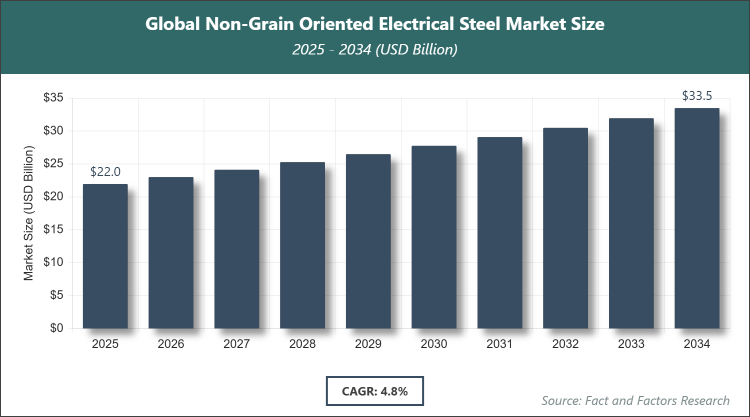
[225 Pages Report] According to Facts & Factors, the global Non-Grain Oriented Electrical Steel market size was estimated at USD 21.96 billion in 2025 and is expected to reach USD 33.4 billion by the end of 2034. The Non-Grain Oriented Electrical Steel industry is anticipated to grow by a CAGR of 4.8% between 2026 and 2034. The Non-Grain Oriented Electrical Steel Market is driven by rising demand for efficient transformers and electric motors.
 Market Overview
Non-grain oriented electrical steel, also known as NGOES or isotropic electrical steel, is a specialized ferromagnetic alloy designed for applications where magnetic properties are required to be uniform in all directions. It is primarily utilized in the cores of electric motors, generators, and small transformers, offering low core losses and high permeability to enhance energy efficiency in electrical devices.
Key Insights
- As per the analysis shared by our research analyst, the global Non-Grain Oriented Electrical Steel market is estimated to grow annually at a CAGR of around 4.8% over the forecast period (2026-2034).
- In terms of revenue, the global Non-Grain Oriented Electrical Steel market size was valued at around USD 21.96 billion in 2025 and is projected to reach USD 33.4 billion, by 2034.
- The market is driven by the growing emphasis on renewable energy and energy-efficient technologies.
- Based on the Type, the Fully Processed segment dominated the market in 2025 with a revenue share of 55% owing to its superior magnetic properties and ease of use in high-efficiency applications.
- Based on the Application, the Motors segment dominated the market in 2025 with a revenue share of 45% due to increasing demand from electric vehicles and industrial automation.
- Based on the End-User, the Energy and Utilities segment dominated the market in 2025 with a revenue share of 33% because of its critical role in power generation and distribution infrastructure.
- Asia Pacific dominated the global market in 2025 with a revenue share of 55% attributed to its status as a manufacturing hub with high EV production and rapid industrialization.
Growth Drivers
- Rising Demand for Electric Vehicles
The surge in electric vehicle adoption is a primary growth driver for the Non-Grain Oriented Electrical Steel market. NGOES is essential in EV motors for its ability to reduce energy losses and improve efficiency, aligning with global shifts toward sustainable transportation. Government incentives and stringent emission regulations further accelerate this demand, pushing manufacturers to innovate in motor designs that rely on high-quality electrical steel.
As EV production scales up in regions like Asia Pacific, the need for advanced NGOES grades increases, fostering market expansion. This trend not only boosts revenue but also encourages investments in production capacity to meet the evolving requirements of the automotive sector.
Restraints
- High Manufacturing Costs
The production of NGOES requires precise control over composition and processing, leading to elevated manufacturing costs that can hinder market growth in price-sensitive regions. Raw material price volatility, particularly for silicon and iron, exacerbates this issue, making it challenging for smaller players to compete.
These cost barriers limit adoption in developing economies where budget constraints prioritize affordability over efficiency. As a result, market penetration in emerging markets remains slower, potentially capping overall global expansion despite strong demand in premium applications.
Opportunities
- Advancements in Renewable Energy Infrastructure
The expansion of renewable energy sources like wind and solar presents significant opportunities for NGOES in efficient generators and transformers. As governments worldwide invest in green energy projects, the demand for materials that minimize power losses in these systems rises, opening new avenues for market players.
Technological innovations in thinner NGOES gauges enhance performance in renewable applications, allowing for lighter and more efficient equipment. This alignment with global sustainability goals positions the market for long-term growth through diversified applications beyond traditional sectors.
Challenges
- Supply Chain Vulnerabilities
Geopolitical tensions and raw material shortages pose challenges to the NGOES supply chain, leading to potential disruptions and price instability. Dependence on specific regions for key inputs like silicon increases risks, affecting production timelines and costs.
These vulnerabilities can delay project implementations in critical sectors like energy and automotive, impacting market confidence. Manufacturers must navigate these issues through diversification strategies, but ongoing global uncertainties continue to test the resilience of the supply network.
Report Scope
Report Attribute |
Details |
Market Size 2025 |
USD 21.96 Billion |
Projected Market Size in 2034 |
USD 33.4 Billion |
CAGR Growth Rate |
4.8% CAGR |
Base Year |
2025 |
Forecast Years |
2026-2034 |
Key Market Players |
ArcelorMittal, POSCO, Arnold Magnetic Technologies, Baosteel Group Corporation, Cleveland-Cliffs Inc., JFE Steel Corporation, NIPPON STEEL CORPORATION, Nucor Corporation, Thyssenkrupp, VIZ-Steel, and Others. |
Key Segment |
By Type, By Application, By End-User, and By Region |
Major Regions Covered |
North America, Europe, Asia Pacific, Latin America, and the Middle East & Africa |
Purchase Options |
Request customized purchase options to meet your research needs. Explore purchase options |
Market Segmentation
The Non-Grain Oriented Electrical Steel market is segmented by type, application, end-user, and region.
Based on Type Segment, the Non-Grain Oriented Electrical Steel market is divided into Fully Processed, Semi-Processed.
The most dominant segment is Fully Processed, holding a 55% share, as it offers ready-to-use properties with minimal additional processing, making it ideal for high-efficiency motors and transformers. This dominance drives the market by enabling faster assembly and better performance in energy-sensitive applications. The second most dominant is Semi-Processed, with around 45% share, valued for its cost-effectiveness in custom applications where manufacturers can tailor the final annealing, supporting market growth through flexibility in industrial uses.
Based on Application Segment, the Non-Grain Oriented Electrical Steel market is divided into Motors, Transformers, Generators, Others.
The most dominant segment is Motors, capturing 45% share, due to surging EV and industrial demand where NGOES reduces core losses for optimal efficiency. This drives overall market expansion by aligning with electrification trends. The second most dominant is Transformers, with about 30% share, essential for power distribution with low hysteresis losses, contributing to market growth via infrastructure upgrades.
Based on End-User Segment, the Non-Grain Oriented Electrical Steel market is divided into Energy and Utilities, Automotive, Household Appliances, Others.
The most dominant segment is Energy and Utilities, with 33% share, as NGOES is crucial for efficient power generation and transmission equipment amid rising energy demands. This propels market growth through renewable integration. The second most dominant is Automotive, holding around 25% share, driven by EV motor requirements for lightweight, high-performance materials, accelerating market momentum with sustainable mobility shifts.
Recent Developments
- In February 2025, ArcelorMittal announced plans to build a new electrical steel manufacturing plant in Calvert, Alabama, with an annual capacity of 150,000 metric tons focused on NGOES for automotive, renewable energy, and industrial sectors, aiming to start production in 2027.
- In October 2023, U.S. Steel introduced a new NGOES production line at its Big River Steel facility in Osceola, Arkansas, marking the largest capacity addition in the U.S., emphasizing sustainable solutions like InduX for the electric vehicle market.
Regional Analysis
- Asia Pacific to dominate the global market
Asia Pacific holds the largest share in the Non-Grain Oriented Electrical Steel market, driven by rapid industrialization and urbanization in countries like China and India. China dominates the region as the world's leading producer and consumer of electrical steel, supported by massive investments in EV manufacturing and renewable energy infrastructure. The region's robust manufacturing ecosystem and government policies promoting energy efficiency further solidify its position, fostering innovation and supply chain integration.
North America exhibits strong growth, with the United States leading due to stringent energy efficiency regulations and EV adoption. Investments in grid modernization and automotive electrification, such as through the Energy Independence and Security Act, enhance demand for NGOES in motors and transformers. Canada's focus on renewable energy and Mexico's automotive sector transformations contribute to regional dynamics, emphasizing sustainable technologies.
Europe emphasizes energy-efficient systems, with Germany dominating through its leadership in smart grids and renewable integration. Countries like France and Italy invest in advanced transformers and generators using NGOES to meet EU sustainability goals. The region's commitment to reducing carbon emissions drives innovation in electrical steel applications, supporting a transition to cleaner energy infrastructures.
Central & South America shows potential, led by Brazil's investments in wind and solar power. As a key renewable energy producer, Brazil utilizes NGOES for efficient electrical components in expanding infrastructure. The region's growing manufacturing and mining sectors in countries like Argentina further increase demand for energy-efficient motors, aligning with economic development.
The Middle East & Africa is emerging, with South Africa and the UAE leading through investments in manufacturing and construction. Egypt's focus on power sector upgrades boosts NGOES use in transformers. The region's diversification from oil dependency toward renewables and industrialization creates opportunities for efficient electrical materials in energy and industrial applications.
Competitive Analysis
The global Non-Grain Oriented Electrical Steel market is dominated by players:
- ArcelorMittal
- POSCO
- Arnold Magnetic Technologies
- Baosteel Group Corporation
- Cleveland-Cliffs Inc.
- JFE Steel Corporation
- NIPPON STEEL CORPORATION
- Nucor Corporation
- Thyssenkrupp
- VIZ-Steel
The global Non-Grain Oriented Electrical Steel market is segmented as follows:
By Type
- Fully Processed
- Semi-Processed
By Application
- Motors
- Transformers
- Generators
- Others
By End-User
- Energy and Utilities
- Automotive
- Household Appliances
- Others
By Region
- North America
- The U.S.
- Canada
- Mexico
- Europe
- France
- The UK
- Spain
- Germany
- Italy
- Rest of Europe
- Asia Pacific
- China
- Japan
- India
- Australia
- Southeast Asia
- Rest of Asia Pacific
- The Middle East & Africa
- Saudi Arabia
- UAE
- Egypt
- Kuwait
- South Africa
- Rest of the Middle East & Africa
- Latin America
- Brazil
- Argentina
- Rest of Latin America
Industry Major Market Players
The global Non-Grain Oriented Electrical Steel market is dominated by players:
- ArcelorMittal
- POSCO
- Arnold Magnetic Technologies
- Baosteel Group Corporation
- Cleveland-Cliffs Inc.
- JFE Steel Corporation
- NIPPON STEEL CORPORATION
- Nucor Corporation
- Thyssenkrupp
- VIZ-Steel
Frequently Asked Questions



Copyright © 2025 - 2026, All Rights Reserved, Facts and Factors