
Search Market Research Report
Nano Drones Market Size, Share Global Analysis Report, 2025 - 2034

Nano Drones Market Size, Share, Growth Analysis Report By Type (Fixed Wing Nano Drones, Flapping Wing Nano Drones, Rotor Nano Drones and Others), By Payload (Camera, Control Systems, Tracking Systems and Others), By End User (Consumer, Military or law enforcement and Others) And By Region - Global Industry Insights, Overview, Comprehensive Analysis, Trends, Statistical Research, Market Intelligence, Historical Data and Forecast 2025 - 2034
Industry Insights
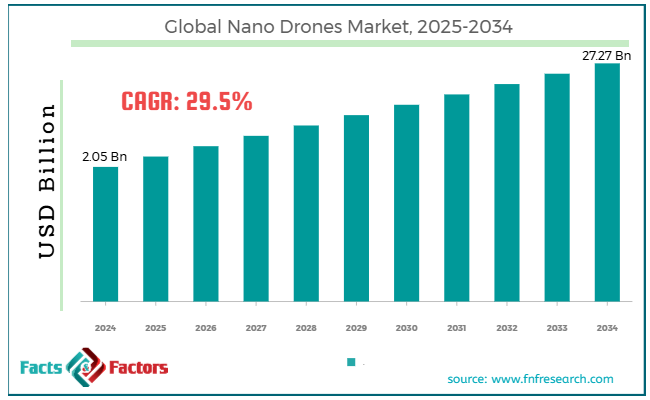
[221+ Pages Report] According to Facts & Factors, the global nano drones market size was worth around USD 2.05 billion in 2024 and is predicted to grow to around USD 27.27 billion by 2034 with a compound annual growth rate (CAGR) of roughly 29.5% between 2025 and 2034.
 Market Overview
Unmanned aerial vehicles (UAVs) called "nano drones" are distinguished by their minuscule size, usually with a maximum length of around 20 centimeters, but usually only a few centimeters. Due to their extensive technological features, including cameras, sensors, and communication systems, these tiny drones can carry out a variety of activities like monitoring, surveillance, reconnaissance, and even deliveries in tight or difficult-to-reach areas.
They are useful tools in industries such as military operations, disaster relief, agriculture, and entertainment because of their small size, which allows them to maneuver through confined locations and traverse with agility. The nano drones market is being driven by several factors including rising commercial applications, technological advancements, growing demand for surveillance and reconnaissance, increasing regulatory support and frameworks and many others.
Key Insights
- As per the analysis shared by our research analyst, the global nano drones market is estimated to grow annually at a CAGR of around 29.5% over the forecast period (2025-2034).
- In terms of revenue, the global nano drones market size was valued at around USD 2.05 billion in 2024 and is projected to reach USD 27.27 billion, by 2034.
- The growing product launch is expected to drive market growth over the forecast period.
- Based on the type, the fixed wing nano drones segment is expected to dominate the market during the forecast period.
- Based on the end user, the military or law enforcement is expected to grow at a significant rate during the projected period.
- Based on region, North America is expected to dominate the market during the forecast period.
Growth Drivers
- Technological advancement drives market growth
Component downsizing, increased battery efficiency, and improved data processing power have all contributed to the creation of small but potent drones. These developments allow small drones to fly longer and be more maneuverable while carrying complex sensors, cameras, and communication systems. Drones now possess autonomous capabilities because of the integration of artificial intelligence and machine learning, which enables them to operate in challenging conditions and complete tasks without continual human assistance. The possibility for additional shrinking and the addition of sophisticated features promises to revolutionize the possibilities of small drones across industries as technology continues to improve.
Restraints
- Regulatory challenges and limited payload capacity hinder market growth
It is still difficult to navigate the complicated regulatory environment governing UAVs, even with growing support from the government. Because of their small size and possible safety risks, nano drones are frequently subject to more fierce regulations, which restricts their operational capabilities and prevents market expansion.
Additionally, because of their small size, nano drones can only carry a limited amount of equipment, cameras, or sensors due to their restricted payload capacity. Their efficacy in specific applications, such as payload delivery or long-range surveillance, may be impacted by this constraint. Therefore, the regulatory challenge and limited payload capacity are expected to hinder the market growth during the forecast period.
Opportunities
- Rising product launches offer a lucrative opportunity for market growth
The increasing product launches are expected to offer a lucrative opportunity for market growth over the forecast period. For instance, in January 2024, an innovator in drone technology and top customer-focused consumer electronics brand in India, IZI, unveiled the IZI MINI X, the country's first 4K nano drone weighing 249 grams with two adaptable versions: Standalone and Fly More Combo.
With a slew of cutting-edge technologies, this drone completely transforms airborne capabilities. A 3-axis stabilized gimbal guarantees a wider angle and more thorough photos in the Standalone version, while an excellent CMOS sensor allows for a remarkable 20MP (5120*3840) image capability and smooth video recording. The drone has a strong 4Km live video transmission range, can fly for 31 minutes at a speed of 16m/sec (58km/h), and can reach a maximum height of 120m (800m). It weighs only 249 grams. With a one-year warranty and precise navigation and return mode utilizing GPS/GLONASS technology, it ensures safe returns with one-tap control in the event of a low battery or lost control.
Challenges
- Security and privacy concern poses a major challenge to market expansion
There are security risks associated with the widespread usage of nanodrones, including illegal spying, trespassing, and possible misuse by bad actors. Resolving these privacy and security issues is crucial to establishing confidence and promoting broader adoption of nanodrone technology.
Report Scope
Report Attribute |
Details |
Market Size in 2024 |
USD 2.05 Billion |
Projected Market Size in 2034 |
USD 27.27 Billion |
CAGR Growth Rate |
29.5% CAGR |
Base Year |
2024 |
Forecast Years |
2025-2034 |
Key Market Players |
Parrot SA, AeroVironment Inc., JJRC Toy, Prox Dynamics, Skyrocket Toys LLC, Mota Group Inc., Syma Toys, Guangdong Cheerson Hobby Technology Co. Ltd, Horizon Hobby, Aerix Drone, Hubsan Technology Company Ltd., Acumen Robot Intelligence (ARI), Extreme Fliers, UDIRC Toys Co. Ltd, Swarm Systems Ltd., TRNDlabs, WLtoys, Drona Aviation Pvt. Ltd., XK Innovations, and others. |
Key Segment |
By Type, By Payload, By End User, and Region |
Major Regions Covered |
North America, Europe, Asia Pacific, Latin America, and the Middle East &, Africa |
Purchase Options |
Request customized purchase options to meet your research needs. Explore purchase options |
Segmentation Analysis
The global nano drones industry is segmented based on type, payload, end user and region.
Based on the type, the global nano drones market is bifurcated into fixed wing nano drones, flapping wing nano drones, rotor nano drones and others. The fixed wing nano drones segment is expected to dominate the market during the forecast period. When it comes to range and flight duration, fixed-wing nano drones usually outperform their rotary-wing counterparts. Their increased endurance makes them desirable for applications like environmental monitoring, infrastructure inspection, and agriculture since it allows them to traverse greater ground and carry out longer surveillance or mapping missions.
Furthermore, fixed-wing nano drones work well in open spaces, remote locations, and large regions where long-distance flights are required. Their adaptability and market appeal across industries like forestry, land management, and disaster response are enhanced by their capacity to cover a variety of landscapes and endure moderate wind conditions. Thus, these characteristics are expected to drive the segment expansion.
Based on the payload, the global nano drones industry is segmented into camera, control systems, tracking systems and others.
Based on the end user, the global nano drones market is segmented into consumer, military or law enforcement and others. The military or law enforcement is expected to grow at a significant rate during the projected period. To meet changing security risks and challenges, military and law enforcement organizations are putting more emphasis on improving their surveillance and reconnaissance capabilities. Nano drones offer an agile and economical way to do clandestine operations, monitor regions of interest, and obtain real-time intelligence.
Additionally, the performance and dependability of nano drones have been greatly enhanced by technological developments in reduction, battery life, sensor capabilities, and communication systems. The military and law enforcement organizations are adopting nano drones because of their increased autonomy and efficiency in complex operations, as well as their ability to operate in a variety of climatic circumstances. Thus, driving the revenue growth of the market from military or law enforcement.
Regional Analysis
- North America is expected to dominate the market during the forecast period
North America is expected to dominate the market over the forecast period. The regional growth of the market is attributed to rising military and defense spending. The need for nano drones for military applications like surveillance, reconnaissance, and battlefield awareness is fueled by the region's strong focus on defense modernization and investment in cutting-edge technologies, particularly unmanned aerial systems.
For instance, the U.S. Congressional Budget Office projects that by 2033, defense spending will reach 1.1 trillion dollars. The Departments of the Air Force and the Navy receive the greatest amount of funding. The United States Air Force's budget for 2024 was close to 260 billion dollars. Moreover, the presence of major players and innovative product development is expected to lead the market growth in the region.
For instance, in October 2024, the new Black Hornet® 4 Personal Reconnaissance System was unveiled by Teledyne FLIR Defense, a division of Teledyne Technologies Incorporated, at the Association of the U.S. Army (AUSA) conference in Washington, D.C. Expanding upon its predecessor, Black Hornet 4 is the latest generation of lightweight nano-drones that provide tiny units with improved covert situational awareness. Crisp video and still photos are provided to the operator via a new 12-megapixel daytime camera with exceptional low-light performance and a new high-resolution thermal imager. The Black Hornet 4 weighs only 70 grams and can fly for over 30 minutes in 25 knot gusts. Its range is over two kilometers. An upgraded battery and improved obstacle avoidance capabilities have improved flight performance.
Competitive Analysis
The global nano drones market is dominated by players like:
- Parrot SA
- AeroVironment Inc.
- JJRC Toy
- Prox Dynamics
- Skyrocket Toys LLC
- Mota Group Inc.
- Syma Toys
- Guangdong Cheerson Hobby Technology Co. Ltd
- Horizon Hobby
- Aerix Drone
- Hubsan Technology Company Ltd.
- Acumen Robot Intelligence (ARI)
- Extreme Fliers
- UDIRC Toys Co. Ltd
- Swarm Systems Ltd.
- TRNDlabs
- WLtoys
- Drona Aviation Pvt. Ltd.
- XK Innovations
The global nano drones market is segmented as follows:
By Type
- Fixed Wing Nano Drones
- Flapping Wing Nano Drones
- Rotor Nano Drones
- Others
By Payload
- Camera
- Control Systems
- Tracking Systems
- Others
By End User
- Consumer
- Military or law enforcement
- Others
By Regional Segment Analysis
- North America
- The U.S.
- Canada
- Mexico
- Europe
- France
- The UK
- Spain
- Germany
- Italy
- Rest of Europe
- Asia Pacific
- China
- Japan
- India
- Australia
- Southeast Asia
- Rest of Asia Pacific
- The Middle East & Africa
- Saudi Arabia
- UAE
- Egypt
- Kuwait
- South Africa
- Rest of the Middle East & Africa
- Latin America
- Brazil
- Argentina
- Rest of Latin America
Industry Major Market Players
- Parrot SA
- AeroVironment Inc.
- JJRC Toy
- Prox Dynamics
- Skyrocket Toys LLC
- Mota Group Inc.
- Syma Toys
- Guangdong Cheerson Hobby Technology Co. Ltd
- Horizon Hobby
- Aerix Drone
- Hubsan Technology Company Ltd.
- Acumen Robot Intelligence (ARI)
- Extreme Fliers
- UDIRC Toys Co. Ltd
- Swarm Systems Ltd.
- TRNDlabs
- WLtoys
- Drona Aviation Pvt. Ltd.
- XK Innovations
Frequently Asked Questions



Copyright © 2025 - 2026, All Rights Reserved, Facts and Factors