
Search Market Research Report
Lithium Fluoride Market Size, Share Global Analysis Report, 2026-2034

Lithium Fluoride Market Size, Share, Growth Analysis Report By Type (Upto 98%, Above 98%), By Application (Fluorescent Materials, Lithium-ion Batteries, Radiation Measurement, Optical Materials, Others), and By Region - Global Industry Insights, Overview, Comprehensive Analysis, Trends, Statistical Research, Market Intelligence, Historical Data and Forecast 2026-2034
Industry Insights
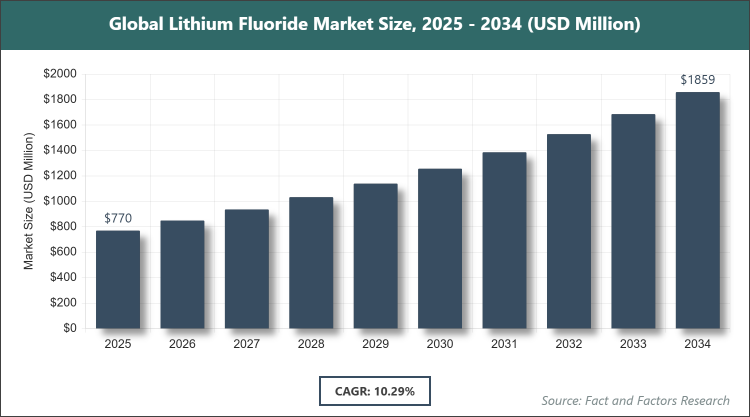
[242+ Pages Report] According to Facts & Factors, the global Lithium Fluoride market size was estimated at USD 770.05 million in 2025 and is expected to reach USD 1859.05 million by the end of 2034. The Lithium Fluoride industry is anticipated to grow by a CAGR of 10.29% between 2026 and 2034. The Lithium Fluoride Market is driven by increasing demand in lithium-ion batteries and glass & ceramics sectors.
 Market Overview
Lithium fluoride is an inorganic chemical compound characterized by its white, crystalline appearance and high solubility in polar solvents, serving primarily as a fluxing agent in the production of glasses, enamels, and ceramics to lower melting points and enhance product durability. It plays a critical role in specialized applications such as neutron detectors in nuclear reactors due to its ability to capture thermal neutrons, and as a component in molten salt mixtures for advanced energy systems. Additionally, this compound is utilized in optical materials for its exceptional transparency to ultraviolet light, making it ideal for lenses and windows in spectroscopic instruments, while its use in battery electrolytes contributes to improved ionic conductivity and stability in energy storage technologies.
Key Insights
- As per the analysis shared by our research analyst, the global Lithium Fluoride market is estimated to grow annually at a CAGR of around 10.29% over the forecast period (2026-2034).
- In terms of revenue, the global Lithium Fluoride market size was valued at around USD 770.05 million in 2025 and is projected to reach USD 1859.05 million by 2034.
- The market is driven by surging adoption of electric vehicles and advancements in energy storage systems.
- Based on the type, the above 98% segment dominated the market with a share of 67.9%, as it provides superior purity essential for high-performance applications in lithium-ion batteries and optics.
- Based on the application, the lithium-ion batteries segment dominated with a share of 49.2%, due to the escalating demand for efficient electrolytes in EV and renewable energy storage.
- Asia Pacific dominated the global market with a share of 45%, attributed to China's leadership in battery manufacturing and strong industrial base in electronics and automotive sectors.
Growth Drivers
- Expanding Electric Vehicle Production
The rapid proliferation of electric vehicles globally has heightened the need for lithium fluoride as a key precursor in battery electrolytes, enabling enhanced conductivity and thermal stability that support longer battery life and faster charging. This driver is fueled by governmental policies promoting clean energy transitions and subsidies for EV adoption, which in turn stimulate investments in battery manufacturing infrastructure and research into advanced materials.
Moreover, collaborations between automotive giants and chemical suppliers are fostering innovations in fluoride-based compounds, optimizing battery performance for diverse climates and usage scenarios. As consumer awareness of environmental benefits grows, the push for sustainable mobility solutions continues to amplify market demand, solidifying lithium fluoride's role in the electrification ecosystem.
Restraints
- Supply Chain Vulnerabilities and Raw Material Scarcity
Dependencies on limited lithium resources and complex extraction processes create supply bottlenecks, elevating production costs and leading to price volatility that challenges market stability. Geopolitical factors and environmental regulations further constrain mining operations, restricting access to high-quality feedstock necessary for lithium fluoride synthesis.
In addition, transportation disruptions and trade barriers can delay deliveries, impacting downstream industries reliant on a consistent supply. These restraints are particularly acute in regions without domestic lithium reserves, forcing reliance on imports and exposing markets to external economic fluctuations.
Opportunities
- Advancements in Nuclear Energy Technologies
The resurgence of interest in nuclear power as a low-carbon energy source opens avenues for lithium fluoride in molten salt reactors, where it acts as a coolant and neutron moderator, enhancing safety and efficiency. Investments in next-generation nuclear facilities and research into fusion energy highlight the compound's potential in high-temperature applications.
Furthermore, partnerships between energy firms and material scientists are exploring modified lithium fluoride formulations to improve reactor longevity and reduce maintenance needs. This opportunity aligns with global efforts to diversify energy portfolios and achieve net-zero emissions, positioning the market for sustained expansion.
Challenges
- Environmental Regulations and Sustainability Concerns
Stringent environmental standards governing lithium extraction and processing pose compliance hurdles, increasing operational costs and necessitating investments in eco-friendly technologies. Concerns over water usage and habitat disruption in mining areas attract scrutiny from regulators and activists, potentially delaying projects.
Additionally, the push for circular economies demands effective recycling methods for fluoride-containing products, which are currently underdeveloped. Balancing growth with sustainability requires ongoing innovation, but slow adoption could hinder market progress in environmentally conscious regions.
Report Scope
Report Attribute |
Details |
Market Size 2025 |
USD 770.05 Million |
Projected Market Size in 2034 |
USD 1859.05 Million |
CAGR Growth Rate |
10.29% CAGR |
Base Year |
2025 |
Forecast Years |
2026-2034 |
Key Market Players |
Crystran Ltd, FMC Corporation, American Elements, Leverton Clarke, Axiom Chemicals Pvt. Ltd., Ganfeng Lithium Group Co., Ltd., Harshil Fluoride Brivo Lithium, Eagle Picher Technologies, Albemarle Corporation, and Others. |
Key Segment |
By Type, By Application, and By Region |
Major Regions Covered |
North America, Europe, Asia Pacific, Latin America, and the Middle East & Africa |
Purchase Options |
Request customized purchase options to meet your research needs. Explore purchase options |
Market Segmentation
The Lithium Fluoride market is segmented by type, application, and region.
Based on Type Segment, The Lithium Fluoride market is divided into upto 98%, above 98%. The above 98% segment emerges as the most dominant, holding approximately 67.9% market share, primarily due to its high purity levels that ensure minimal impurities in critical applications like lithium-ion batteries and optical components, driving market growth by enabling superior performance, reliability, and compliance with stringent industry standards for energy storage and precision instruments. The upto 98% segment follows as the second most dominant, with around 32% share, owing to its cost-effectiveness for less demanding uses such as fluxes in metallurgy and ceramics, contributing to market expansion by facilitating broader accessibility and supporting industrial processes that prioritize affordability over ultra-high purity.
Based on Application Segment, The Lithium Fluoride market is divided into fluorescent materials, lithium-ion batteries, radiation measurement, optical materials, others. The lithium-ion batteries segment is the most dominant, capturing about 49.2% of the market, as it utilizes lithium fluoride's excellent ionic conductivity and stability in electrolytes, propelled by the global shift toward electric mobility and renewable energy, thereby driving overall market growth through increased production scales and technological advancements in battery efficiency. The optical materials segment ranks second, with roughly 20% share, benefiting from lithium fluoride's transparency to UV light and low refractive index, essential for lenses and windows in scientific instruments, aiding market progression by supporting innovations in spectroscopy and imaging technologies.
Recent Developments
- In January 2024, Livent Corporation and Allkem Limited merged to form Arcadium Lithium, enhancing lithium chemical capabilities including fluoride derivatives for battery applications, strengthening global supply chains.
- In August 2024, Arcadium Lithium acquired Li-Metal’s lithium metal business for USD 11 million, boosting production of advanced materials like lithium fluoride for sustainable battery solutions.
- In January 2023, Ganfeng Lithium announced a USD 2.14 billion investment in two new battery factories, increasing capacity by 34 GWh, which includes expanded production of lithium fluoride-based electrolytes.
- In January 2026, US lithium fluoride prices surged 6.2% due to tight imports and rising demand from the battery sector, reflecting constrained global supplies.
- In November 2025, Posco invested KRW 1.1 trillion in a 30% stake in Australian lithium operations, securing feedstock for lithium fluoride production in EV batteries.
Regional Analysis
- Asia Pacific to dominate the global market
Asia Pacific leads the lithium fluoride market, bolstered by extensive manufacturing hubs and aggressive policies supporting electric vehicle adoption and renewable energy integration. China dominates this region with its integrated supply chains encompassing mining, processing, and battery assembly, enabling cost advantages and rapid scaling of production to meet both domestic and international demands for advanced energy materials.
North America exhibits steady growth, driven by investments in sustainable technologies and incentives for domestic production to enhance supply security. The United States stands out as the key country, with federal initiatives like tax credits for clean energy spurring developments in battery and nuclear sectors, fostering innovation in high-purity compounds for diverse applications.
Europe focuses on green transitions and regulatory frameworks emphasizing low-emission technologies, accelerating demand in automotive and energy storage. Germany emerges dominant, leveraging its engineering prowess and EU funding to advance material sciences, prioritizing eco-friendly processes that align with sustainability goals and strengthen regional competitiveness in global markets.
Latin America shows emerging potential, supported by abundant natural resources and efforts to develop local value chains for economic growth. Brazil leads, utilizing its mineral wealth and international partnerships to expand extraction and refining capabilities, aiming to integrate into the battery supply ecosystem and promote regional advancements in clean technologies.
The Middle East & Africa region is progressively engaging, aided by diversification strategies and renewable energy projects. South Africa dominates, capitalizing on its mining infrastructure and solar initiatives to build expertise in chemical processing, contributing to energy access and positioning the area in the evolving landscape of sustainable materials.
Competitive Analysis
The global Lithium Fluoride market is dominated by players:
- Crystran Ltd
- FMC Corporation
- American Elements
- Leverton Clarke
- Axiom Chemicals Pvt. Ltd.
- Ganfeng Lithium Group Co., Ltd.
- Harshil Fluoride Brivo Lithium
- Eagle Picher Technologies
- Albemarle Corporation
- Anhui Fitech Materials Co., Ltd.
- Shandong Yinglang Chemical Co., Ltd.
- Hubei Baijierui Advanced Materials Co., Ltd.
- And Others.
The global Lithium Fluoride market is segmented as follows:
By Type
- Upto 98%
- Above 98%
By Application
- Fluorescent Materials
- Lithium-ion Batteries
- Radiation Measurement
- Optical Materials
- Others
By Region
- North America
- The U.S.
- Canada
- Mexico
- Europe
- France
- The UK
- Spain
- Germany
- Italy
- Rest of Europe
- Asia Pacific
- China
- Japan
- India
- Australia
- Southeast Asia
- Rest of Asia Pacific
- The Middle East & Africa
- Saudi Arabia
- UAE
- Egypt
- Kuwait
- South Africa
- Rest of the Middle East & Africa
- Latin America
- Brazil
- Argentina
- Rest of Latin America
Industry Major Market Players
- Crystran Ltd
- FMC Corporation
- American Elements
- Leverton Clarke
- Axiom Chemicals Pvt. Ltd.
- Ganfeng Lithium Group Co., Ltd.
- Harshil Fluoride Brivo Lithium
- Eagle Picher Technologies
- Albemarle Corporation
- Anhui Fitech Materials Co., Ltd.
- Shandong Yinglang Chemical Co., Ltd.
- Hubei Baijierui Advanced Materials Co., Ltd
Frequently Asked Questions



Copyright © 2025 - 2026, All Rights Reserved, Facts and Factors