
Search Market Research Report
LED Lighting Market Size, Share Global Analysis Report, 2026-2034

LED Lighting Market Size, Share, Growth Analysis Report By Product Type (Lamps, Luminaires, and Others), By Application (Indoor, Outdoor, and Others), By End-User (Residential, Commercial, Industrial, and Others), and By Region - Global Industry Insights, Overview, Comprehensive Analysis, Trends, Statistical Research, Market Intelligence, Historical Data and Forecast 2026-2034
Industry Insights
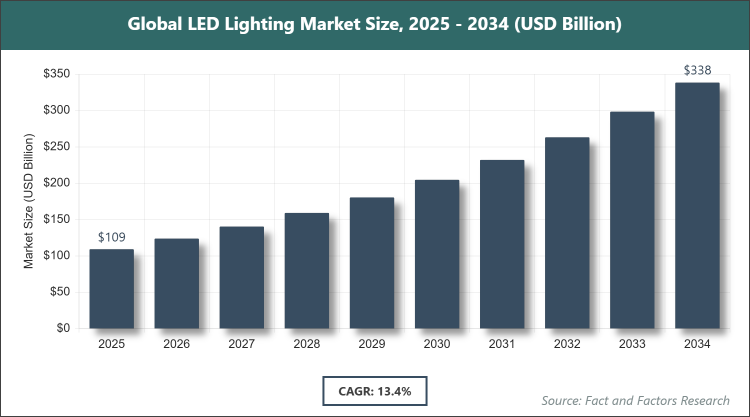
[220 Pages Report] According to Facts & Factors, the global LED lighting market size was estimated at USD 109.11 billion in 2025 and is expected to reach USD 336.90 billion by the end of 2034. The LED lighting industry is anticipated to grow by a CAGR of 13.40% between 2026 and 2034. The LED Lighting Market is driven by increasing demand for energy-efficient and sustainable lighting solutions.
 Market Overview
The LED lighting market encompasses the production, distribution, and application of light-emitting diode (LED) technologies used for illumination purposes across various sectors. LEDs are semiconductor devices that convert electricity into light through electroluminescence, offering superior energy efficiency, longer lifespan, and reduced environmental impact compared to traditional lighting sources like incandescent and fluorescent bulbs. This market includes a wide range of products such as lamps and luminaires designed for indoor and outdoor use, serving residential, commercial, and industrial needs. It is characterized by ongoing innovations in smart lighting, integration with IoT systems, and a focus on sustainability to meet global energy conservation goals.
Key Insights
- As per the analysis shared by our research analyst, the global LED lighting market is estimated to grow annually at a CAGR of around 13.40% over the forecast period (2026-2034).
- In terms of revenue, the global LED lighting market size was valued at around USD 109.11 billion in 2025 and is projected to reach USD 336.90 billion by 2034.
- The market is driven by rising demand for energy-efficient lighting, government incentives, and adoption in sectors like automotive and consumer electronics.
- Based on the product type, the luminaires segment dominated the market with a share of around 58% due to their versatility in applications such as track lighting, high bays, and troffers, which allow for customized and efficient illumination in commercial and industrial settings.
- Based on the application, the indoor segment dominated the market with a share of around 62% as it caters to the majority of daily lighting needs in homes, offices, and public spaces, where energy savings and longevity are prioritized.
- Based on the end-user, the commercial segment dominated the market with a share of around 52% owing to the high volume of lighting requirements in offices, retail, and hospitality environments, driven by cost reduction and regulatory compliance for energy efficiency.
- Based on region, Asia Pacific dominated the global market with a share of around 40% attributed to its role as a manufacturing hub, rapid urbanization, and supportive government policies in countries like China and India promoting energy-efficient technologies.
Market Dynamics
Growth Drivers
- Increasing Demand for Energy-Efficient Solutions
The global push towards sustainability has significantly boosted the adoption of LED lighting, as it consumes up to 80% less energy than traditional alternatives, leading to substantial cost savings and reduced carbon emissions. Governments worldwide are implementing stringent regulations and incentives, such as subsidies and bans on inefficient bulbs, to accelerate this transition.
In addition, advancements in LED technology, including improved luminous efficacy and dimmable features, have made them suitable for diverse applications, further driving market expansion. The integration of LEDs with smart systems enhances user control and automation, appealing to modern consumers and businesses focused on operational efficiency.
Restraints
- High Initial Investment Costs
Despite long-term savings, the upfront cost of LED products remains a barrier, particularly in price-sensitive markets and for large-scale installations. This can deter adoption in developing regions where budget constraints prioritize short-term expenses over future benefits.
Quality variations among manufacturers also pose challenges, as substandard products may fail prematurely, eroding consumer trust and slowing market penetration. Supply chain disruptions, including raw material shortages, can exacerbate these issues by increasing prices and delaying availability.
Opportunities
- Expansion of Smart Lighting and IoT Integration
The rise of smart cities and connected homes presents vast opportunities for LED lighting embedded with sensors and wireless controls, enabling features like remote management and adaptive brightness. This convergence with IoT platforms allows for data-driven insights, optimizing energy use and enhancing security applications.
Emerging markets in Asia and Africa, with growing infrastructure projects, offer untapped potential for LED adoption through partnerships and localized production. Innovations in human-centric lighting, which mimics natural light to improve well-being, are also opening new avenues in healthcare and education sectors.
Challenges
- Counterfeit Products and Market Saturation
The proliferation of low-quality counterfeit LEDs undermines market integrity, leading to safety concerns and reduced performance, which can hinder genuine manufacturers' growth. Regulatory enforcement varies globally, complicating efforts to maintain standards.
As the market matures, saturation in developed regions shifts competition towards price wars, pressuring margins and innovation. Adapting to evolving standards for recyclability and environmental impact adds complexity, requiring ongoing R&D investments to stay compliant.
Report Scope
Report Attribute |
Details |
Market Size 2025 |
USD 109.11 Billion |
Projected Market Size in 2034 |
USD 336.90 Billion |
CAGR Growth Rate |
13.40% CAGR |
Base Year |
2025 |
Forecast Years |
2026-2034 |
Key Market Players |
Signify N.V., OSRAM GmbH, GE Lighting, Acuity Brands, Inc., Cree Lighting, Nichia Corporation, Seoul Semiconductor Co., Ltd., Zumtobel Group AG, Everlight Electronics Co., Ltd., and Others. |
Key Segment |
By Product Type, By Application, By End-User, and By Region |
Major Regions Covered |
North America, Europe, Asia Pacific, Latin America, and the Middle East & Africa |
Purchase Options |
Request customized purchase options to meet your research needs. Explore purchase options |
Market Segmentation
The LED lighting market is segmented by product type, application, end-user, and region.
Based on Product Type Segment, the LED lighting market is divided into lamps, luminaires, and others. The luminaires segment emerged as the most dominant, capturing a significant market share due to its widespread use in fixed installations that require durable and design-flexible lighting solutions. Luminaires drive the market by enabling seamless integration into architectural designs, supporting energy-efficient retrofits, and accommodating advanced features like dimming and color tuning, which enhance user experience and promote broader adoption. The lamps segment follows as the second most dominant, valued for its ease of replacement in existing fixtures and cost-effectiveness for residential applications, contributing to market growth through quick upgrades that reduce energy consumption without major infrastructure changes.
Based on Application Segment, the LED lighting market is divided into indoor, outdoor, and others. The indoor segment stands out as the most dominant, holding the largest share because of its essential role in everyday environments where consistent, high-quality lighting is crucial for productivity and comfort. It propels the market forward by addressing the high demand for efficient illumination in homes, offices, and retail spaces, where LEDs offer superior color rendering and longevity, leading to lower maintenance costs and encouraging widespread replacement of outdated systems. The outdoor segment is the second most dominant, driven by applications in street lighting and landscaping, where weather-resistant LEDs improve safety and visibility while supporting urban development initiatives through energy savings and smart controls.
Based on End-User Segment, the LED lighting market is divided into residential, commercial, industrial, and others. The commercial segment dominates with the highest share, as businesses prioritize cost-effective lighting to minimize operational expenses in large-scale facilities like malls and offices. It accelerates market growth by leveraging LEDs for enhanced ambiance and energy management, often integrated with building automation systems to achieve sustainability targets and comply with green building certifications. The residential segment ranks second, fueled by consumer awareness of energy bills and environmental benefits, driving market expansion through affordable, user-friendly LED bulbs that enable easy home upgrades and support the trend towards smart homes.
Recent Developments
- In February 2026, Cree LED launched OptiLamp™ LEDs with Active Intelligence in Every Pixel, enhancing brightness, efficiency, and system simplicity for displays and lighting applications.
- In October 2025, Signify introduced the Philips Aura Floodlight in India, combining decorative aesthetics with professional outdoor illumination for cultural and municipal uses.
- In November 2025, LED Expo New Delhi showcased innovations from global manufacturers, highlighting new LED technologies and applications.
- In July 2025, Acuity Brands announced a price increase for luminaires and electronics due to global tariffs and market volatility.
- In June 2025, Wolfspeed filed for Chapter 11 bankruptcy to reduce debt while continuing operations.
- In April 2025, Signify sued Nanoleaf for infringement of smart-lighting patents.
Regional Analysis
- Asia Pacific to dominate the global market
The Asia Pacific region leads the LED lighting market, primarily due to rapid urbanization and extensive manufacturing capabilities in countries like China, which serves as the dominant player with its vast production ecosystem and export prowess. China's government initiatives for energy conservation and infrastructure modernization have accelerated LED adoption, fostering innovation in cost-effective solutions that cater to both domestic and international demands. The region's emphasis on sustainable development further strengthens its position, with policies promoting green technologies that reduce energy consumption across urban landscapes.
North America holds a significant share, with the United States dominating through advanced R&D and strong adoption of smart lighting systems. The focus on energy efficiency standards and corporate sustainability goals drives market growth, as businesses and municipalities invest in LED retrofits to achieve cost savings and environmental compliance. Technological integrations like IoT enhance functionality, making the region a hub for premium, connected lighting solutions that prioritize performance and user control.
Europe follows closely, led by Germany, which excels in high-quality engineering and stringent environmental regulations that mandate efficient lighting. The European Union's push for carbon neutrality encourages widespread LED implementation in public and private sectors, emphasizing recyclable materials and low-emission production. This regulatory environment supports innovation in human-centric lighting, improving well-being in workplaces and homes while aligning with broader climate objectives.
Latin America is emerging, with Brazil at the forefront due to growing infrastructure projects and increasing awareness of energy savings. Government programs aimed at modernizing public lighting in urban areas drive demand, as LEDs offer reliable solutions for enhancing safety and reducing utility costs in developing economies. The region's tropical climate benefits from durable outdoor LEDs, supporting expansion in street and architectural applications.
The Middle East & Africa region shows potential, dominated by the United Arab Emirates, where ambitious smart city initiatives like those in Dubai integrate advanced LED systems for efficient urban management. Oil-rich economies are diversifying into sustainable technologies, using LEDs to lower energy demands in harsh environments and support tourism through illuminated landmarks. Challenges like high temperatures are addressed with robust designs, paving the way for broader adoption.
Competitive Analysis
The global LED lighting market is dominated by players:
- Signify N.V.
- OSRAM GmbH
- GE Lighting
- Acuity Brands, Inc.
- Cree Lighting
- Nichia Corporation
- Seoul Semiconductor Co., Ltd.
- Zumtobel Group AG
- Everlight Electronics Co., Ltd.
- Others
The global LED lighting market is segmented as follows:
By Product Type
- Lamps
- Luminaires
- Others
By Application
- Indoor
- Outdoor
- Others
By End-User
- Residential
- Commercial
- Industrial
- Others
By Regional Segment Analysis
- North America
- The U.S.
- Canada
- Mexico
- Europe
- France
- The UK
- Spain
- Germany
- Italy
- Rest of Europe
- Asia Pacific
- China
- Japan
- India
- Australia
- Southeast Asia
- Rest of Asia Pacific
- The Middle East & Africa
- Saudi Arabia
- UAE
- Egypt
- Kuwait
- South Africa
- Rest of the Middle East & Africa
- Latin America
- Brazil
- Argentina
- Rest of Latin America
Industry Major Market Players
Frequently Asked Questions



Copyright © 2025 - 2026, All Rights Reserved, Facts and Factors