
Search Market Research Report
UHT Milk Market Size, Share Global Analysis Report, 2026-2034

UHT Milk Market Size, Share, Growth Analysis Report By Product Type (Whole UHT Milk, Semi-Skimmed UHT Milk, Skimmed UHT Milk, Flavored UHT Milk, and Others), By Application (Direct Drinking, Food Processing, Bakery & Confectionery, and Others), By End-User (Households, HoReCa, Industrial, and Others), and By Region - Global Industry Insights, Overview, Comprehensive Analysis, Trends, Statistical Research, Market Intelligence, Historical Data and Forecast 2026-2034
Industry Insights
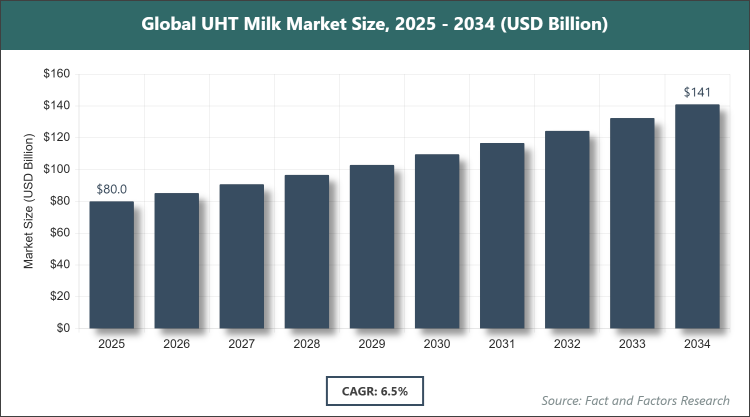
[220+ Pages Report] According to Facts & Factors, the global UHT Milk market size was estimated at USD 80 billion in 2025 and is expected to reach USD 140 billion by the end of 2034. The UHT Milk industry is anticipated to grow by a CAGR of 6.5% between 2026 and 2034. The UHT Milk Market is driven by increasing urbanization and demand for shelf-stable dairy products.
 Market Overview
UHT milk, or ultra-high temperature milk, is a dairy product processed at high temperatures for a short duration to eliminate bacteria and extend shelf life without refrigeration, making it a convenient option for consumers in regions with limited cold chain infrastructure and appealing to those seeking long-lasting, nutritious beverages for everyday use.
Key Insights
- As per the analysis shared by our research analyst, the global UHT Milk market is estimated to grow annually at a CAGR of around 6.5% over the forecast period (2026-2034).
- In terms of revenue, the global UHT Milk market size was valued at around USD 80 billion in 2025 and is projected to reach USD 140 billion by 2034.
- The market is driven by rising preference for convenient, long-shelf-life dairy in emerging economies.
- Based on the Product Type, the Whole UHT Milk segment dominated the market in 2025 with a share of over 42%, due to its rich taste and versatility in culinary applications like coffee and cooking.
- Based on the Application, the Direct Drinking segment dominated the market in 2025 with a share of over 59%, attributed to consumer demand for ready-to-consume nutritious beverages without preparation.
- Based on the End-User, the Households segment dominated the market in 2025 with a share of over 70%, owing to everyday consumption needs and convenience in storage for families.
- Based on the region, Asia Pacific dominated the market in 2025 with a share of around 42%, driven by rapid urbanization, expanding retail channels, and limited refrigeration in rural areas.
Growth Drivers
- Rising Urbanization and Busy Lifestyles
Urban expansion in developing regions increases the need for convenient food options like UHT milk, which requires no refrigeration and offers extended shelf life, catering to time-constrained consumers. This trend supports market growth by aligning with modern retail formats and e-commerce platforms that enhance accessibility.
Innovations in packaging, such as aseptic cartons, improve portability and sustainability, further encouraging adoption among health-conscious urban dwellers seeking nutritious alternatives to fresh milk.
Restraints
- High Processing Costs and Equipment Investments
The capital-intensive nature of UHT processing technology poses barriers for small-scale producers, limiting market entry and expansion in price-sensitive regions. This cost factor can lead to higher product prices, affecting competitiveness against traditional pasteurized milk.
Supply chain complexities, including raw milk sourcing fluctuations, exacerbate production challenges, potentially disrupting availability and increasing operational expenses.
Opportunities
- Expansion into Plant-Based and Functional Variants
The growing demand for lactose-free and fortified UHT milk opens avenues for product diversification, targeting health-focused consumers and those with dietary restrictions. This innovation can capture premium segments through added nutrients like vitamins and probiotics.
Emerging markets in Africa and Latin America offer untapped potential via partnerships with local dairies, leveraging government initiatives for food security and nutrition.
Challenges
- Consumer Perception of Taste and Nutrition
Perceived alterations in flavor from high-temperature processing can deter traditional milk consumers, requiring marketing efforts to educate on benefits. This skepticism impacts adoption in mature markets favoring fresh dairy.
Environmental concerns over packaging waste challenge sustainability claims, necessitating investments in recyclable materials amid regulatory pressures on single-use plastics.
Report Scope
Report Attribute |
Details |
Market Size 2025 |
USD 80 Billion |
Projected Market Size in 2034 |
USD 140 Billion |
CAGR Growth Rate |
6.5% CAGR |
Base Year |
2025 |
Forecast Years |
2026-2034 |
Key Market Players |
Nestlé SA, Arla Foods, Danone SA, Groupe Lactalis, Fonterra Co-operative Group Limited, Amul (GCMMF), Mother Dairy, Parmalat, Grupo Lala, Inner Mongolia Yili Industrial Group, and Others. |
Key Segment |
By Product Type, By Application, By End-User, and By Region |
Major Regions Covered |
North America, Europe, Asia Pacific, Latin America, and the Middle East & Africa |
Purchase Options |
Request customized purchase options to meet your research needs. Explore purchase options |
Market Segmentation
The UHT Milk market is segmented by product type, application, end-user, and region.
Based on Product Type Segment, the UHT Milk market is divided into Whole UHT Milk, Semi-Skimmed UHT Milk, Skimmed UHT Milk, Flavored UHT Milk, and Others. The most dominant segment is Whole UHT Milk, holding over 42% share, due to its creamy texture and widespread use in beverages and cooking, driving the market by appealing to taste preferences in emerging economies and supporting volume sales; the second most dominant is Semi-Skimmed UHT Milk, favored for balancing health and flavor, contributing to growth through alignment with low-fat diet trends and expanding retail availability.
Based on Application Segment, the UHT Milk market is divided into Direct Drinking, Food Processing, Bakery & Confectionery, and Others. The most dominant segment is Direct Drinking, with over 59% share, as it offers convenience for on-the-go consumption, propelling the market by meeting urban lifestyle demands and reducing spoilage losses; the second most dominant is Food Processing, utilized in dairy derivatives, aiding expansion via industrial applications in cheese and yogurt production.
Based on End-User Segment, the UHT Milk market is divided into Households, HoReCa, Industrial, and Others. The most dominant segment is Households, capturing over 70% share, owing to daily nutritional needs and storage ease, fueling market progress by driving bulk purchases in supermarkets; the second most dominant is HoReCa, where long shelf life minimizes waste, advancing the market through hospitality sector growth in tourism-driven regions.
Recent Developments
- In February 2025, Arla Foods announced an investment of EUR 107.7 Million in its Lockerbie UHT milk production facility in Scotland to establish a center for Lactofree and UHT milk, supporting future expansion.
- In June 2024, Arla Foods Bangladesh inaugurated a new UHT milk manufacturing plant in Gazipur, Bangladesh, with a €15 Million investment, focusing on safe and ecological dairy production.
- In April 2025, Malo Dairy introduced UHT milk in sustainable Pure-Pak cartons developed by Elopak, aligning with sustainability strategies.
- In March 2025, Arla Foods opened a new UHT milk facility in the United Kingdom with a USD 124.72 Million investment, producing lactose-free and regular UHT milk.
Regional Analysis
- Asia Pacific to dominate the global market
Asia Pacific leads the UHT milk arena with its dynamic consumer base and evolving retail landscapes that prioritize convenience and nutrition in fast-paced urban settings. China stands as the dominating country, harnessing its vast population and improving supply chains to boost production and exports of shelf-stable dairy. The region's tropical climates favor non-refrigerated products, encouraging innovations in flavored variants to cater to diverse tastes and dietary shifts towards protein-rich options.
Europe exhibits maturity through its established dairy traditions and regulatory emphasis on quality, with Germany as the dominating country leveraging advanced processing technologies for premium UHT offerings. This area focuses on sustainable sourcing, integrating organic and lactose-free lines to meet health trends and export demands.
North America shows resilience via consumer-driven innovations and robust distribution, positioning the United States as the dominating country with its focus on functional fortifications like added vitamins. The continent adapts to lifestyle changes, promoting UHT in convenience stores and online platforms for busy households.
Latin America progresses amid economic diversification and urban growth, led by Brazil as the dominating country utilizing its agricultural strengths for local and regional supply. This region addresses accessibility issues, expanding through affordable packaging to serve emerging middle classes.
The Middle East & Africa advances through infrastructure investments and import dependencies, with Saudi Arabia as the dominating country emphasizing food security via domestic production enhancements. This area explores fortified products to combat nutritional deficiencies, supporting health initiatives.
Competitive Analysis
The global UHT Milk market is dominated by players:
- Nestlé SA
- Arla Foods
- Danone SA
- Groupe Lactalis
- Fonterra Co-operative Group Limited
- Amul (GCMMF)
- Mother Dairy
- Parmalat
- Grupo Lala
- Inner Mongolia Yili Industrial Group
The global UHT Milk market is segmented as follows:
By Product Type
- Whole UHT Milk
- Semi-Skimmed UHT Milk
- Skimmed UHT Milk
- Flavored UHT Milk
- Others
By Application
- Direct Drinking
- Food Processing
- Bakery & Confectionery
- Others
By End-User
- Households
- HoReCa
- Industrial
- Others
By Region
- North America
- The U.S.
- Canada
- Mexico
- Europe
- France
- The UK
- Spain
- Germany
- Italy
- Rest of Europe
- Asia Pacific
- China
- Japan
- India
- Australia
- Southeast Asia
- Rest of Asia Pacific
- The Middle East & Africa
- Saudi Arabia
- UAE
- Egypt
- Kuwait
- South Africa
- Rest of the Middle East & Africa
- Latin America
- Brazil
- Argentina
- Rest of Latin America
Industry Major Market Players
- Nestlé SA
- Arla Foods
- Danone SA
- Groupe Lactalis
- Fonterra Co-operative Group Limited
- Amul (GCMMF)
- Mother Dairy
- Parmalat
- Grupo Lala
- Inner Mongolia Yili Industrial Group



Copyright © 2025 - 2026, All Rights Reserved, Facts and Factors