
Search Market Research Report
Thermal Imaging Market Size, Share Global Analysis Report, 2026-2034

Thermal Imaging Market Size, Share, Growth Analysis Report By Type (Cooled, Uncooled, and Others), By Product (Thermal Cameras, Thermal Modules, Thermal Scopes, and Others), By Application (Security & Surveillance, Monitoring & Inspection, Detection & Measurement, and Others), By End-User (Aerospace & Defense, Manufacturing, Healthcare & Life Sciences, Automotive, Oil & Gas, and Others), and By Region - Global Industry Insights, Overview, Comprehensive Analysis, Trends, Statistical Research, Market Intelligence, Historical Data and Forecast 2026-2034
Industry Insights
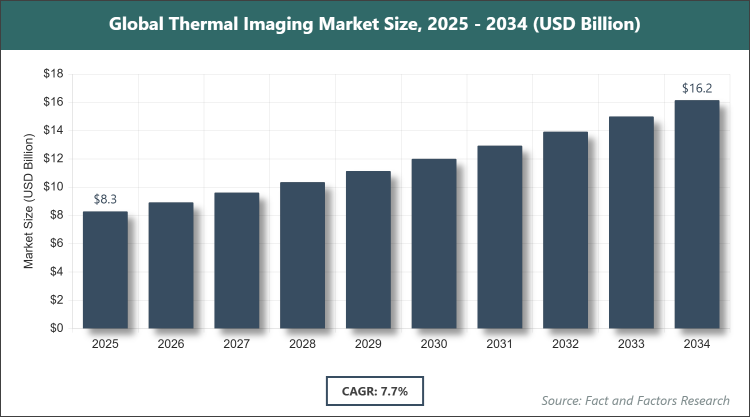
[220+ Pages Report] According to Facts & Factors, the global thermal imaging market size was estimated at USD 8.29 billion in 2025 and is expected to reach USD 16 billion by the end of 2034. The thermal imaging industry is anticipated to grow by a CAGR of 7.7% between 2026 and 2034. The thermal imaging Market is driven by increasing adoption in defense and surveillance applications.
 Market Overview
Thermal imaging refers to the technology that detects infrared radiation emitted by objects and converts it into visible images based on temperature differences, enabling non-contact temperature measurement and visualization in various environments.
Key Insights
- As per the analysis shared by our research analyst, the global thermal imaging market is estimated to grow annually at a CAGR of around 7.7% over the forecast period (2026-2034).
- In terms of revenue, the global thermal imaging market size was valued at around USD 8.29 billion in 2025 and is projected to reach USD 16 billion by 2034.
- The market is driven by rising demand for advanced surveillance and monitoring solutions across defense and industrial sectors.
- Based on the type, the uncooled segment dominated the market with a share of 62% due to its cost-effectiveness and versatility in commercial applications.
- Based on the product, the thermal cameras segment dominated the market with a share of 45% due to widespread use in security and industrial inspection.
- Based on the application, the security & surveillance segment dominated the market with a share of 48% due to increasing focus on border security and public safety.
- Based on the end-user, the aerospace & defense segment dominated the market with a share of 38% due to high adoption in military operations and unmanned systems.
- Based on region, North America held a dominant share of 41% due to substantial defense investments and technological advancements in the U.S.
Growth Drivers
- Increasing Adoption in Defense and Surveillance
The rising need for enhanced security measures in military and border protection is propelling the demand for thermal imaging technology, which provides superior detection capabilities in low-visibility conditions.
This factor is significantly boosting market expansion as governments worldwide prioritize advanced surveillance systems to combat threats effectively. Additionally, integration with unmanned aerial vehicles and ground-based systems further amplifies its utility in defense applications.
- Advancements in Sensor Technology
Innovations in uncooled infrared sensors are reducing costs and improving resolution, making thermal imaging more accessible for industrial and commercial uses.
These developments enable precise predictive maintenance and quality control in manufacturing, driving broader adoption across sectors. Enhanced portability and integration with AI also contribute to market growth by offering real-time analytics.
Restraints
- High Initial Costs
The substantial upfront investment required for high-end thermal imaging systems limits adoption among small and medium enterprises.
This cost barrier hinders market penetration in price-sensitive regions and applications. Moreover, maintenance expenses add to the overall financial burden, restraining widespread implementation.
- Export Regulations and Restrictions
Stringent international trade controls on thermal imaging technology due to its dual-use nature in military applications pose challenges for global market expansion.
These regulations complicate supply chains and limit access to certain markets. Compliance requirements further increase operational complexities for manufacturers.
Opportunities
- Integration with AI and IoT
The convergence of thermal imaging with artificial intelligence and Internet of Things opens new avenues for automated monitoring and smart city applications.
This integration enhances data accuracy and enables predictive analytics in various industries. Emerging use cases in autonomous vehicles and smart infrastructure present significant growth potential.
- Expansion in Healthcare Applications
Growing utilization of thermal imaging for non-invasive diagnostics and fever screening creates opportunities in the medical sector, especially post-pandemic.
This technology offers quick and contactless temperature assessment for large populations. Advancements in medical-grade thermal cameras further expand its role in disease detection and patient monitoring.
Challenges
- Technical Limitations in Adverse Conditions
Thermal imaging performance can be affected by environmental factors like rain, fog, or extreme temperatures, reducing reliability in certain scenarios.
This limitation challenges its effectiveness in outdoor applications. Ongoing research aims to mitigate these issues through advanced signal processing.
- Intense Market Competition
The presence of numerous players leads to price wars and innovation pressures, making it challenging for companies to maintain market share.
Rapid technological evolution requires continuous R&D investment. Differentiation through specialized solutions becomes crucial for sustained competitiveness.
Report Scope
Report Attribute |
Details |
Market Size 2025 |
USD 8.29 Billion |
Projected Market Size in 2034 |
USD 16 Billion |
CAGR Growth Rate |
7.7% CAGR |
Base Year |
2025 |
Forecast Years |
2026-2034 |
Key Market Players |
Teledyne FLIR LLC, Fluke Corporation, Leonardo S.p.A., Axis Communications AB, L3Harris Technologies, Inc., RTX, BAE Systems, Lynred, Honeywell International Inc., Testo SE & Co. KGaA, Opgal Optronic Industries Ltd., and Others. |
Key Segment |
By Type, By Product, By Application, By End-User, and By Region |
Major Regions Covered |
North America, Europe, Asia Pacific, Latin America, and the Middle East & Africa |
Purchase Options |
Request customized purchase options to meet your research needs. Explore purchase options |
Market Segmentation
The thermal imaging market is segmented by type, product, application, end-user, and region.
Based on Type Segment, the thermal imaging market is divided into cooled, uncooled, and others. The uncooled segment is the most dominant, holding a significant market share due to its lower cost and maintenance requirements compared to cooled systems, making it ideal for commercial and industrial applications. The cooled segment is the second most dominant, valued for its superior sensitivity and resolution in high-end defense and scientific uses, driving market growth through precision in critical operations.
Based on Product Segment, the thermal imaging market is divided into thermal cameras, thermal modules, thermal scopes, and others. The thermal cameras segment is the most dominant, capturing the largest share owing to its versatility in surveillance and inspection tasks across multiple industries. The thermal modules segment is the second most dominant, contributing to market expansion by enabling easy integration into custom systems for automotive and consumer electronics, thus broadening application scope.
Based on Application Segment, the thermal imaging market is divided into security & surveillance, monitoring & inspection, detection & measurement, and others. The security & surveillance segment is the most dominant, leading due to heightened global security concerns and its effectiveness in low-light environments for perimeter protection. The monitoring & inspection segment is the second most dominant, aiding market growth by facilitating predictive maintenance in manufacturing and energy sectors, reducing downtime and costs.
Based on End-User Segment, the thermal imaging market is divided into aerospace & defense, manufacturing, healthcare & life sciences, automotive, oil & gas, and others. The aerospace & defense segment is the most dominant, commanding the highest share because of extensive use in military surveillance and navigation systems. The manufacturing segment is the second most dominant, propelling market development through applications in quality control and equipment monitoring, enhancing operational efficiency.
Recent Developments
- In 2025, LightPath Technologies acquired G5 Infrared, enhancing its infrared camera systems for defense and industrial applications.
- In 2025, Teledyne FLIR reported over 500,000 uncooled LWIR automotive shipments, accelerating ADAS integration.
- In 2025, Meridian Innovation unveiled the Cheetah 50x50 LWIR sensor for smart devices and automotive sensing.
Regional Analysis
- North America to dominate the global market
North America leads the thermal imaging market, primarily driven by substantial defense budgets and technological innovations in the United States, which hosts major players and invests heavily in military and surveillance applications. The region's advanced infrastructure supports widespread adoption in industrial monitoring and automotive sectors, fostering continuous growth through R&D initiatives.
Asia Pacific emerges as the fastest-growing region, fueled by rapid industrialization and increasing defense expenditures in countries like China and India, where thermal imaging is integral to manufacturing quality control and border security. Government initiatives for smart cities and infrastructure development further accelerate market expansion in this dynamic area.
Europe maintains a strong position with Germany and the UK leading in automotive and aerospace applications, emphasizing precision engineering and safety standards that drive demand for thermal solutions. The focus on energy efficiency and environmental monitoring contributes to steady market progression across the continent.
Latin America shows promising growth potential, particularly in Brazil, where thermal imaging aids in agricultural monitoring and public safety amid rising urbanization. Challenges like economic variability are offset by increasing foreign investments in security infrastructure.
The Middle East & Africa region, led by Saudi Arabia, utilizes thermal imaging extensively in oil & gas operations and defense, capitalizing on harsh environmental conditions that necessitate reliable detection technologies. Growing tourism and infrastructure projects enhance adoption in commercial sectors.
Competitive Analysis
The global thermal imaging market is dominated by players:
- Teledyne FLIR LLC
- Fluke Corporation
- Leonardo S.p.A.
- Axis Communications AB
- L3Harris Technologies, Inc.
- RTX
- BAE Systems
- Lynred
- Honeywell International Inc.
- Testo SE & Co. KGaA
- Opgal Optronic Industries Ltd.
The global thermal imaging market is segmented as follows:
By Type
- Cooled
- Uncooled
- Others
By Product
- Thermal Cameras
- Thermal Modules
- Thermal Scopes
- Others
By Application
- Security & Surveillance
- Monitoring & Inspection
- Detection & Measurement
- Others
By End-User
- Aerospace & Defense
- Manufacturing
- Healthcare & Life Sciences
- Automotive
- Oil & Gas
- Others
By Region
- North America
- The U.S.
- Canada
- Mexico
- Europe
- France
- The UK
- Spain
- Germany
- Italy
- Rest of Europe
- Asia Pacific
- China
- Japan
- India
- Australia
- Southeast Asia
- Rest of Asia Pacific
- The Middle East & Africa
- Saudi Arabia
- UAE
- Egypt
- Kuwait
- South Africa
- Rest of the Middle East & Africa
- Latin America
- Brazil
- Argentina
- Rest of Latin America
Industry Major Market Players
The global thermal imaging market is dominated by players:
- Teledyne FLIR LLC
- Fluke Corporation
- Leonardo S.p.A.
- Axis Communications AB
- L3Harris Technologies, Inc.
- RTX
- BAE Systems
- Lynred
- Honeywell International Inc.
- Testo SE & Co. KGaA
- Opgal Optronic Industries Ltd.



Copyright © 2025 - 2026, All Rights Reserved, Facts and Factors