
Search Market Research Report
Surgical Headlight Market Size, Share Global Analysis Report, 2026-2034

Surgical Headlight Market Size, Share, Growth Analysis Report By Product Type (LED, Halogen, Xenon, and Others), By Application (Cardiac Surgeries, Gynecological Surgeries, Neurological Surgeries, ENT Surgeries, and Others), By End-User (Hospitals, Ambulatory Surgical Centers, Clinics, and Others), and By Region - Global Industry Insights, Overview, Comprehensive Analysis, Trends, Statistical Research, Market Intelligence, Historical Data and Forecast 2026-2034
Industry Insights
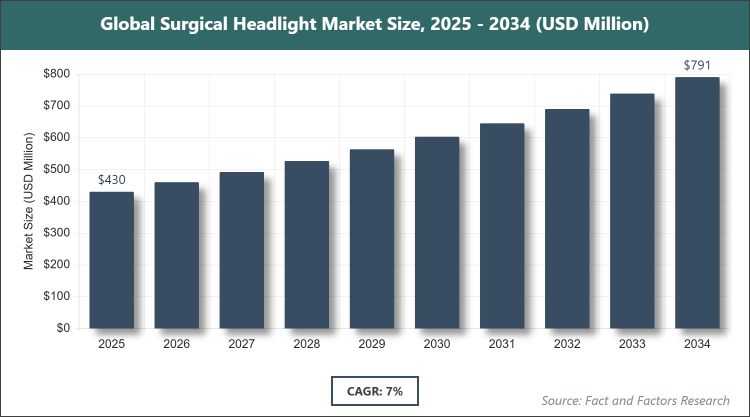
[235+ Pages Report] According to Facts & Factors, the global surgical headlight market size was estimated at USD 430 million in 2025 and is expected to reach USD 790 million by the end of 2034. The surgical headlight industry is anticipated to grow by a CAGR of 7% between 2026 and 2034. The surgical headlight Market is driven by increasing number of surgical procedures worldwide.
 Market Overview
The surgical headlight market encompasses devices designed to provide focused, high-intensity illumination directly on the surgical site, worn on the head by surgeons or medical professionals during procedures. These headlights enhance visibility in operating rooms, enabling precise work in deep cavities or minimally invasive surgeries where overhead lights may cast shadows or fail to reach adequately. They integrate advanced light sources and ergonomic designs to support extended use without causing fatigue, playing a critical role in improving surgical outcomes across various medical fields.
Key Insights
- As per the analysis shared by our research analyst, the global surgical headlight market is estimated to grow annually at a CAGR of around 7% over the forecast period (2026-2034).
- In terms of revenue, the global surgical headlight market size was valued at around USD 430 million in 2025 and is projected to reach USD 790 million by 2034.
- The market is driven by the rising demand for minimally invasive surgeries and technological advancements in LED lighting.
- Based on the product type, the LED segment dominated the market with a share of 65% due to its energy efficiency, longer lifespan, and superior illumination quality.
- Based on the application, the neurological surgeries segment dominated with a share of 28% as it requires high-precision lighting for intricate brain and nerve procedures.
- Based on the end-user, the hospitals segment dominated with a share of 55% owing to the high volume of complex surgeries performed in hospital settings.
- North America dominated the global market with a share of 40% attributed to advanced healthcare infrastructure and high adoption of innovative medical technologies.
Growth Drivers
- Rising Number of Surgical Procedures Worldwide
The increasing prevalence of chronic diseases, such as cardiovascular disorders and neurological conditions, has led to a surge in surgical interventions globally. This trend is further amplified by an aging population that requires more frequent medical procedures, driving demand for reliable illumination tools like surgical headlights to ensure accuracy and safety.
Advancements in minimally invasive techniques also contribute significantly, as these procedures often occur in confined spaces where traditional lighting is insufficient. As healthcare systems expand in emerging economies, the need for portable and efficient surgical lighting solutions continues to grow, supporting market expansion through enhanced procedural efficiency and reduced complication rates.
Restraints
- High Cost of Advanced Surgical Headlights
Sophisticated models incorporating LED technology, wireless features, and ergonomic designs come with elevated price tags, limiting accessibility for smaller clinics and healthcare facilities in developing regions. This cost barrier can slow adoption rates, particularly where budget constraints prioritize essential equipment over specialized lighting.
Maintenance and replacement expenses for batteries or bulbs add to the financial burden, deterring potential buyers. Regulatory requirements for quality and safety further increase production costs, which are passed on to end-users, potentially hindering market penetration in price-sensitive areas despite the long-term benefits of these devices.
Opportunities
- Technological Innovations in Wireless and Battery-Powered Models
The shift toward cordless headlights with extended battery life offers surgeons greater mobility and reduces infection risks associated with cables. Integration of smart features, such as adjustable intensity and color temperature, opens new avenues for customization in diverse surgical environments.
Emerging markets in Asia-Pacific present untapped potential as healthcare infrastructure improves, creating demand for affordable yet advanced solutions. Partnerships between manufacturers and hospitals for product trials can accelerate adoption, while ongoing research in energy-efficient materials promises to lower costs and enhance performance, fostering broader market growth.
Challenges
- Stringent Regulatory Approvals and Compliance Standards
Obtaining certifications from bodies like the FDA or CE marking involves rigorous testing and documentation, delaying product launches and increasing development expenses. Variations in regional regulations complicate global distribution, requiring manufacturers to navigate diverse compliance landscapes.
Ensuring device safety, such as preventing overheating or electromagnetic interference, adds complexity to design processes. As standards evolve with technological advancements, companies must invest continuously in updates, which can strain resources for smaller players and impact overall market dynamics.
Report Scope
Report Attribute |
Details |
Market Size 2025 |
USD 430 Million |
Projected Market Size in 2034 |
USD 790 Million |
CAGR Growth Rate |
7% CAGR |
Base Year |
2025 |
Forecast Years |
2026-2034 |
Key Market Players |
Stryker, Integra LifeSciences, KLS Martin, Karl Storz, Welch Allyn, Koninklijke Philips, Enova Illumination, SurgiTel, Sunoptic Surgical, ATMOS MedizinTechnik, and Others. |
Key Segment |
By Product Type, By Application, By End-User, and By Region |
Major Regions Covered |
North America, Europe, Asia Pacific, Latin America, and the Middle East & Africa |
Purchase Options |
Request customized purchase options to meet your research needs. Explore purchase options |
Market Segmentation
The surgical headlight market is segmented by product type, application, end-user, and region.
Based on Product Type Segment, the surgical headlight market is divided into LED, halogen, xenon, and others. The LED segment stands out as the most dominant, capturing a significant market share due to its advantages in energy consumption, heat reduction, and longevity, which minimize disruptions during long procedures. The halogen segment follows as the second most dominant, valued for its cost-effectiveness and bright white light, though it generates more heat, making it suitable for shorter surgeries where budget is a key consideration. LED's dominance drives the market by enabling precise, shadow-free illumination that enhances surgical accuracy, while halogen supports accessibility in resource-limited settings, collectively expanding the market's reach across various healthcare facilities.
Based on Application Segment, the surgical headlight market is divided into cardiac surgeries, gynecological surgeries, neurological surgeries, ENT surgeries, and others. Neurological surgeries emerge as the most dominant segment, driven by the need for exceptional precision in delicate brain and spinal operations where even minor visibility issues can lead to complications. Cardiac surgeries rank as the second most dominant, requiring focused lighting for intricate vascular work in confined chest cavities. The dominance of neurological applications propels market growth through demand for high-lumen, adjustable headlights, while cardiac uses contribute by emphasizing durability and intensity, together advancing innovations that improve outcomes in high-stakes procedures and broaden adoption in specialized medical fields.
Based on End-User Segment, the surgical headlight market is divided into hospitals, ambulatory surgical centers, clinics, and others. Hospitals represent the most dominant segment, benefiting from high procedural volumes and access to advanced equipment budgets, allowing integration of premium headlights in operating theaters. Ambulatory surgical centers are the second most dominant, favoring portable models for outpatient efficiency and cost savings. Hospitals drive market expansion by adopting cutting-edge technologies that set industry standards, while ambulatory centers enhance growth through demand for lightweight, battery-operated options, collectively pushing manufacturers toward versatile designs that cater to diverse operational needs and accelerate overall market penetration.
Recent Developments
- In January 2024, Karl Storz launched the KS70 surgical headlight, featuring advanced LED technology and a lightweight design for enhanced surgeon comfort during extended procedures.
- In March 2025, Stryker introduced a wireless headlight system with integrated camera capabilities, aimed at improving real-time documentation and training in surgical environments.
- In July 2025, Integra LifeSciences unveiled an upgraded LED headlight model with adjustable color temperature, addressing needs in minimally invasive neurosurgeries.
Regional Analysis
- North America to Dominate the Global Market
North America leads the surgical headlight market, primarily due to its robust healthcare system and rapid adoption of innovative technologies. The region's emphasis on minimally invasive procedures and high surgical volumes in advanced facilities drives demand for high-quality illumination tools. The United States stands out as the dominating country, with extensive research and development investments fostering product advancements. Strong reimbursement policies and a focus on patient safety further bolster market growth, positioning North America as a hub for cutting-edge surgical solutions that influence global standards.
Europe follows closely, supported by stringent quality regulations and a growing elderly population requiring more surgeries. Germany emerges as the key player here, renowned for its engineering expertise and manufacturing prowess in medical devices. The region's commitment to sustainable healthcare practices encourages the shift to energy-efficient LED headlights, enhancing procedural precision across diverse medical specialties.
Asia Pacific exhibits the fastest growth, fueled by expanding healthcare infrastructure and rising medical tourism. China dominates this region, benefiting from large-scale production capabilities and increasing investments in hospital upgrades. The surge in chronic disease prevalence necessitates better surgical visibility, driving adoption of affordable yet reliable headlights in both urban and rural settings.
Latin America shows steady progress, with improving access to healthcare services and government initiatives to modernize facilities. Brazil leads as the prominent country, where a growing number of ambulatory centers demand portable lighting solutions for efficient outpatient care. Economic development supports the integration of advanced technologies, gradually closing the gap with more developed regions.
The Middle East & Africa region is emerging, driven by investments in healthcare diversification beyond oil economies. Saudi Arabia is the frontrunner, with ambitious projects like Vision 2030 enhancing medical infrastructure and attracting global manufacturers. The focus on specialized surgeries in urban hospitals propels the need for high-performance headlights, though challenges like uneven access persist in rural areas.
Competitive Analysis
The global surgical headlight market is dominated by players:
- Stryker
- Integra LifeSciences
- KLS Martin
- Karl Storz
- Welch Allyn
- Koninklijke Philips
- Enova Illumination
- SurgiTel
- Sunoptic Surgical
- ATMOS MedizinTechnik
- Others
The global surgical headlight market is segmented as follows:
By Product Type
- LED
- Halogen
- Xenon
- Others
By Application
- Cardiac Surgeries
- Gynecological Surgeries
- Neurological Surgeries
- ENT Surgeries
- Others
By End-User
- Hospitals
- Ambulatory Surgical Centers
- Clinics
- Others
By Region
- North America
- The U.S.
- Canada
- Mexico
- Europe
- France
- The UK
- Spain
- Germany
- Italy
- Rest of Europe
- Asia Pacific
- China
- Japan
- India
- Australia
- Southeast Asia
- Rest of Asia Pacific
- The Middle East & Africa
- Saudi Arabia
- UAE
- Egypt
- Kuwait
- South Africa
- Rest of the Middle East & Africa
- Latin America
- Brazil
- Argentina
- Rest of Latin America
Industry Major Market Players
The global surgical headlight market is dominated by players:
- Stryker
- Integra LifeSciences
- KLS Martin
- Karl Storz
- Welch Allyn
- Koninklijke Philips
- Enova Illumination
- SurgiTel
- Sunoptic Surgical
- ATMOS MedizinTechnik
- Others



Copyright © 2025 - 2026, All Rights Reserved, Facts and Factors