
Search Market Research Report
Seasonings and Spices Market Size, Share Global Analysis Report, 2026-2034

Seasonings and Spices Market Size, Share, Growth Analysis Report By Product Type (Spices, Herbs, Salt and Salt Substitutes, and Others), By Application (Meat and Poultry Products, Snacks and Convenience Food, Soups, Sauces and Dressings, Bakery and Confectionery, Frozen Products, Beverages, and Others), By End-User (Food Processing Industry, Food Service, Retail/Household, and Others), and By Region - Global Industry Insights, Overview, Comprehensive Analysis, Trends, Statistical Research, Market Intelligence, Historical Data and Forecast 2026-2034
Industry Insights
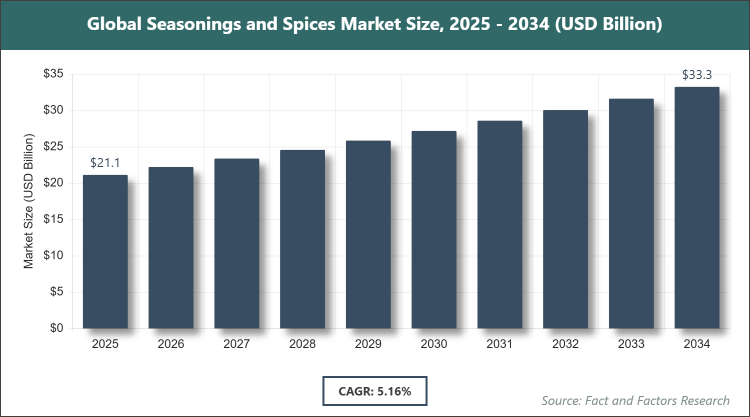
[215 Pages Report] According to Facts & Factors, the global seasonings and spices market size was estimated at USD 21.14 billion in 2025 and is expected to reach USD 32.88 billion by the end of 2034. The Seasonings and Spices industry is anticipated to grow by a CAGR of 5.16% between 2026 and 2034. The Seasonings and Spices Market is driven by growing demand for convenience and ready-to-eat food products along with escalating popularity of ethnic cuisines.
 Market Overview
The seasonings and spices market refers to the global industry involved in the production, distribution, and consumption of dried plant-based materials such as herbs, roots, barks, seeds, and fruits used primarily to enhance flavor, aroma, and color in food and beverages. These products, excluding basic staples like salt or sugar, are derived from various botanical sources and processed into whole, ground, or blended forms to suit culinary applications across households, food services, and industrial manufacturing. The market encompasses a wide array of traditional and exotic varieties, influenced by cultural cuisines and health trends, serving as essential ingredients that elevate taste profiles while offering potential nutritional benefits like antioxidants or anti-inflammatory properties in natural, unadulterated forms.
Key Insights
- As per the analysis shared by our research analyst, the Seasonings and Spices market is estimated to grow annually at a CAGR of around 5.16% over the forecast period (2026-2034).
- In terms of revenue, the Seasonings and Spices market size was valued at around USD 21.14 billion in 2025 and is projected to reach USD 32.88 billion by 2034.
- The market is driven by growing demand for convenience and ready-to-eat food products along with escalating popularity of ethnic cuisines.
- Based on the product type, the spices segment dominated the market in 2025 with a market share of 64% due to their versatility, strong flavor profiles, and widespread use in diverse global cuisines.
- Based on the application, the meat and poultry products segment dominated the market in 2025 with a market share of 30% due to the essential role of spices in enhancing taste and preserving proteins in processed and home-cooked meals.
- Based on the end-user, the food processing industry segment dominated the market in 2025 with a market share of 45% due to high-volume demand for consistent flavoring in manufactured food products.
- North America dominated the global market in 2025 with a market share of 39% due to high consumption of ethnic cuisines, convenience foods, and strong presence of key manufacturers.
Market Dynamics
Growth Drivers
- Increasing Popularity of Ethnic and Exotic Cuisines
The globalization of food culture has led to a surge in demand for authentic flavors from Asian, Latin American, and Middle Eastern cuisines, prompting consumers to incorporate diverse spices like turmeric, cumin, and paprika into everyday meals. This trend is amplified by social media and travel influences, encouraging home cooks to experiment with international recipes. Restaurants and food manufacturers are responding by innovating product lines with fusion blends, further expanding market reach.
Additionally, health-conscious consumers are drawn to spices for their natural preservative and medicinal properties, such as anti-inflammatory effects, boosting incorporation in functional foods. Strategic marketing by brands highlighting cultural stories and sustainability enhances appeal, driving consistent growth in both developed and emerging markets.
Restraints
- Supply Chain Vulnerabilities and Climate Change Impacts
Spice production is highly dependent on specific climatic conditions, making it susceptible to weather disruptions, pests, and geopolitical issues in key growing regions like India and Vietnam, leading to supply shortages and price volatility. These factors increase costs for manufacturers and can disrupt consistent availability for consumers.
This restraint challenges market stability, as buyers may shift to synthetic alternatives or reduce usage during price spikes. Producers face pressure to invest in resilient farming practices, but small-scale farmers often lack resources, exacerbating inequalities and potentially slowing overall market expansion.
Opportunities
- Rising Demand for Organic and Clean-Label Products
Consumers increasingly seek natural, pesticide-free spices amid health and environmental concerns, creating avenues for premium organic offerings with transparent sourcing. Brands can capitalize by certifying products and emphasizing eco-friendly packaging, appealing to millennials and Gen Z demographics.
Expansion into e-commerce platforms allows direct-to-consumer sales, enabling niche blends and subscription models. Partnerships with wellness brands for spice-infused supplements further diversify applications, unlocking new revenue streams in untapped segments.
Challenges
- Adulteration and Quality Control Issues
The prevalence of counterfeit or diluted spices erodes consumer trust and poses health risks, complicating regulatory compliance across global supply chains. Detecting adulterants requires advanced testing, increasing operational costs for legitimate players.
Addressing this demands industry-wide standards and traceability technologies like blockchain, but implementation varies by region, hindering uniform progress. Smaller enterprises struggle with these requirements, potentially leading to market fragmentation.
Report Scope
Report Attribute |
Details |
Market Size 2025 |
USD 21.14 Billion |
Projected Market Size in 2034 |
USD 32.88 Billion |
CAGR Growth Rate |
5.16% CAGR |
Base Year |
2025 |
Forecast Years |
2026-2034 |
Key Market Players |
McCormick & Company, Inc., Olam International, Kerry Group Plc, Ajinomoto Co., Inc., Associated British Foods Plc, Sensient Technologies Corporation, Givaudan SA, DS Group, Everest Spices, The Kraft Heinz Company, Unilever Plc, Baria Pepper, Dohler GmbH, SHS Group, and Others. |
Key Segment |
By Product Type, By Application, By End-User, and By Region |
Major Regions Covered |
North America, Europe, Asia Pacific, Latin America, and the Middle East & Africa |
Purchase Options |
Request customized purchase options to meet your research needs. Explore purchase options |
Market Segmentation
The Seasonings and Spices market is segmented by product type, application, end-user, and region.
Based on Product Type Segment, the Seasonings and Spices market is divided into spices, herbs, salt and salt substitutes, and others. The most dominant is the spices segment, and the second most dominant is the herbs segment. The spices segment leads due to its robust flavors essential for staple dishes worldwide, with high demand in meat seasoning and ethnic foods driving market growth through volume sales and innovation in blends; this dominance supports expansion by catering to diverse culinary needs and health trends like antioxidant-rich options. The herbs segment ranks second, valued for fresh, aromatic profiles in Mediterranean and Western cuisines, contributing to market drive by appealing to clean-label preferences and enabling premium products in salads and beverages.
Based on Application Segment, the Seasonings and Spices market is divided into meat and poultry products, snacks and convenience food, soups, sauces and dressings, bakery and confectionery, frozen products, beverages, and others. The most dominant is meat and poultry products, and the second most dominant is snacks and convenience food. Meat and poultry products dominate owing to spices' role in marination, preservation, and flavor enhancement amid rising protein consumption globally; this propels market growth by aligning with processed food trends and cultural dietary staples. Snacks and convenience food rank second, utilizing bold seasonings for on-the-go appeal, driving the market through innovation in ready-to-eat items targeting busy lifestyles.
Based on End-User Segment, the Seasonings and Spices market is divided into food processing industry, food service, retail/household, and others. The most dominant is food processing industry, and the second most dominant is food service. The food processing industry prevails due to large-scale incorporation in manufactured goods like sauces and frozen meals, fueled by industrialization; this fuels market growth via bulk procurement and product standardization. Food service ranks second, leveraging spices for restaurant menus and catering, contributing to growth through experiential dining trends.
Recent Developments
- In January 2025, McCormick & Company launched Aji Amarillo Seasoning, a limited-time offering available online, targeting consumers seeking exotic Peruvian flavors.
- In November 2024, Afia launched a new line of Mediterranean spices, expanding its portfolio to include authentic blends for home cooks and foodservice.
- In August 2024, The Baltimore Ravens partnered with McCormick to create Blackbird Spice, a custom seasoning blend for fans and culinary enthusiasts.
- In May 2023, The Kraft Heinz Co. introduced Just Spices in the U.S. market, offering ready-made blends through retail and online channels to enhance flavor convenience.
- In April 2023, McCormick collaborated with Tabitha Brown to release five new salt-free, vegan seasoning products, including all-purpose and mix varieties for diverse applications.
- In March 2023, McCormick unveiled a new packaging design for its herbs and spices, incorporating 50% recycled plastic to promote environmental sustainability.
Regional Analysis
- Asia Pacific to dominate the global market
Asia Pacific commands the seasonings and spices market, with India as the dominating country owing to its vast production of staples like turmeric and pepper, supported by rich agricultural heritage and export prowess. China's growing processed food sector and urbanization fuel demand for blends, while Japan's fusion cuisine integrates traditional spices innovatively. The region's diverse climates enable year-round cultivation, ensuring supply stability and low costs, attracting global buyers and sustaining dominance through cultural culinary exports.
North America demonstrates robust growth in the seasonings and spices market, led by the United States with its multicultural population driving ethnic flavor adoption in convenience foods. Canada's health-focused consumers boost organic demand, whereas Mexico's traditional spices influence cross-border trade. Emphasis on clean-label products and e-commerce enhances accessibility, positioning the region for expansion amid wellness trends.
Europe maintains a sophisticated seasonings and spices market, dominated by Germany's industrial food processing utilizing herbs in sausages and bakery. France and Italy contribute through gourmet applications in Mediterranean diets, leveraging premium blends. EU regulations on sustainability foster innovation in organic sourcing, bolstering market resilience via heritage preservation and modern adaptations.
Latin America emerges as a vibrant area in the seasonings and spices market, with Brazil leading via its bold flavors in barbecue and snacks, supported by biodiversity. Mexico's chili varieties drive exports, while Argentina focuses on herb-infused meats. Regional trade pacts facilitate growth, addressing diverse culinary needs amid rising middle-class consumption.
The Middle East & Africa region shows potential in the seasonings and spices market, spearheaded by Turkey's cumin and sumac production for kebabs and salads. South Africa's fusion spices cater to diverse populations, while the UAE's import hubs distribute globally. Traditional medicine uses enhance demand, fostering expansion through cultural exchanges and tourism.
Competitive Analysis
The global Seasonings and Spices market is dominated by players:
- McCormick & Company, Inc.
- Olam International
- Kerry Group Plc
- Ajinomoto Co., Inc.
- Associated British Foods Plc
- Sensient Technologies Corporation
- Givaudan SA
- DS Group
- Everest Spices
- The Kraft Heinz Company
- Unilever Plc
- Baria Pepper
- Dohler GmbH
- SHS Group
The global Seasonings and Spices market is segmented as follows:
By Product Type
- Spices
- Herbs
- Salt and Salt Substitutes
- Others
By Application
- Meat and Poultry Products
- Snacks and Convenience Food
- Soups, Sauces and Dressings
- Bakery and Confectionery
- Frozen Products
- Beverages
- Others
By End-User
- Food Processing Industry
- Food Service
- Retail/Household
- Others
By Region
- North America
- The U.S.
- Canada
- Mexico
- Europe
- France
- The UK
- Spain
- Germany
- Italy
- Rest of Europe
- Asia Pacific
- China
- Japan
- India
- Australia
- Southeast Asia
- Rest of Asia Pacific
- The Middle East & Africa
- Saudi Arabia
- UAE
- Egypt
- Kuwait
- South Africa
- Rest of the Middle East & Africa
- Latin America
- Brazil
- Argentina
- Rest of Latin America
Industry Major Market Players
The global Seasonings and Spices market is dominated by players:
McCormick & Company, Inc.
Olam International
Kerry Group Plc
Ajinomoto Co., Inc.
Associated British Foods Plc
Sensient Technologies Corporation
Givaudan SA
DS Group
Everest Spices
The Kraft Heinz Company
Unilever Plc
Baria Pepper
Dohler GmbH
SHS Group



Copyright © 2025 - 2026, All Rights Reserved, Facts and Factors