
Search Market Research Report
Pyrethrum Market Size, Share Global Analysis Report, 2026-2034

Pyrethrum Market Size, Share, Growth Analysis Report By Type (Pyrethrin I, Pyrethrin II, and Others), By Application (Agriculture, Household, Public Health, Animal Health, and Others), By End-User (Farmers, Consumers, Commercial, and Others), and By Region - Global Industry Insights, Overview, Comprehensive Analysis, Trends, Statistical Research, Market Intelligence, Historical Data and Forecast 2026-2034
Industry Insights
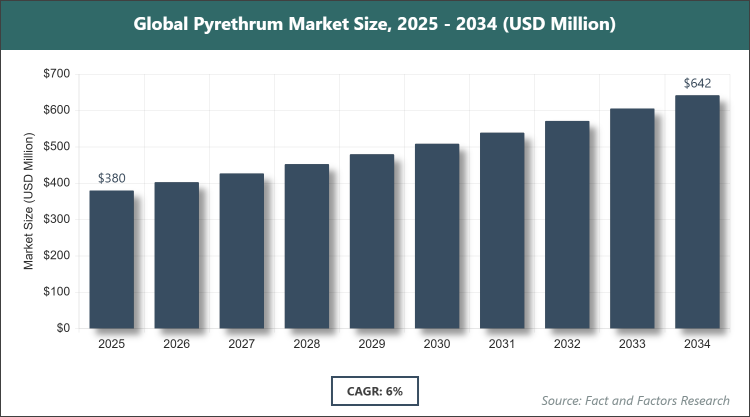
[245+ Pages Report] According to Facts & Factors, the global Pyrethrum market size was estimated at USD 0.38 billion in 2025 and is expected to reach USD 0.65 billion by the end of 2034. The Pyrethrum industry is anticipated to grow by a CAGR of 6.0% between 2026 and 2034. The Pyrethrum Market is driven by increasing demand for natural and eco-friendly insecticides.
 Market Overview
Pyrethrum refers to a natural insecticide derived from the dried flowers of Chrysanthemum cinerariifolium, containing active compounds known as pyrethrins that disrupt the nervous systems of insects, making it an effective biopesticide for pest control. This market involves the cultivation, extraction, formulation, and distribution of pyrethrum-based products used in agriculture, household pest management, and public health applications, emphasizing its biodegradable and low-toxicity profile compared to synthetic alternatives, without numerical specifics.
Key Insights
- As per the analysis shared by our research analyst, the global Pyrethrum market is estimated to grow annually at a CAGR of around 6.0% over the forecast period (2026-2034).
- In terms of revenue, the global Pyrethrum market size was valued at around USD 0.38 billion in 2025 and is projected to reach USD 0.65 billion by 2034.
- The market is driven by growing preference for organic farming and stringent regulations on synthetic pesticides.
- Based on the type, the pyrethrin I segment dominated with a 55% share due to its higher potency and rapid knockdown effect on insects.
- Based on the application, the agriculture segment dominated with a 50% share owing to extensive use in crop protection for sustainable pest management.
- Based on the end-user, the farmers segment dominated with a 60% share because of direct application in agricultural fields to enhance yield.
- Based on the region, North America dominated with a 40% share attributed to high adoption of natural pesticides and strong regulatory support.
Growth Drivers
- Rising Demand for Eco-Friendly Pesticides
The increasing consumer and regulatory preference for sustainable and non-toxic pest control solutions has boosted pyrethrum's adoption, as it offers effective insecticidal properties without persistent environmental residues. This trend is amplified by global shifts toward organic agriculture, where pyrethrum serves as a key component in integrated pest management strategies.
Furthermore, advancements in extraction technologies have improved yield and purity, making pyrethrum more cost-competitive and accessible for widespread use in diverse applications.
Restraints
- Supply Chain Vulnerabilities
Pyrethrum production is geographically concentrated in regions like East Africa, leading to supply disruptions from weather variability and geopolitical issues, which increase prices and limit availability. This restraint affects market stability and adoption in price-sensitive areas.
Additionally, the short shelf life of pyrethrum extracts requires specialized storage, adding logistical challenges and costs for distributors and end-users.
Opportunities
- Expansion in Emerging Markets
Growing agricultural activities in developing regions present opportunities for pyrethrum penetration, supported by government initiatives promoting natural pesticides. This can drive volume growth through localized production and partnerships.
Moreover, innovation in formulations, such as microencapsulation for extended efficacy, opens new applications in public health and veterinary sectors.
Challenges
- Competition from Synthetic Alternatives
Synthetic pyrethroids offer lower costs and longer-lasting effects, challenging pyrethrum's market share despite its natural advantages. This requires ongoing education on environmental benefits to shift preferences.
In addition, regulatory hurdles for organic certification vary by region, complicating global trade and market expansion efforts.
Report Scope
Report Attribute |
Details |
Market Size 2025 |
USD 0.38 Billion |
Projected Market Size in 2034 |
USD 0.65 Billion |
CAGR Growth Rate |
6.0% CAGR |
Base Year |
2025 |
Forecast Years |
2026-2034 |
Key Market Players |
Botanical Resources Australia Pty Ltd, Horizon Sopyrwa, McLaughlin Gormley King Company (MGK), KAPI Limited, Valent BioSciences, Bayer AG, Sumitomo Chemical Co., Ltd., FMC Corporation, Syngenta AG, BASF SE, and Others. |
Key Segment |
By Type, By Application, By End-User, and By Region |
Major Regions Covered |
North America, Europe, Asia Pacific, Latin America, and the Middle East & Africa |
Purchase Options |
Request customized purchase options to meet your research needs. Explore purchase options |
Market Segmentation
The Pyrethrum market is segmented by type, application, end-user, and region.
Based on Type Segment, the Pyrethrum market is divided into pyrethrin I, pyrethrin II, and others. The most dominant segment is pyrethrin I, followed by pyrethrin II as the second most dominant. Pyrethrin I dominates due to its superior insecticidal activity and quick paralytic effect on pests, making it essential for immediate control in agriculture and household settings, driving the market by enabling efficient pest management that supports higher crop yields and safer environments; pyrethrin II, with its delayed but potent toxic effects, complements by providing residual protection, contributing to market growth through versatile formulations for long-term applications.
Based on Application Segment, the Pyrethrum market is divided into agriculture, household, public health, animal health, and others. The most dominant segment is agriculture, followed by household as the second most dominant. Agriculture leads owing to the critical need for natural pest control in organic farming to protect crops without chemical residues, propelling market expansion by aligning with global sustainability goals; household applications, used in sprays and repellents for home pest management, drive growth by catering to consumer demand for safe, non-toxic products.
Based on End-User Segment, the Pyrethrum market is divided into farmers, consumers, commercial, and others. The most dominant segment is farmers, followed by commercial as the second most dominant. Farmers dominate as they require large volumes for field applications to ensure crop health and yield, boosting the market through bulk procurement and adoption of eco-friendly practices; commercial users, including pest control services, support growth by utilizing pyrethrum in professional settings for effective, low-risk solutions.
Recent Developments
- In May 2024, BASF SE launched SUWEIDA natural pyrethrin aerosol in China, providing rapid household pest control with low residue and enhanced safety.
- In December 2023, Rovensa Next announced the launch of tec-fort, a 100% natural-pyrethrin bioinsecticide registered in Peru.
- In April 2024, Bayer AG partnered with AlphaBio to introduce new biological insecticides based on pyrethrum derivatives.
- In January 2025, MGK secured EPA registration for Veratrine, enhancing its botanical portfolio with innovative pyrethrum-based solutions.
Regional Analysis
- North America to Dominate the Global Market
North America dominates the Pyrethrum market, led by the United States, where stringent environmental regulations favor natural pesticides, coupled with high consumer awareness of organic products and robust agricultural practices that integrate pyrethrum for sustainable pest control, supported by advanced R&D and strong distribution networks.
Europe maintains a strong presence, with Germany leading through eco-conscious policies and emphasis on organic farming, promoting pyrethrum use in crop protection and public health to meet EU sustainability standards and reduce synthetic chemical reliance.
Asia Pacific is rapidly expanding, dominated by China, driven by increasing agricultural exports requiring residue-free produce, government support for green pesticides, and rising urban pest issues necessitating safe household solutions.
Latin America shows growth potential, led by Brazil, through expanding organic agriculture and export-oriented farming that adopts pyrethrum to comply with international standards and enhance market competitiveness.
The Middle East & Africa region is emerging, with Kenya as a key producer and South Africa leading consumption, benefiting from local cultivation advantages and increasing demand for natural insecticides in agriculture and vector control.
Competitive Analysis
The global Pyrethrum market is dominated by players:
- Botanical Resources Australia Pty Ltd
- Horizon Sopyrwa
- McLaughlin Gormley King Company (MGK)
- KAPI Limited
- Valent BioSciences
- Bayer AG
- Sumitomo Chemical Co., Ltd.
- FMC Corporation
- Syngenta AG
- BASF SE
- Others
The global Pyrethrum market is segmented as follows:
By Type
- Pyrethrin I
- Pyrethrin II
By Application
- Agriculture
- Household
- Public Health
- Animal Health
By End-User
- Farmers
- Consumers
- Commercial
By Region
- North America
- The U.S.
- Canada
- Mexico
- Europe
- France
- The UK
- Spain
- Germany
- Italy
- Rest of Europe
- Asia Pacific
- China
- Japan
- India
- Australia
- Southeast Asia
- Rest of Asia Pacific
- The Middle East & Africa
- Saudi Arabia
- UAE
- Egypt
- Kuwait
- South Africa
- Rest of the Middle East & Africa
- Latin America
- Brazil
- Argentina
- Rest of Latin America
Industry Major Market Players
- Botanical Resources Australia Pty Ltd
- Horizon Sopyrwa
- McLaughlin Gormley King Company (MGK)
- KAPI Limited
- Valent BioSciences
- Bayer AG
- Sumitomo Chemical Co., Ltd.
- FMC Corporation
- Syngenta AG
- BASF SE
- Others



Copyright © 2025 - 2026, All Rights Reserved, Facts and Factors