
Search Market Research Report
Paclitaxel Injection Market Size, Share Global Analysis Report, 2026-2034

Paclitaxel Injection Market Size, Share, Growth Analysis Report By Type (Branded Paclitaxel Injection and Generic Paclitaxel Injection), By Application (Breast Cancer, Ovarian Cancer, Non-Small Cell Lung Cancer, Kaposi Sarcoma, and Others), By End-User (Hospitals, Specialty Clinics, Cancer Research Institutes, and Others), and By Region - Global Industry Insights, Overview, Comprehensive Analysis, Trends, Statistical Research, Market Intelligence, Historical Data and Forecast 2026-2034
Industry Insights
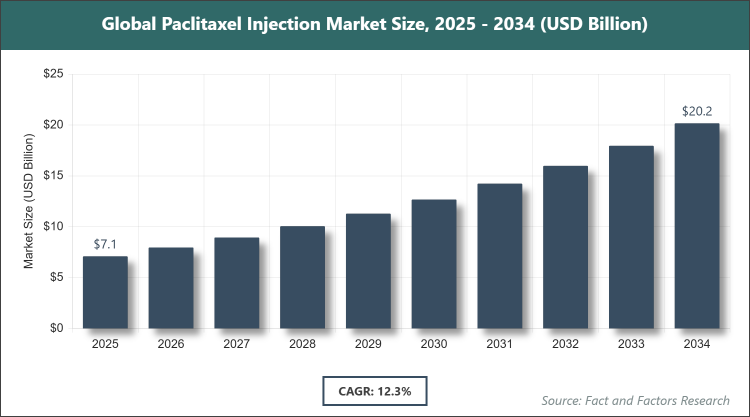
[242 + Pages Report] According to Facts & Factors, the global Paclitaxel Injection market size was estimated at USD 7.1 billion in 2025 and is expected to reach USD 17.5 billion by the end of 2034. The Paclitaxel Injection industry is anticipated to grow by a CAGR of 12.3% between 2026 and 2034. The Paclitaxel Injection Market is driven by the rising global prevalence of various cancers and the increasing adoption of chemotherapy regimens in oncology treatment protocols.
 Market Overview
The Paclitaxel Injection market involves the development, manufacturing, regulatory approval, distribution, and clinical administration of paclitaxel, a potent microtubule-stabilizing chemotherapeutic agent derived originally from the Pacific yew tree or produced semi-synthetically, formulated as an injectable solution or albumin-bound nanoparticle suspension for intravenous delivery. This antineoplastic drug is widely indicated for the treatment of multiple solid tumors by interfering with the normal breakdown of microtubules during cell division, thereby inhibiting cancer cell proliferation and inducing apoptosis. The market encompasses both branded innovator formulations and cost-effective generic versions, supplied in single-dose vials of varying strengths, and is integrated into standard combination chemotherapy protocols across hospital oncology departments and specialized infusion centers worldwide.
Key Insights
- As per the analysis shared by our research analyst, the Paclitaxel Injection market is estimated to grow annually at a CAGR of around 12.3% over the forecast period (2026-2034).
- In terms of revenue, the Paclitaxel Injection market size was valued at around USD 7.1 billion in 2025 and is projected to reach USD 17.5 billion by 2034.
- The Paclitaxel Injection Market is driven by rising global cancer incidence and expanding chemotherapy applications.
- Based on the Type, the Generic Paclitaxel Injection segment dominated the market in 2025 with a share of 67% due to patent expirations, widespread availability, and significant cost advantages over branded versions.
- Based on the Application, the Breast Cancer segment dominated the market in 2025 with a share of 48% owing to high incidence rates worldwide and the established efficacy of paclitaxel in neoadjuvant, adjuvant, and metastatic settings.
- Based on the End-User, the Hospitals segment dominated the market in 2025 with a share of 71% because of the requirement for supervised intravenous administration, advanced infusion facilities, and multidisciplinary oncology care teams.
- North America dominated the global Paclitaxel Injection market in 2025 with a share of 39%, attributed to high cancer prevalence, advanced healthcare infrastructure, favorable reimbursement policies, and strong presence of key pharmaceutical manufacturers.
Growth Drivers
- Rising Global Cancer Burden
The continuous increase in cancer incidence across breast, ovarian, lung, and other malignancies has directly expanded the patient pool requiring paclitaxel-based chemotherapy regimens, driving consistent demand for both conventional and albumin-bound formulations.
Advancements in combination therapies and improved survival outcomes when paclitaxel is paired with targeted agents or immunotherapies have further encouraged its inclusion in first-line and subsequent treatment lines, supporting sustained market expansion.
Restraints
- Adverse Side Effects and Hypersensitivity Reactions
Common toxicities, including neuropathy, myelosuppression, and infusion-related reactions, necessitate premedication with corticosteroids and antihistamines, which can limit patient tolerability and complicate treatment adherence.
High development and manufacturing costs for albumin-bound formulations, coupled with stringent cold-chain storage requirements, create pricing pressures that restrict broader accessibility in resource-limited settings.
Opportunities
- Expansion of Generic and Biosimilar Approvals
Increasing regulatory approvals for cost-effective generic and biosimilar paclitaxel injections in emerging markets are expected to improve affordability and penetration in low- and middle-income countries with high cancer burdens.
Ongoing research into novel nanoparticle formulations, liposomal delivery systems, and oral paclitaxel alternatives presents opportunities to reduce toxicity and enhance patient convenience, opening new therapeutic niches.
Challenges
- Supply Chain Vulnerabilities and Raw Material Dependency
Dependence on semi-synthetic production processes and occasional shortages of key starting materials can disrupt consistent supply, affecting treatment continuity for oncology patients globally.
Intense competition among generic manufacturers leads to price erosion and margin compression, challenging profitability and discouraging investment in next-generation delivery technologies.
Report Scope
Report Attribute |
Details |
Market Size 2025 |
USD 7.1 Billion |
Projected Market Size in 2034 |
USD 17.5 Billion |
CAGR Growth Rate |
12.3% CAGR |
Base Year |
2025 |
Forecast Years |
2026-2034 |
Key Market Players |
Bristol Myers Squibb Company, Pfizer Inc., Fresenius Kabi Oncology Ltd., Abbott Laboratories, Eli Lilly and Company, Dr. Reddy’s Laboratories Ltd., Accord Healthcare, Sun Pharmaceutical Industries Ltd., and Others. |
Key Segment |
By Type, By Application, By End-User, and By Region |
Major Regions Covered |
North America, Europe, Asia Pacific, Latin America, and the Middle East & Africa |
Purchase Options |
Request customized purchase options to meet your research needs. Explore purchase options |
Market Segmentation
The Paclitaxel Injection market is segmented by type, application, end-user, and region.
Based on Type Segment, the Paclitaxel Injection market is divided into branded paclitaxel injection and generic paclitaxel injection. The most dominant segment is Generic Paclitaxel Injection, followed by Branded Paclitaxel Injection. Generic Paclitaxel Injection dominates because of widespread patent expirations of innovator products, significantly lower pricing that improves affordability for healthcare systems and patients, and equivalent therapeutic efficacy, which together accelerate adoption across hospitals and clinics while driving overall market volume growth through expanded access in both developed and developing regions.
Based on Application Segment, the Paclitaxel Injection market is divided into breast cancer, ovarian cancer, non-small cell lung cancer, kaposi sarcoma, and others. The most dominant segment is Breast Cancer, followed by Ovarian Cancer. Breast Cancer leads the segment due to its highest global incidence among paclitaxel-treatable cancers, extensive clinical evidence supporting its use in multiple treatment lines, and integration into standard guidelines for both early-stage and metastatic disease, thereby generating the largest consumption volumes and fueling continuous demand for optimized dosing regimens that sustain market expansion.
Based on End-User Segment, the Paclitaxel Injection market is divided into hospitals, specialty clinics, cancer research institutes, and others. The most dominant segment is Hospitals, followed by Specialty Clinics. Hospitals dominate because they possess the necessary infrastructure for safe intravenous administration, emergency management of infusion reactions, and multidisciplinary teams required for complex chemotherapy protocols, enabling high-volume usage while driving market growth through centralized procurement and standardized treatment pathways.
Recent Developments
- In May 2025, Meitheal Pharmaceuticals launched a generic version of paclitaxel protein-bound particles for injectable suspension (albumin-bound) in the United States through an exclusive licensing agreement, expanding affordable options for metastatic breast cancer and other indications.
- In September 2025, Fresenius Kabi received additional regulatory approvals for its generic paclitaxel injection in multiple European markets, strengthening its oncology portfolio and improving supply reliability.
- In March 2025, Bristol Myers Squibb expanded access programs for its branded paclitaxel formulations in key Asia-Pacific countries to support combination therapies in ovarian and lung cancers.
- In November 2025, Sun Pharmaceutical Industries introduced a new ready-to-use paclitaxel injection formulation in emerging markets, reducing preparation time and minimizing dosing errors in hospital settings.
- In January 2026, Accord Healthcare announced successful Phase IV data demonstrating bioequivalence of its generic paclitaxel to the reference product in non-small cell lung cancer patients.
Regional Analysis
- North America to dominate the global market
North America leads the Paclitaxel Injection market through its advanced oncology infrastructure, high cancer screening rates, and robust reimbursement frameworks that facilitate widespread use of both branded and generic formulations. The region benefits from extensive clinical research networks conducting trials that expand paclitaxel indications and from strong collaboration between pharmaceutical companies and cancer centers. Rapid adoption of albumin-bound paclitaxel in combination regimens further supports market leadership. The United States dominates within North America owing to its largest patient population, presence of leading oncology research institutions, favorable FDA pathways for generics and new formulations, and high healthcare expenditure that enables premium pricing for innovative delivery systems while maintaining broad access through insurance coverage.
Europe maintains a significant position in the Paclitaxel Injection market supported by unified regulatory standards, comprehensive cancer care programs, and increasing focus on cost-effective generic utilization across public healthcare systems. The region emphasizes personalized treatment approaches that integrate paclitaxel with targeted therapies, while strong pharmacovigilance frameworks ensure safety monitoring. Germany dominates within Europe through its advanced pharmaceutical manufacturing capabilities, high density of specialized cancer centers, and leadership in clinical guideline development that promotes standardized use of paclitaxel across multiple tumor types.
Asia Pacific exhibits the fastest growth in the Paclitaxel Injection market driven by rapidly rising cancer incidence, expanding healthcare infrastructure, and growing government initiatives to improve oncology access in populous nations. Increasing availability of affordable generics and rising medical tourism for cancer treatment accelerate adoption. China dominates within Asia Pacific with its massive patient base, domestic manufacturing scale for generic paclitaxel, and aggressive investments in hospital oncology departments that support high-volume chemotherapy administration.
Latin America shows steady expansion in the Paclitaxel Injection market fueled by improving cancer awareness, modernization of healthcare facilities, and rising private insurance coverage for oncology drugs. Growing partnerships with global manufacturers help introduce cost-effective formulations. Brazil dominates the region through its large population, expanding network of public and private cancer centers, and national programs aimed at reducing cancer mortality that incorporate paclitaxel into essential treatment protocols.
The Middle East & Africa region demonstrates emerging potential in the Paclitaxel Injection market supported by increasing healthcare investments, rising cancer registries, and international aid for oncology capacity building. Urban centers are witnessing improved access to chemotherapy services. The Kingdom of Saudi Arabia leads within the region through its Vision 2030 healthcare transformation, modern cancer treatment facilities, and strategic procurement of essential oncology injectables that enhance availability of paclitaxel for breast and ovarian cancer patients.
Competitive Analysis
The global Paclitaxel Injection market is dominated by players:
- Bristol Myers Squibb Company
- Pfizer Inc.
- Fresenius Kabi Oncology Ltd.
- Abbott Laboratories
- Eli Lilly and Company
- Dr. Reddy’s Laboratories Ltd.
- Accord Healthcare
- Sun Pharmaceutical Industries Ltd.
- Teva Pharmaceutical Industries Ltd.
- Sagent Pharmaceuticals
The global Paclitaxel Injection market is segmented as follows:
By Type
- Branded Paclitaxel Injection
- Generic Paclitaxel Injection
By Application
- Breast Cancer
- Ovarian Cancer
- Non-Small Cell Lung Cancer
- Kaposi Sarcoma
- Others
By End-User
- Hospitals
- Specialty Clinics
- Cancer Research Institutes
- Others
By Region
- North America
- The U.S.
- Canada
- Mexico
- Europe
- France
- The UK
- Spain
- Germany
- Italy
- Rest of Europe
- Asia Pacific
- China
- Japan
- India
- Australia
- Southeast Asia
- Rest of Asia Pacific
- The Middle East & Africa
- Saudi Arabia
- UAE
- Egypt
- Kuwait
- South Africa
- Rest of the Middle East & Africa
- Latin America
- Brazil
- Argentina
- Rest of Latin America
Industry Major Market Players
- Bristol Myers Squibb Company
- Pfizer Inc.
- Fresenius Kabi Oncology Ltd.
- Abbott Laboratories
- Eli Lilly and Company
- Dr. Reddy’s Laboratories Ltd.
- Accord Healthcare
- Sun Pharmaceutical Industries Ltd.
- Teva Pharmaceutical Industries Ltd.
- Sagent Pharmaceuticals



Copyright © 2025 - 2026, All Rights Reserved, Facts and Factors