
Search Market Research Report
Orthokeratology Contact Lens Market Size, Share Global Analysis Report, 2026-2034

Orthokeratology Contact Lens Market Size, Share, Growth Analysis Report By Type (Overnight Ortho-K Lens and Daytime Ortho-K Lens), By Application (Myopia and Astigmatism), By End-User (Optometrist Offices, Hospitals & Ophthalmology Clinics, and Others), and By Region - Global Industry Insights, Overview, Comprehensive Analysis, Trends, Statistical Research, Market Intelligence, Historical Data and Forecast 2026-2034
Industry Insights
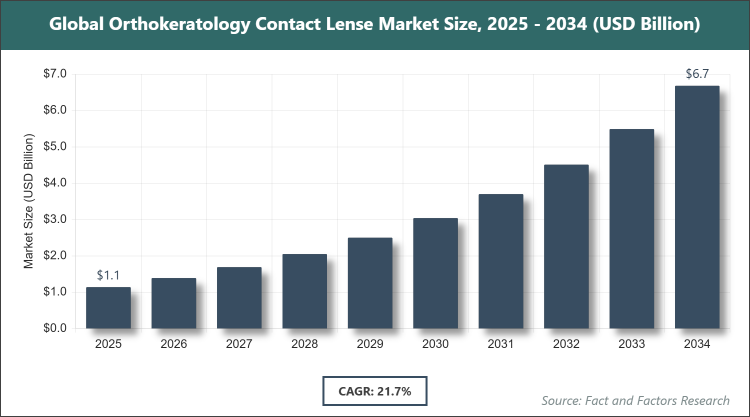
[228 + Pages Report] According to Facts & Factors, the global Orthokeratology Contact Lens market size was estimated at USD 1.14 billion in 2025 and is expected to reach USD 6.35 billion by the end of 2034. The Orthokeratology Contact Lens industry is anticipated to grow by a CAGR of 21.7% between 2026 and 2034. The Orthokeratology Contact Lens Market is driven by the surging global prevalence of myopia among children and young adults, along with a strong preference for non-invasive, reversible vision correction solutions.
 Market Overview
The Orthokeratology Contact Lens market involves the development, manufacturing, distribution, and clinical application of specialized rigid gas-permeable contact lenses designed to be worn overnight to temporarily reshape the cornea, thereby providing clear daytime vision without the need for glasses or daytime lenses. These lenses, commonly known as Ortho-K or overnight vision correction lenses, are primarily indicated for myopia management and control, particularly in pediatric and adolescent populations, while also addressing other refractive errors such as mild astigmatism and hyperopia in select cases. The market encompasses advanced lens materials with high oxygen permeability, digital topography-based fitting technologies, and comprehensive aftercare services that ensure safety, efficacy, and long-term corneal health. It serves as a non-surgical, reversible alternative to refractive surgeries like LASIK, appealing to patients seeking myopia progression control without permanent alteration of eye structure.
Key Insights
- As per the analysis shared by our research analyst, the Orthokeratology Contact Lens market is estimated to grow annually at a CAGR of around 21.7% over the forecast period (2026-2034).
- In terms of revenue, the Orthokeratology Contact Lens market size was valued at around USD 1.14 billion in 2025 and is projected to reach USD 6.35 billion by 2034.
- The Orthokeratology Contact Lens Market is driven by rising global myopia prevalence and demand for non-invasive correction options.
- Based on the Type, the Overnight Ortho-K Lens segment dominated the market in 2025 with a share of 62% due to the superior convenience of overnight wear and proven efficacy in providing full-day clear vision.
- Based on the Application, the Myopia segment dominated the market in 2025 with a share of 82%, owing to the worldwide myopia epidemic, especially among school childre,n and strong clinical evidence supporting Ortho-K for progression control.
- Based on the End-User, the Optometrist Offices segment dominated the market in 2025 with a share of 54% because specialized fitting, topography mapping, and regular follow-ups are most efficiently handled in dedicated optometry practices.
- Asia Pacific dominated the global Orthokeratology Contact Lens market in 2025 with a share of 56%, attributed to the highest myopia burden in East and Southeast Asia, coupled with aggressive government-backed school screening and myopia prevention programs.
Growth Drivers
- Escalating Global Myopia Burden
The rapid rise in myopia cases driven by increased near-work activities, screen time, and reduced outdoor exposure, particularly among childre,n has created urgent demand for effective control methods, positioning Ortho-K lenses as a frontline non-pharmacological intervention.
Technological improvements in lens design using high-Dk materials, reverse geometry curves, and AI-assisted fitting software have significantly enhanced comfort, safety, and predictability of outcomes, encouraging broader adoption by eye care professionals and patients alike.
Restraints
- High Initial Cost and Professional Expertise Requirement
The premium pricing of custom-fitted Ortho-K lenses, combined with the need for specialized training and equipment for accurate corneal topography and ongoing monitoring, creates accessibility barriers, especially in price-sensitive markets.
Limited insurance coverage for Ortho-K as a vision correction modality rather than medical treatment further restricts patient uptake and slows market penetration in many healthcare systems.
Opportunities
- Pediatric Myopia Management Expansion
Growing clinical consensus and regulatory approvals for Ortho-K in children open substantial growth avenues as parents and pediatric ophthalmologists increasingly seek evidence-based interventions to slow myopia progression and reduce future complication risks.
Emerging digital platforms for remote monitoring and tele-optometry fitting services are expected to improve patient compliance and expand reach into underserved rural and semi-urban regions globally.
Challenges
- Patient Compliance and Adaptation Issues
Initial discomfort during the adaptation period, strict lens hygiene requirements, and the need for consistent overnight wear pose significant hurdles to long-term patient adherence and overall treatment success rates.
Variability in individual corneal response and the requirement for frequent aftercare visits can lead to higher dropout rates if expectations are not properly managed through comprehensive patient education programs.
Report Scope
Report Attribute |
Details |
Market Size 2025 |
USD 1.14 Billion |
Projected Market Size in 2034 |
USD 6.35 Billion |
CAGR Growth Rate |
21.7% CAGR |
Base Year |
2025 |
Forecast Years |
2026-2034 |
Key Market Players |
The Cooper Companies Inc., Bausch + Lomb Corporation, Johnson & Johnson Vision Care, Inc., Menicon Co., Ltd., Euclid Systems Corporation, and Others. |
Key Segment |
By Type, By Application, By End-User, and By Region |
Major Regions Covered |
North America, Europe, Asia Pacific, Latin America, and the Middle East & Africa |
Purchase Options |
Request customized purchase options to meet your research needs. Explore purchase options |
Market Segmentation
The Orthokeratology Contact Lens market is segmented by type, application, end-user, and region.
Based on Type Segment, the Orthokeratology Contact Lens market is divided into overnight ortho-k lenses and daytime ortho-k lenses. The most dominant segment is the Overnight Ortho-K Lens, followed by the daytime Ortho-K Lens. Overnight Ortho-K Lens dominates due to its ability to reshape the cornea during sleep and deliver crisp unaided vision throughout the day, which aligns perfectly with active lifestyles of children and adults, thereby driving higher prescription rates, repeat purchases, and overall market momentum through superior patient satisfaction and clinical outcomes in myopia control.
Based on the Application Segment, the Orthokeratology Contact Lens market is divided into myopia and astigmatism. The most dominant segment is Myopia, followed by Astigmatism. Myopia leads the segment because of its overwhelming global prevalence and the unique capacity of Ortho-K lenses to not only correct but also slow axial elongation in growing eyes, making it the preferred choice for proactive intervention programs worldwide and significantly fueling innovation, volume growth, and revenue expansion across the entire Orthokeratology ecosystem.
Based on End-User Segment, the Orthokeratology Contact Lens market is divided into optometrist offices, hospitals & ophthalmology clinics, and others. The most dominant segment is Optometrist Offices, followed by Hospitals & Ophthalmology Clinics. Optometrist Offices dominate because they offer specialized expertise in corneal topography, precise custom lens fitting, and frequent follow-up care in a convenient outpatient setting, which accelerates adoption, ensures better patient retention, and drives market growth by serving as the primary point of care for the majority of Ortho-K prescriptions globally.
Recent Developments
- In March 2025, Bausch + Lomb Corporation commercially launched its Arise orthokeratology lens system in the United States, featuring cloud-based topography integration and toric peripheral curves for improved myopia management outcomes.
- In January 2025, CooperVision Specialty EyeCare introduced the Visavy digital fitting platform at the Global Specialty Lens Symposium, enabling faster and more accurate Paragon CRT lens design using topography-guided algorithms.
- In May 2025, Menicon Co., Ltd. successfully rolled out its Menicon Z Night orthokeratology lenses across China, expanding access in one of the world’s largest myopia markets.
- In September 2025, Johnson & Johnson Vision Care expanded the availability of ACUVUE Abiliti overnight therapeutic lenses in additional Asian countries following strong clinical performance data in pediatric myopia control.
- In November 2025, Euclid Systems Corporation received expanded regulatory clearance for its Euclid MAX lenses in multiple European markets, supporting broader adoption for both pediatric and adult patients.
Regional Analysis
- Asia Pacific to dominate the global market
Asia Pacific leads the Orthokeratology Contact Lens market through exceptionally high myopia prevalence rates across school-age populations, particularly in urban centers of East and Southeast Asia, where intensive academic pressures and limited outdoor time have created one of the world’s largest patient pools. Governments in the region have implemented nationwide myopia screening programs in schools and provide subsidies or insurance coverage that encourage early Ortho-K intervention, while rapid urbanization has increased awareness and disposable income for premium vision care solutions.
North America maintains a strong position in the Orthokeratology Contact Lens market, supported by advanced healthcare infrastructure, high consumer awareness of myopia control benefits, and a robust network of fellowship-trained optometrists and ophthalmologists. The region benefits from favorable regulatory pathways that expedite approval of innovative lens designs and digital fitting tools, while private insurance plans increasingly recognize Ortho-K as a medically necessary intervention for progressive myopia.
Europe exhibits steady growth in the Orthokeratology Contact Lens market, driven by rising parental concern over childhood myopia, supportive clinical guidelines from ophthalmological societies, and increasing integration of Ortho-K into standard pediatric eye care protocols. Countries with established public health systems have begun piloting school-based vision programs that include Ortho-K options, while cross-border collaboration among eye care professionals accelerates knowledge sharing and standardization of fitting practices.
Latin America is witnessing an accelerating uptake in the Orthokeratology Contact Lens market as improving economic conditions raise awareness of advanced vision correction and myopia control among urban middle-class families. The rising incidence of myopia linked to changing lifestyles and digital device usage has prompted eye care professionals to incorporate Ortho-K into their service portfolios, supported by training programs offered by international manufacturers. Brazil dominates the region with its large population, expanding network of private ophthalmology and optometry clinics in major cities, and growing medical tourism for premium eye care services, which collectively create a fertile environment for premium Ortho-K lens adoption and localized distribution partnerships.
The Middle East & Africa region shows promising early-stage development in the Orthokeratology Contact Lens market, fueled by increasing healthcare investments, rising prevalence of refractive errors in urban youth, and strategic partnerships with global manufacturers to establish training centers and distribution networks. Growing medical infrastructure in Gulf Cooperation Council countries has enabled the introduction of advanced topography equipment necessary for precise Ortho-K fitting, while awareness campaigns by local health authorities highlight non-surgical options for vision correction.
Competitive Analysis
The global Orthokeratology Contact Lens market is dominated by players:
- The Cooper Companies Inc.
- Bausch + Lomb Corporation
- Johnson & Johnson Vision Care, Inc.
- Menicon Co., Ltd.
- Euclid Systems Corporation
- Art Optical Contact Lens, Inc.
- Brighten Optix Co., Ltd.
- GP Specialists, Inc.
- Alpha Corporation
- Lucid Korea Co., Ltd.
The global Orthokeratology Contact Lens market is segmented as follows:
By Type
- Overnight Ortho-K Lens
- Daytime Ortho-K Lens
By Application
- Myopia
- Astigmatism
- Others
By End-User
- Optometrist Offices
- Hospitals & Ophthalmology Clinics
- Others
By Region
- North America
- The U.S.
- Canada
- Mexico
- Europe
- France
- The UK
- Spain
- Germany
- Italy
- Rest of Europe
- Asia Pacific
- China
- Japan
- India
- Australia
- Southeast Asia
- Rest of Asia Pacific
- The Middle East & Africa
- Saudi Arabia
- UAE
- Egypt
- Kuwait
- South Africa
- Rest of the Middle East & Africa
- Latin America
- Brazil
- Argentina
- Rest of Latin America
Industry Major Market Players
- The Cooper Companies Inc.
- Bausch + Lomb Corporation
- Johnson & Johnson Vision Care, Inc.
- Menicon Co., Ltd.
- Euclid Systems Corporation
- Art Optical Contact Lens, Inc.
- Brighten Optix Co., Ltd.
- GP Specialists, Inc.
- Alpha Corporation
- Lucid Korea Co., Ltd.



Copyright © 2025 - 2026, All Rights Reserved, Facts and Factors