
Search Market Research Report
Multi-Touch Screen Market Size, Share Global Analysis Report, 2026-2034

Multi-Touch Screen Market Size, Share, Growth Analysis Report By Technology (Capacitive, Resistive, Infrared, Surface Acoustic Wave, and Others), By Application (Smartphones & Tablets, Laptops & PCs, Interactive Displays, Digital Signage, and Others), By End-Use (Consumer Electronics, Automotive, Healthcare, Retail & Hospitality, Education, and Others), and By Region - Global Industry Insights, Overview, Comprehensive Analysis, Trends, Statistical Research, Market Intelligence, Historical Data and Forecast 2026-2034
Industry Insights
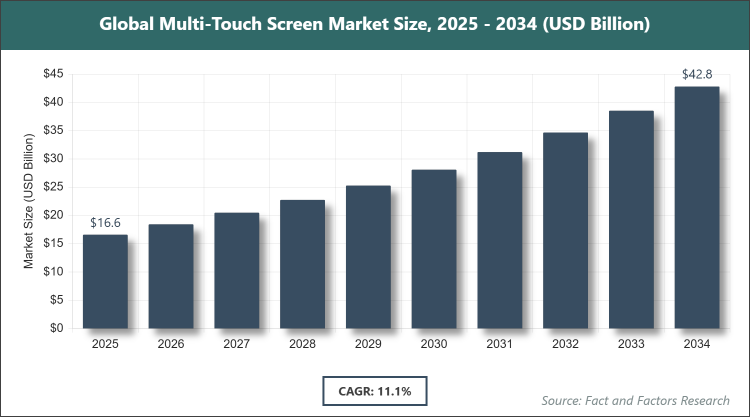
[220+ Pages Report] According to Facts & Factors, the global Multi-Touch Screen market size was estimated at USD 16.6 billion in 2025 and is expected to reach USD 42.6 billion by the end of 2034. The Multi-Touch Screen industry is anticipated to grow by a CAGR of 11.1% between 2026 and 2034. The Multi-Touch Screen Market is driven by increasing adoption of touch-enabled devices in consumer electronics.
 Market Overview
The multi-touch screen market encompasses technologies that enable displays to detect and respond to multiple points of contact simultaneously, revolutionizing user interfaces across various devices and applications. This market includes hardware components, software integrations, and supporting ecosystems that facilitate intuitive interactions through gestures like pinching, swiping, and tapping, primarily used in consumer electronics, automotive systems, and interactive kiosks without incorporating numerical data.
Key Insights
- As per the analysis shared by our research analyst, the global Multi-Touch Screen market is estimated to grow annually at a CAGR of around 11.1% over the forecast period (2026-2034).
- In terms of revenue, the global Multi-Touch Screen market size was valued at around USD 16.6 Billion in 2025 and is projected to reach USD 42.6 Billion by 2034.
- The market is driven by rising demand for interactive and user-friendly interfaces in smartphones, tablets, and digital signage.
- Based on the technology, the capacitive segment dominated with 65% share due to its high sensitivity, durability, and widespread adoption in modern smartphones and tablets.
- Based on the application, the smartphones & tablets segment dominated with 50% share owing to the proliferation of mobile devices requiring precise multi-touch capabilities for enhanced user experiences.
- Based on the end-use, the consumer electronics segment dominated with 70% share because of the integration of multi-touch screens in everyday gadgets like laptops and smart home devices, driving mass-market accessibility.
- Asia Pacific dominated with 45% share attributed to its role as a manufacturing hub for electronics and high consumer demand in countries like China and South Korea.
Growth Drivers
- Increasing Demand for Smart Devices
The surge in smartphone and tablet usage has significantly propelled the multi-touch screen market, as consumers seek seamless and intuitive interactions. This demand is fueled by the integration of multi-touch technology in portable devices, enhancing functionalities like gaming and navigation.
Furthermore, the expansion of e-commerce and digital content consumption has necessitated advanced touch interfaces, leading to broader adoption across personal and professional applications.
- Technological Advancements in Display Solutions
Innovations such as flexible and foldable screens have opened new avenues for multi-touch applications, improving durability and responsiveness. These advancements allow for thinner, lighter devices without compromising performance, attracting manufacturers to invest in R&D.
Additionally, the incorporation of haptic feedback and AI-enhanced touch recognition has elevated user engagement, fostering market growth through differentiated product offerings.
Restraints
- High Manufacturing Costs
The production of advanced multi-touch screens involves expensive materials and complex processes, limiting accessibility for smaller manufacturers and emerging markets. This cost barrier can slow down market penetration in price-sensitive regions.
Moreover, fluctuations in raw material prices, such as indium tin oxide used in capacitive screens, add to the financial strain, potentially hindering overall industry expansion.
- Technical Limitations in Harsh Environments
Multi-touch screens can face issues like reduced accuracy in extreme temperatures or wet conditions, restricting their use in industrial or outdoor settings. These limitations require additional protective layers, increasing design complexity.
In addition, compatibility challenges with legacy systems and software can delay adoption, as users may encounter glitches or require frequent updates to maintain optimal performance.
Opportunities
- Expansion in Emerging Markets
Rapid urbanization in developing regions presents opportunities for multi-touch screen adoption in education and retail sectors, where interactive kiosks and digital classrooms are gaining traction. This growth potential is supported by improving infrastructure and rising disposable incomes.
Furthermore, government initiatives promoting digitalization can accelerate market entry, allowing companies to tailor affordable solutions for local needs.
- Integration with IoT and AI Technologies
The convergence of multi-touch screens with IoT devices enables smarter home and automotive interfaces, creating new revenue streams. This integration enhances automation and personalization, appealing to tech-savvy consumers.
Additionally, AI-driven predictive touch features can improve accessibility, opening doors to applications in healthcare and assistive technologies for diverse user groups.
Challenges
- Intense Market Competition
The presence of numerous players leads to price wars and rapid innovation cycles, making it difficult for companies to maintain market share. This competition demands continuous investment in differentiation strategies.
Moreover, intellectual property disputes over touch technologies can result in legal hurdles, diverting resources from core development activities.
- Supply Chain Disruptions
Global events like pandemics or trade tensions can interrupt the supply of critical components, affecting production timelines and costs. Reliance on specific regions for manufacturing exacerbates these vulnerabilities.
In response, companies must diversify suppliers, but this transition can be time-consuming and may initially increase operational complexities.
Report Scope
Report Attribute |
Details |
Market Size 2025 |
USD 16.6 Billion |
Projected Market Size in 2034 |
USD 42.6 Billion |
CAGR Growth Rate |
11.1% CAGR |
Base Year |
2025 |
Forecast Years |
2026-2034 |
Key Market Players |
Apple Inc., Samsung Electronics, LG Display Co., Ltd., Panasonic Corporation, Fujitsu Limited, 3M Company, Planar Systems Inc., DISPLAX Interactive Systems, GestureTek, HP Development Company L.P., Immersion Corporation, and Others. |
Key Segment |
By Technology, By Application, By End-Use, and By Region |
Major Regions Covered |
North America, Europe, Asia Pacific, Latin America, and the Middle East & Africa |
Purchase Options |
Request customized purchase options to meet your research needs. Explore purchase options |
Market Segmentation
The Multi-Touch Screen market is segmented by technology, application, end-use, and region.
Based on Technology Segment, the Multi-Touch Screen market is divided into capacitive, resistive, infrared, surface acoustic wave, and others. The most dominant segment is capacitive, holding approximately 65% market share, while the second most dominant is resistive with around 20%. The capacitive segment leads due to its superior touch sensitivity, support for multi-finger gestures, and integration in high-end devices like smartphones, which drives market growth by enabling advanced user interfaces and boosting demand in consumer electronics; its cost-effectiveness in mass production further accelerates adoption across various applications.
Based on Application Segment, the Multi-Touch Screen market is divided into smartphones & tablets, laptops & PCs, interactive displays, digital signage, and others. The most dominant segment is smartphones & tablets, capturing about 50% share, followed by laptops & PCs at roughly 25%. Smartphones & tablets dominate because of the massive global demand for mobile devices requiring precise and responsive touch inputs for apps and multimedia, propelling the market forward through continuous innovation in screen sizes and resolutions that enhance portability and user engagement.
Based on End-Use Segment, the Multi-Touch Screen market is divided into consumer electronics, automotive, healthcare, retail & hospitality, education, and others. The most dominant segment is consumer electronics with around 70% share, and the second is retail & hospitality at approximately 15%. Consumer electronics leads owing to the widespread incorporation of multi-touch in everyday gadgets like TVs and gaming consoles, fueling market expansion by improving interactive experiences and supporting the shift towards smart homes and connected devices.
Recent Developments
- In June 2023, Samsung Electronics launched a new interactive display model named "WAC," marking the first Samsung product to integrate multi-touch technology with advanced collaborative features for education and business environments.
- Leading manufacturers like Fujitsu and STMicroelectronics introduced improved resistive multi-touch screens in 2024, featuring advanced 10-point touch solutions that enhance accuracy and responsiveness for industrial applications.
- Innovations in 2025 focused on flexible, foldable, and transparent touchscreens, enabling enhanced design possibilities and user experiences in wearable and automotive sectors.
- The integration of AI and machine learning in touch screen interfaces gained momentum in 2026, allowing for predictive touch features and improved gesture recognition in smart devices.
Regional Analysis
- Asia Pacific to dominate the global market
The Asia Pacific region stands out as the leading area in the multi-touch screen market, driven by its robust manufacturing ecosystem and technological innovation hubs in countries like China, which hosts major electronics producers and benefits from cost-effective labor and supply chains, facilitating rapid production scaling and export to global markets.
North America follows closely, with the United States at the forefront due to its strong emphasis on research and development, coupled with high consumer adoption of advanced gadgets in sectors like entertainment and automotive, supported by a mature tech infrastructure that encourages innovation and investment.
Europe demonstrates steady growth, led by Germany and its focus on automotive integration of multi-touch technologies, where stringent quality standards and a push towards sustainable manufacturing practices enhance product reliability and market penetration in industrial applications.
Latin America is emerging gradually, with Brazil as a key player owing to increasing digitalization in retail and education, bolstered by improving economic conditions and government initiatives that promote technology adoption to bridge infrastructural gaps.
The Middle East & Africa region shows potential, particularly in the United Arab Emirates, where investments in smart city projects and hospitality drive demand for interactive displays, leveraging oil revenues to fund technological advancements and attract international partnerships.
Competitive Analysis
The global Multi-Touch Screen market is dominated by players:
- Apple Inc.
- Samsung Electronics
- LG Display Co., Ltd.
- Panasonic Corporation
- Fujitsu Limited
- 3M Company
- Planar Systems Inc.
- DISPLAX Interactive Systems
- GestureTek
- HP Development Company L.P.
- Immersion Corporation
The global Multi-Touch Screen market is segmented as follows:
By Technology
- Capacitive
- Resistive
- Infrared
- Surface Acoustic Wave
- Others
By Application
- Smartphones & Tablets
- Laptops & PCs
- Interactive Displays
- Digital Signage
- Others
By End-Use
- Consumer Electronics
- Automotive
- Healthcare
- Retail & Hospitality
- Education
- Others
By Region
- North America
- The U.S.
- Canada
- Mexico
- Europe
- France
- The UK
- Spain
- Germany
- Italy
- Rest of Europe
- Asia Pacific
- China
- Japan
- India
- Australia
- Southeast Asia
- Rest of Asia Pacific
- The Middle East & Africa
- Saudi Arabia
- UAE
- Egypt
- Kuwait
- South Africa
- Rest of the Middle East & Africa
- Latin America
- Brazil
- Argentina
- Rest of Latin America
Industry Major Market Players
The global Multi-Touch Screen market is dominated by players:
- Apple Inc.
- Samsung Electronics
- LG Display Co., Ltd.
- Panasonic Corporation
- Fujitsu Limited
- 3M Company
- Planar Systems Inc.
- DISPLAX Interactive Systems
- GestureTek
- HP Development Company L.P.
- Immersion Corporation



Copyright © 2025 - 2026, All Rights Reserved, Facts and Factors