
Search Market Research Report
MLM Market Size, Share Global Analysis Report, 2026-2034

MLM Market Size, Share, Growth Analysis Report By Product Type (Personal Care, Wellness, Household Goods, Cosmetics, Food & Beverages, and Others), By Business Model (Single-Level Marketing, Multi-Level Marketing), By Sales Strategy (Online Sales, Face-to-Face Sales), By End-user (Men, Women, Families, Seniors), and By Region - Global Industry Insights, Overview, Comprehensive Analysis, Trends, Statistical Research, Market Intelligence, Historical Data and Forecast 2026-2034
Industry Insights
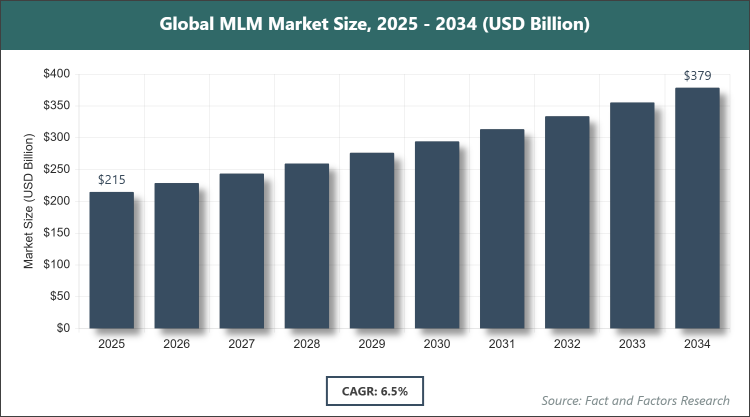
[220+ Pages Report] According to Facts & Factors, the global MLM market size was estimated at USD 214.85 billion in 2025 and is expected to reach USD 397.82 billion by the end of 2034. The MLM industry is anticipated to grow by a CAGR of 6.5% between 2026 and 2034. The MLM Market is driven by rising entrepreneurship, direct-to-consumer product distribution models, and increasing use of digital tools for network building and sales.
 Market Overview
Multilevel marketing (MLM), also known as direct selling or network marketing, represents a business model where companies facilitate person-to-person sales of goods and services. This approach allows firms to contract third parties or vendors to distribute products directly to consumers, bypassing traditional retail channels and reducing costs associated with wholesalers and intermediaries. MLM emphasizes building networks of independent distributors who not only sell products but also recruit others into the system, creating layers of compensation based on sales performance and team-building efforts. It thrives on personal relationships, community engagement, and entrepreneurial spirit, offering participants flexibility in work schedules and potential for supplemental income through commission-based structures.
Key Insights
- As per the analysis shared by our research analyst, the global MLM market is estimated to grow annually at a CAGR of around 6.5% over the forecast period (2026-2034).
- In terms of revenue, the global MLM market size was valued at around USD 214.85 Billion in 2025 and is projected to reach USD 397.82 Billion by 2034.
- The market is driven by rising entrepreneurship, direct-to-consumer product distribution models, and increasing use of digital tools for network building and sales.
- Based on the Product Type, Health & Wellness dominated with 66% share because it addresses growing consumer concerns over health issues, pandemics, and chronic diseases, leading to higher demand for wellness products.
- Based on the Business Model, Single-Level Marketing dominated with 55% share because it offers simpler compensation structures that appeal to a broader base of participants seeking straightforward earning opportunities without complex recruitment hierarchies.
- Based on the Sales Strategy, Online Sales dominated with 60% share because digital platforms enable wider reach, lower overhead costs, and seamless integration with social media for marketing and transactions.
- Based on the End-user, Men dominated with 50% share because of increasing male participation in health, wellness, and entrepreneurial ventures traditionally dominated by other demographics.
- Based on the region, North America dominated with 40% share because of its mature direct selling infrastructure, high consumer spending power, and supportive regulatory environment for entrepreneurial activities.
Growth Drivers
- Requirement for Fastest Distribution Channels
The demand for efficient and rapid product distribution has significantly propelled the MLM market forward. By eliminating intermediaries, MLM allows companies to deliver goods directly to consumers, reducing time lags and costs associated with traditional supply chains. This model appeals to businesses aiming to maintain control over branding and customer interactions while ensuring quicker market penetration. As global trade becomes more competitive, the need for agile distribution strategies has intensified, making MLM an attractive option for firms seeking to optimize logistics and enhance customer satisfaction through personalized service.
Furthermore, the surge in cost-effective consumer goods has amplified MLM's role in providing affordable access to products. Participants benefit from additional income streams, fostering a cycle of growth where more individuals join as distributors. With over 126 million direct sellers globally, this expansion underscores MLM's ability to create employment opportunities and stimulate economic activity at grassroots levels, contributing to broader market resilience and adaptability in fluctuating economic conditions.
- Rise in Direct Sellers
The increasing number of direct sellers has been a key catalyst for MLM market expansion. As more individuals seek flexible work options, MLM offers a low-barrier entry into entrepreneurship, allowing participants to leverage personal networks for sales. This trend is supported by rising awareness of supplemental income sources amid economic uncertainties, driving higher recruitment rates and network growth. The model's scalability enables rapid expansion, with new sellers contributing to overall revenue through both personal sales and team-building efforts.
In addition, technological advancements have facilitated easier onboarding and management of large seller networks. Digital tools for training, tracking, and communication have lowered operational hurdles, making MLM more accessible and efficient. This has led to sustained growth, as evidenced by projections of continued increases in direct seller numbers, which in turn bolster market revenues and foster innovation in product offerings and marketing strategies.
Restraints
- Growth of E-commerce and Online Purchases
The proliferation of e-commerce platforms has posed a significant challenge to the MLM market by offering consumers convenient, price-competitive alternatives to direct selling. Online marketplaces provide vast product selections with user reviews, fast delivery, and often lower prices due to economies of scale, diverting potential MLM customers. This shift has eroded the traditional advantages of person-to-person sales, as digital channels reduce the need for interpersonal interactions in purchasing decisions. Consequently, MLM companies face pressure to adapt their models to compete in a digitally dominated retail landscape.
Moreover, the thriving e-commerce sector has increased advertising costs for MLM activities, as competition for online visibility intensifies. Traditional MLM reliance on word-of-mouth and personal networks is undermined by algorithmic promotions and targeted ads on e-commerce sites, making it harder for distributors to attract and retain customers. This dynamic has led to slower growth rates in some MLM segments, necessitating strategic pivots toward hybrid models that integrate online elements to remain viable.
Opportunities
- Reward and Loyalty Programs for Direct Sellers
The introduction of enhanced reward and loyalty programs by MLM companies presents substantial growth opportunities. These initiatives incentivize performance and retention among distributors, fostering long-term commitment and higher productivity. By offering tiered rewards, travel incentives, and recognition events, firms can boost motivation and network expansion. Such programs not only improve seller satisfaction but also attract new participants seeking tangible benefits beyond base commissions, potentially accelerating market penetration in untapped demographics.
Additionally, these programs can differentiate MLM offerings in a competitive landscape, building brand loyalty and community. As private brands invest more in customized incentives, the market stands to gain from increased seller engagement and sales volumes. This approach aligns with evolving consumer preferences for personalized experiences, positioning MLM as a dynamic and rewarding business model capable of sustaining growth amid economic shifts.
Challenges
- Fluctuating Government Policies and Regulations
Evolving government policies and regulations create uncertainty in the MLM market, often leading to compliance burdens and operational disruptions. Changes in consumer protection laws, anti-pyramid scheme regulations, and tax policies can restrict business practices, requiring companies to invest heavily in legal adaptations. Low foreign direct investment due to policy instability further hampers expansion into new markets, limiting global scalability and innovation potential.
Outbreaks of pandemics exacerbate these challenges by interrupting supply chains and in-person sales activities central to MLM. Restrictions on gatherings and travel during health crises force rapid shifts to digital alternatives, which not all companies or distributors are equipped to handle. This vulnerability highlights the need for resilient strategies, but persistent regulatory flux continues to pose risks to sustained industry growth and stability.
Report Scope
Report Attribute |
Details |
Market Size 2025 |
USD 214.85 Billion |
Projected Market Size in 2034 |
USD 397.82 Billion |
CAGR Growth Rate |
6.5% CAGR |
Base Year |
2025 |
Forecast Years |
2026-2034 |
Key Market Players |
Amway Enterprises Pvt. Ltd., Nu Skin Enterprises, Cutco Corporation, Mary Kay Inc., Belcorp Corporation, Oriflame Holding AG, Vorwerk, Tupperware Brands Corporation, Natura & Co., Herbalife Nutrition Ltd., and Others. |
Key Segment |
By Product Type, By Business Model, By Sales Strategy, By End-user, and By Region |
Major Regions Covered |
North America, Europe, Asia Pacific, Latin America, and the Middle East & Africa |
Purchase Options |
Request customized purchase options to meet your research needs. Explore purchase options |
Market Segmentation
The MLM market is segmented by product type, business model, sales strategy, end-user, and region.
Based on Product Type Segment, the MLM market is divided into Personal Care, Wellness, Household Goods, Cosmetics, Food & Beverages, and others. The most dominant segment is Health & Wellness, while the second most dominant is Cosmetics & Personal Care. Health & Wellness leads due to escalating global health concerns, including chronic diseases like diabetes and cancer, as well as stress-related disorders, driving consumer demand for preventive and supportive products; this dominance helps propel the market by capitalizing on heightened awareness post-pandemics, encouraging repeat purchases and network expansion through shared health benefits. Cosmetics & Personal Care ranks second, fueled by increasing emphasis on skincare and beauty routines amid changing climates, promoting branding and personal grooming; it drives market growth by leveraging social media influence and aspirational marketing, attracting diverse demographics and boosting sales through visual appeal and self-improvement narratives.
Based on Business Model Segment, the MLM market is divided into Single-Level Marketing, Multi-Level Marketing. The most dominant segment is Single-Level Marketing, while the second most dominant is Multi-Level Marketing. Single-Level Marketing dominates as it provides a straightforward compensation structure focused on direct sales without complex recruitment, appealing to individuals seeking simple entrepreneurial opportunities; this helps drive the market by lowering entry barriers, increasing participation rates, and ensuring steady revenue from personal sales efforts. Multi-Level Marketing follows, emphasizing network building and tiered commissions, which attracts ambitious participants; it contributes to market expansion by fostering exponential growth through recruitment, creating larger distributor bases that amplify product distribution and overall industry scale.
Based on Sales Strategy Segment, the MLM market is divided into Online Sales, Face-to-Face Sales. The most dominant segment is Online Sales, while the second most dominant is Face-to-Face Sales. Online Sales leads by utilizing digital platforms for broader reach and convenience, integrating with social media for targeted marketing; this dominance drives the market through cost efficiencies, global accessibility, and data-driven personalization, enhancing customer engagement and sales conversion rates. Face-to-Face Sales ranks second, relying on personal relationships and trust-building; it supports market growth by enabling product demonstrations and immediate feedback, strengthening community ties and loyalty in regions where digital penetration is lower.
Based on End-user Segment, the MLM market is divided into Men, Women, Families, Seniors. The most dominant segment is Men, while the second most dominant is Women. Men dominate due to growing involvement in health, wellness, and business opportunities, shifting from traditional demographics; this helps drive the market by diversifying the participant base, introducing new networks, and expanding product appeal to male-specific needs like fitness and career flexibility. Women follow as the second dominant, with strong historical participation in beauty and household products; they propel growth through robust social networks, mentorship roles, and advocacy, sustaining recruitment and sales in core categories.
Recent Developments
- In May 2025, Shaklee acquired the rights to Modere products following the shutdown of Modere’s MLM operations, allowing Shaklee to expand its product portfolio in health and wellness categories and integrate Modere's customer base for enhanced market presence.
- In June 2025, MLM Medical Labs acquired Cytespace Africa Laboratories, marking a strategic expansion into Africa’s growing clinical research sector and potentially opening new avenues for MLM models in health-related services.
- In early 2026, several MLM companies integrated AI and machine learning into their platforms to enhance lead generation and personalized marketing, reflecting a broader industry shift toward technology-driven efficiency.
Regional Analysis
- North America to dominate the global market
North America stands out as a powerhouse in the MLM landscape, driven by its advanced infrastructure and entrepreneurial culture that encourages direct selling initiatives. The region's emphasis on innovation and consumer trust fosters an environment where MLM companies can thrive through robust training programs and community events. Dominating country United States plays a pivotal role with its large consumer market and regulatory frameworks that support business flexibility, enabling distributors to build extensive networks. This dominance is further bolstered by high disposable incomes and a preference for personalized shopping experiences, which align seamlessly with MLM's person-to-person approach. Overall, North America's leadership stems from its ability to adapt to market trends while maintaining strong ethical standards in operations.
Europe exhibits a mature MLM sector characterized by diverse cultural influences and stringent consumer protection laws that shape business practices. The region's focus on sustainability and quality products attracts distributors who value ethical sourcing and transparency. Germany emerges as the dominating country, leveraging its strong economy and organized workforce to drive MLM growth through efficient distribution channels. European markets benefit from cross-border collaborations, enhancing product variety and market reach. This dynamic environment promotes innovation in sales strategies, ensuring resilience against economic fluctuations and fostering long-term participant engagement.
Asia Pacific represents a rapidly evolving MLM hub, fueled by burgeoning middle-class populations and increasing internet penetration that facilitates online sales models. The region's youthful demographics and entrepreneurial spirit create fertile ground for network building and recruitment. China dominates as the key country, with its vast consumer base and government-backed e-commerce integration propelling MLM expansion. Cultural emphasis on community and relationships strengthens person-to-person interactions, while mobile technologies enable seamless operations. This vibrancy positions Asia Pacific as a growth engine, adapting traditional models to modern digital landscapes for sustained progress.
Latin America showcases emerging potential in MLM, supported by vibrant social networks and a growing appetite for supplemental income opportunities. The region's economic diversity encourages flexible business models that resonate with local communities. Brazil leads as the dominating country, harnessing its large population and cultural affinity for direct selling to boost market penetration. Emphasis on affordable wellness and beauty products aligns with consumer needs, driving distributor motivation. Despite challenges like economic volatility, Latin America's resilience through adaptive strategies ensures steady advancement in the sector.
The Middle East & Africa region is witnessing gradual MLM adoption, influenced by expanding urbanization and rising awareness of entrepreneurial ventures. Cultural traditions of hospitality aid in building trust-based networks essential for direct selling. United Arab Emirates stands out as the dominating country, with its cosmopolitan market and investment in digital infrastructure supporting MLM growth. Focus on luxury and health products caters to affluent segments, while youth empowerment initiatives attract new participants. This area's potential lies in bridging traditional commerce with modern techniques for inclusive economic development.
Competitive Analysis
The global MLM market is dominated by players:
- Amway Enterprises Pvt. Ltd.
- Nu Skin Enterprises
- Cutco Corporation
- Mary Kay Inc.
- Belcorp Corporation
- Oriflame Holding AG
- Vorwerk
- Tupperware Brands Corporation
- Natura & Co.
- Herbalife Nutrition Ltd.
- and others.
The global MLM market is segmented as follows:
By Product Type
- Personal Care
- Wellness
- Household Goods
- Cosmetics
- Food & Beverages
- Others
By Business Model
- Single-Level Marketing
- Multi-Level Marketing
By Sales Strategy
- Online Sales
- Face-to-Face Sales
By End-user
- Men
- Women
- Families
- Seniors
By Region
- North America
- The U.S.
- Canada
- Mexico
- Europe
- France
- The UK
- Spain
- Germany
- Italy
- Rest of Europe
- Asia Pacific
- China
- Japan
- India
- Australia
- Southeast Asia
- Rest of Asia Pacific
- The Middle East & Africa
- Saudi Arabia
- UAE
- Egypt
- Kuwait
- South Africa
- Rest of the Middle East & Africa
- Latin America
- Brazil
- Argentina
- Rest of Latin America
Industry Major Market Players
The global MLM market is dominated by players:
- Amway Enterprises Pvt. Ltd.
- Nu Skin Enterprises
- Cutco Corporation
- Mary Kay Inc.
- Belcorp Corporation
- Oriflame Holding AG
- Vorwerk
- Tupperware Brands Corporation
- Natura & Co.
- Herbalife Nutrition Ltd.
- and others.



Copyright © 2025 - 2026, All Rights Reserved, Facts and Factors