
Search Market Research Report
Marine Winches Market Size, Share Global Analysis Report, 2026-2034

Marine Winches Market Size, Share, Growth Analysis Report By Type (Electric Winches, Hydraulic Winches, Manual Winches, and Others), By Application (Marine Engineering, Hoisting Freight, Fishing, and Others), By End-User (Commercial Vessels, Offshore Platforms, Naval Vessels, and Others), and By Region - Global Industry Insights, Overview, Comprehensive Analysis, Trends, Statistical Research, Market Intelligence, Historical Data and Forecast 2026-2034
Industry Insights
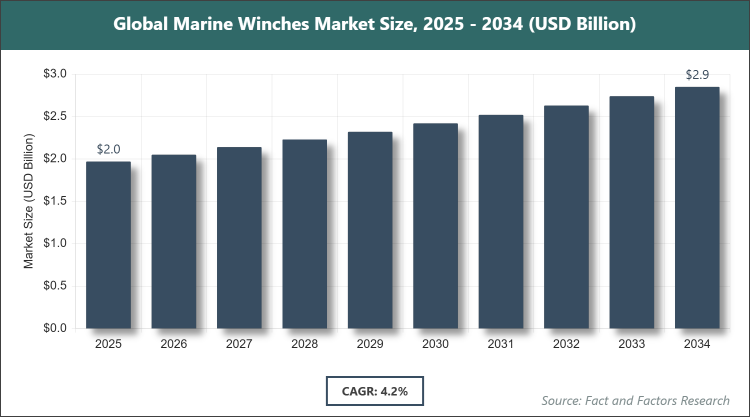
[238+ Pages Report] According to Facts & Factors, the global Marine Winches market size was estimated at USD 1.97 billion in 2025 and is expected to reach USD 2.85 billion by the end of 2034. The Marine Winches industry is anticipated to grow by a CAGR of 4.2% between 2026 and 2034. The Marine Winches Market is driven by expanding maritime trade and offshore exploration activities.
 Market Overview
Marine winches are mechanical devices designed to wind up or wind out ropes, cables, or chains, primarily used in maritime environments for anchoring, mooring, towing, and cargo handling operations. These winches operate through electric, hydraulic, or manual mechanisms to provide controlled tension and pulling force, ensuring safe and efficient vessel maneuvers in various sea conditions. They are integral to shipboard equipment, supporting functions from deck operations to deep-sea applications, where reliability, corrosion resistance, and high load capacity are essential for maintaining operational safety and productivity in commercial, naval, and offshore settings.
Key Insights
- As per the analysis shared by our research analyst, the global Marine Winches market is estimated to grow annually at a CAGR of around 4.2% over the forecast period (2026-2034).
- In terms of revenue, the global Marine Winches market size was valued at around USD 1.97 billion in 2025 and is projected to reach USD 2.85 billion by 2034.
- The market is driven by increasing offshore oil and gas exploration and rising maritime logistics demand.
- Based on the type, the electric winches segment dominated the market with a share of 50%, as it offers energy efficiency, ease of integration with automation systems, and lower maintenance costs suitable for modern vessels.
- Based on the application, the hoisting freight segment dominated with a share of 40%, due to growing global trade volumes requiring reliable cargo handling equipment on commercial ships.
- Based on the end-user, the commercial vessels segment dominated with a share of 55%, attributed to the expansion of global shipping fleets and e-commerce-driven logistics.
- Asia Pacific dominated the global market with a share of 45%, owing to robust shipbuilding industries, extensive maritime trade routes, and investments in port infrastructure in China.
Growth Drivers
- Rising Global Maritime Trade
The escalation in international trade, particularly through sea routes, has significantly increased the demand for marine winches to facilitate efficient cargo loading, unloading, and securing operations on vessels. This growth is supported by the expansion of global supply chains and e-commerce, necessitating larger container ships equipped with advanced winching systems for handling heavier loads. Technological integrations, such as remote-controlled winches, further enhance operational safety and speed, aligning with industry standards for reduced downtime.
Additionally, investments in port modernization and fleet upgrades by major shipping companies are driving innovation in winch designs, focusing on durability and automation. As trade agreements proliferate, the need for versatile winches capable of operating in diverse environmental conditions continues to propel market expansion, benefiting stakeholders across the maritime ecosystem.
Restraints
- High Capital Investment Requirements
The substantial initial costs associated with advanced marine winches, including installation and customization for specific vessel types, pose a challenge for smaller operators and emerging markets. This financial barrier is exacerbated by the need for compliance with stringent maritime regulations, which often require certified, high-quality materials resistant to corrosion and extreme weather.
Moreover, fluctuations in raw material prices, such as steel and electronics, can inflate production expenses, leading to delayed procurements. In regions with limited access to financing, these restraints may hinder adoption, favoring refurbished or basic models over innovative solutions, thus slowing overall market penetration.
Opportunities
- Advancements in Offshore Renewable Energy
The burgeoning offshore wind and tidal energy sectors offer promising opportunities for marine winches in installation, maintenance, and cable laying operations, where precision and reliability are paramount. Innovations in hybrid winch systems combining electric and hydraulic power are emerging to meet the demands of sustainable energy projects, supported by government subsidies and green initiatives.
Furthermore, collaborations between winch manufacturers and renewable energy firms are fostering tailored solutions for harsh offshore environments. This opportunity not only diversifies application scopes but also aligns with global sustainability goals, potentially unlocking new revenue streams through long-term service contracts.
Challenges
- Stringent Environmental Regulations
Increasing regulatory pressures to reduce emissions and noise pollution in marine operations challenge winch manufacturers to develop eco-friendly, low-impact systems, which may require significant R&D investments. Compliance with international standards like IMO guidelines adds complexity to design and certification processes, potentially delaying product launches.
In addition, the transition to greener technologies, such as electric winches, faces hurdles in retrofitting existing fleets, involving technical and cost implications. Balancing innovation with regulatory adherence is essential, but non-compliance risks could impact market trust and growth in environmentally sensitive regions.
Report Scope
Report Attribute |
Details |
Market Size 2025 |
USD 1.97 Billion |
Projected Market Size in 2034 |
USD 2.85 Billion |
CAGR Growth Rate |
4.2% CAGR |
Base Year |
2025 |
Forecast Years |
2026-2034 |
Key Market Players |
MacGregor, Rolls-Royce, Ingersoll Rand, TTS, ACE Winches, Huisman Group, IHC Hytop, Wärtsilä, Mitsubishi Heavy Industries, Fukushima Ltd., Kongsberg Gruppen, Liebherr, and Others. |
Key Segment |
By Type, By Application, By End-User, and By Region |
Major Regions Covered |
North America, Europe, Asia Pacific, Latin America, and the Middle East & Africa |
Purchase Options |
Request customized purchase options to meet your research needs. Explore purchase options |
Market Segmentation
The Marine Winches market is segmented by type, application, end-user, and region.
Based on Type Segment, the Marine Winches market is divided into electric winches, hydraulic winches, manual winches, and others. The electric winches segment emerges as the most dominant, holding approximately 50% market share, primarily due to their superior energy efficiency, integration with automated control systems, and reduced operational costs, which are crucial for modern commercial vessels, thereby driving the market by enabling faster, safer cargo handling and supporting the shift toward electrified maritime operations. The hydraulic winches segment follows as the second most dominant, with around 35% share, owing to their high power output and reliability in heavy-duty applications like offshore platforms, contributing to market growth by providing robust solutions for extreme conditions and enhancing productivity in oil and gas exploration.
Based on Application Segment, the Marine Winches market is divided into marine engineering, hoisting freight, fishing, and others. The hoisting freight segment is the most dominant, capturing about 40% of the market, as it addresses the critical need for efficient cargo management amid rising global trade, driven by e-commerce and supply chain expansions, helping to drive the market through improved vessel turnaround times and reduced labor costs. The marine engineering segment ranks second, with roughly 30% share, benefiting from its role in construction and maintenance of offshore structures, aiding market expansion by supporting infrastructure development in renewable energy and deep-sea projects.
Based on End-User Segment, the Marine Winches market is divided into commercial vessels, offshore platforms, naval vessels, and others. The commercial vessels segment is the most dominant, capturing about 55% of the market, propelled by the growth in shipping fleets and logistics demands, thereby driving the market through enhanced operational efficiency and capacity for global trade routes. The offshore platforms segment ranks second, with roughly 25% share, utilizing winches for drilling and extraction activities, contributing to market growth by facilitating safe and reliable operations in the expanding oil and gas sector.
Recent Developments
- In 2022, MacGregor introduced advanced control systems with remote diagnostics capabilities for marine winches, enhancing operational safety and reducing maintenance downtime in offshore applications.
- In 2023, Rolls-Royce launched a new series of electric winches designed for sustainable maritime operations, focusing on energy efficiency to meet IMO emission standards.
- In 2024, Wärtsilä partnered with a major shipbuilder to integrate hybrid winch technology into new vessels, improving performance in harsh sea conditions.
- In 2025, ACE Winches expanded its manufacturing facility in Scotland to increase production of high-capacity hydraulic winches for the growing offshore wind sector.
- In early 2026, Huisman Group unveiled innovative compact winches for naval applications, emphasizing lightweight design and corrosion resistance.
Regional Analysis
- Asia Pacific to dominate the global market
Asia Pacific commands the marine winches market, bolstered by extensive shipbuilding activities, thriving maritime trade, and significant investments in port infrastructure that enhance logistical capabilities. China dominates this region as the world's largest shipbuilder and exporter, with integrated supply chains supporting rapid production and innovation in winch technologies, catering to both domestic fleet expansions and global demands for efficient cargo handling.
North America maintains a strong position, driven by advanced technological integrations and a focus on sustainable maritime practices amid growing offshore energy projects. The United States leads, with initiatives like the Jones Act promoting domestic manufacturing and R&D in electric winches, ensuring compliance with environmental regulations while bolstering naval and commercial vessel operations.
Europe emphasizes regulatory compliance and innovation in green technologies, accelerating adoption in shipping and renewable sectors. Germany emerges as key, leveraging its engineering heritage and EU maritime policies to advance winch designs for low-emission vessels, strengthening regional competitiveness in global trade and offshore wind installations.
Latin America exhibits potential growth, supported by resource extraction and expanding trade agreements. Brazil stands out, utilizing its offshore oil reserves and port developments to integrate advanced winches, fostering economic diversification and efficiency in maritime logistics.
The Middle East & Africa region progresses through energy sector investments and diversification strategies. The United Arab Emirates dominates, capitalizing on its strategic location and hub status to deploy high-performance winches in shipping and oil platforms, promoting regional trade and sustainable maritime advancements.
Competitive Analysis
The global Marine Winches market is dominated by players:
- MacGregor
- Rolls-Royce
- Ingersoll Rand
- TTS
- ACE Winches
- Huisman Group
- IHC Hytop
- Wärtsilä
- Mitsubishi Heavy Industries
- Fukushima Ltd.
- Kongsberg Gruppen
- Liebherr
- And Others.
The global Marine Winches market is segmented as follows:
By Type
- Electric Winches
- Hydraulic Winches
- Manual Winches
- Others
By Application
- Marine Engineering
- Hoisting Freight
- Fishing
- Others
By End-User
- Commercial Vessels
- Offshore Platforms
- Naval Vessels
- Others
By Region
- North America
- The U.S.
- Canada
- Mexico
- Europe
- France
- The UK
- Spain
- Germany
- Italy
- Rest of Europe
- Asia Pacific
- China
- Japan
- India
- Australia
- Southeast Asia
- Rest of Asia Pacific
- The Middle East & Africa
- Saudi Arabia
- UAE
- Egypt
- Kuwait
- South Africa
- Rest of the Middle East & Africa
- Latin America
- Brazil
- Argentina
- Rest of Latin America
Industry Major Market Players
- MacGregor
- Rolls-Royce
- Ingersoll Rand
- TTS
- ACE Winches
- Huisman Group
- IHC Hytop
- Wärtsilä
- Mitsubishi Heavy Industries
- Fukushima Ltd.
- Kongsberg Gruppen
- Liebherr



Copyright © 2025 - 2026, All Rights Reserved, Facts and Factors