
Search Market Research Report
Magnetic Bearings Market Size, Share Global Analysis Report, 2026-2034

Magnetic Bearings Market Size, Share, Growth Analysis Report By Type (Active Magnetic Bearings, Passive Magnetic Bearings, Hybrid Magnetic Bearings), By Application (Compressors, Turbines, Pumps, Motors, Generators, Others), By End-User (Oil & Gas, Power Generation, Petrochemicals, Others), and By Region - Global Industry Insights, Overview, Comprehensive Analysis, Trends, Statistical Research, Market Intelligence, Historical Data and Forecast 2026-2034
Industry Insights
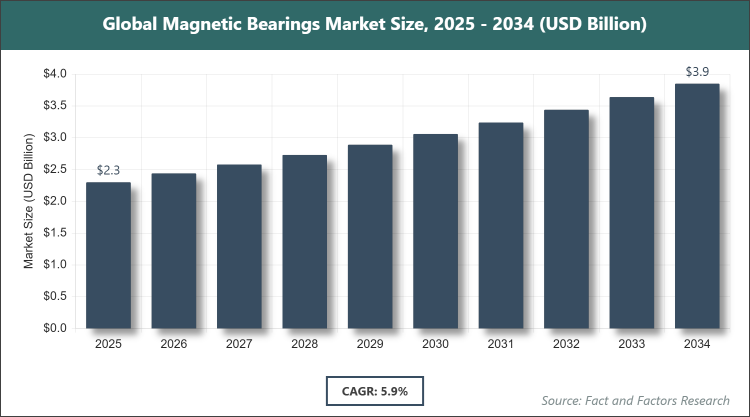
[220+ Pages Report] According to Facts & Factors, the global Magnetic Bearings market size was estimated at USD 2.3 billion in 2025 and is expected to reach USD 4.0 billion by the end of 2034. The Magnetic Bearings industry is anticipated to grow by a CAGR of 5.9% between 2026 and 2034. The Magnetic Bearings Market is driven by increasing demand for energy-efficient and low-maintenance rotating equipment.
 Market Overview
Magnetic bearings are advanced non-contact bearing systems that utilize magnetic fields to levitate and support rotating shafts, eliminating physical contact and friction between moving parts. These bearings typically employ electromagnets or permanent magnets to maintain precise positioning and stability, offering advantages in high-speed applications where traditional mechanical bearings would generate excessive heat and wear. They are essential in industries requiring high reliability, reduced vibration, and minimal maintenance, such as in turbomachinery, compressors, and electric motors, by enabling operation in harsh environments and contributing to improved system efficiency and longevity.
Key Insights
- As per the analysis shared by our research analyst, the global Magnetic Bearings market is estimated to grow annually at a CAGR of around 5.9% over the forecast period (2026-2034).
- In terms of revenue, the global Magnetic Bearings market size was valued at around USD 2.3 billion in 2025 and is projected to reach USD 4.0 billion by 2034.
- The market is driven by advancements in industrial automation and rising adoption in the energy sector.
- Based on the type, the active magnetic bearings segment dominated the market with a share of 70%, as it provides precise control and high load capacity essential for critical industrial applications.
- Based on the application, the turbines segment dominated with a share of 35%, due to the need for high-speed, vibration-free operation in power generation and oil & gas industries.
- Based on the end-user, the power generation segment dominated with a share of 40%, attributed to increasing investments in renewable energy and efficient turbomachinery.
- Asia Pacific dominated the global market with a share of 39%, owing to rapid industrialization, expanding manufacturing sectors, and the strong presence of key players in China.
Growth Drivers
- Increasing Demand for Energy-Efficient Solutions
The growing emphasis on sustainability and energy conservation across industries has propelled the adoption of magnetic bearings, which eliminate friction losses and reduce energy consumption in rotating equipment. This is particularly evident in power generation and oil & gas sectors, where operational efficiency directly impacts cost savings and environmental compliance. Technological advancements in control systems further enhance bearing performance, allowing integration with smart monitoring tools for predictive maintenance.
Moreover, government incentives for green technologies and the shift toward renewable energy sources like wind turbines amplify demand, as magnetic bearings support high-speed operations without lubrication needs. This driver fosters innovation, with manufacturers developing customized solutions to meet diverse application requirements, thereby expanding market reach.
Restraints
- High Initial Installation Costs
The substantial upfront investment required for magnetic bearings, including sophisticated control electronics and sensors, acts as a barrier, especially for small and medium enterprises in cost-sensitive markets. This cost factor is compounded by the need for specialized installation and integration, which can extend project timelines and require skilled personnel.
Additionally, in regions with limited technological infrastructure, the complexity of these systems may deter adoption, favoring traditional bearings despite their higher long-term maintenance costs. These restraints could slow penetration in emerging economies, where budget constraints prioritize affordability over advanced features.
Opportunities
- Expansion in Renewable Energy Applications
The surge in wind and solar power projects presents significant opportunities for magnetic bearings in generators and compressors, where they enable reliable, maintenance-free operation in remote locations. Innovations in hybrid systems combining active and passive technologies are opening new avenues for enhanced stability and efficiency.
Furthermore, partnerships between bearing manufacturers and renewable energy firms are accelerating product development tailored to harsh environmental conditions. This opportunity aligns with global decarbonization goals, positioning the market for growth through sustainable applications and government-backed initiatives.
Challenges
- Technical Complexity and Reliability Concerns
The intricate design of magnetic bearings, reliant on electronic controls, poses challenges in ensuring consistent performance under varying loads and power fluctuations, potentially leading to system failures if not properly managed. Reliability in extreme temperatures or contaminated environments requires ongoing R&D, increasing development costs.
In addition, the dependency on stable power supplies can limit applications in unstable grid areas, necessitating backup systems that add complexity. Addressing these through robust testing and standardization is crucial to build user confidence and sustaining market expansion.
Report Scope
Report Attribute |
Details |
Market Size 2025 |
USD 2.3 Billion |
Projected Market Size in 2034 |
USD 4.0 Billion |
CAGR Growth Rate |
5.9% CAGR |
Base Year |
2025 |
Forecast Years |
2026-2034 |
Key Market Players |
SKF AB, Schaeffler Technologies GmbH & Co. KG, Siemens AG, Waukesha Bearings Corporation, Calnetix Technologies, LLC, Dresser-Rand, MECOS AG, NSK Europe, Levitronix, KML Motion Industries Co. Ltd., and Others. |
Key Segment |
By Type, By Application, By End-User, and By Region |
Major Regions Covered |
North America, Europe, Asia Pacific, Latin America, and the Middle East & Africa |
Purchase Options |
Request customized purchase options to meet your research needs. Explore purchase options |
Market Segmentation
The Magnetic Bearings market is segmented by type, application, end-user, and region.
Based on Type Segment, the Magnetic Bearings market is divided into active magnetic bearings, passive magnetic bearings, hybrid magnetic bearings. The active magnetic bearings segment emerges as the most dominant, holding approximately 70% market share, primarily due to their ability to provide real-time adjustment and high precision control through electromagnets, which is critical for high-speed machinery in industries like power and aerospace, driving the market by reducing downtime and enhancing operational efficiency in demanding environments. The hybrid magnetic bearings segment follows as the second most dominant, with around 20% share, combining permanent magnets with active controls for improved energy efficiency and load handling, contributing to market growth by offering cost-effective solutions for applications requiring both stability and reduced power consumption.
Based on Application Segment, the Magnetic Bearings market is divided into compressors, turbines, pumps, motors, generators, others. The turbines segment is the most dominant, capturing about 35% of the market, as magnetic bearings enable frictionless, high-speed rotation essential for efficient energy conversion in power plants and oil extraction, propelled by the global energy transition and helping to drive the market through lower maintenance costs and higher reliability. The compressors segment ranks second, with roughly 25% share, benefiting from the bearings' vibration damping and oil-free operation in petrochemical processes, aiding market expansion by supporting cleaner and more efficient industrial operations.
Based on End-User Segment, the Magnetic Bearings market is divided into oil & gas, power generation, petrochemicals, others. The power generation segment is the most dominant, capturing about 40% of the market, driven by the need for reliable, low-maintenance bearings in turbines and generators amid rising renewable energy adoption, thereby propelling the market through enhanced system longevity and reduced operational expenses. The oil & gas segment ranks second, with roughly 30% share, utilizing magnetic bearings for high-speed pumps and compressors in harsh environments, contributing to market growth by minimizing wear and improving safety in extraction and refining processes.
Recent Developments
- In November 2023, SpinDrive secured USD 4.10 million in funding to advance its active magnetic bearing systems, focusing on frictionless, oil-free solutions that reduce industrial energy waste and align with sustainability goals.
- In May 2023, SKF and Wolong Electric Group expanded their collaboration in magnetic bearings and high-speed levitation motors, aiming to enhance offerings for turbomachinery and industrial compressors.
- In November 2023, SKF acquired 2C Composites, a specialist in high-performance fiber composites, to bolster its capabilities in advanced bearing technologies including magnetic systems.
Regional Analysis
- Asia Pacific to dominate the global market
Asia Pacific leads the magnetic bearings market, driven by rapid industrialization, substantial investments in energy infrastructure, and a booming manufacturing sector that demands high-efficiency components. China dominates this region with its extensive power generation projects, including renewables, and strong domestic production of turbomachinery, enabling cost-competitive innovations and exports that support global supply chains while addressing local energy needs.
North America exhibits robust growth, fueled by technological advancements and regulatory support for clean energy initiatives. The United States emerges as the key country, with federal incentives promoting adoption in aerospace and oil & gas, fostering R&D in smart bearing systems that enhance reliability and integrate with IoT for predictive maintenance.
Europe emphasizes sustainability and innovation, with strict environmental standards accelerating demand in power and industrial applications. Germany stands out as dominant, leveraging its engineering expertise and EU policies to develop eco-friendly magnetic solutions, strengthening regional leadership in renewable integration and high-tech manufacturing.
Latin America shows emerging potential, supported by resource extraction and energy diversification efforts. Brazil leads, utilizing its oil reserves and renewable projects to adopt advanced bearings, building local capabilities through international partnerships to improve efficiency and reduce maintenance in challenging terrains.
The Middle East & Africa region advances gradually, propelled by oil-dependent economies investing in efficient technologies. South Africa dominates, capitalizing on its industrial base and mining sector to implement magnetic bearings in pumps and compressors, promoting energy savings and positioning the area in sustainable resource management.
Competitive Analysis
The global Magnetic Bearings market is dominated by players:
- SKF AB
- Schaeffler Technologies GmbH & Co. KG
- Siemens AG
- Waukesha Bearings Corporation
- Calnetix Technologies, LLC
- Dresser-Rand
- MECOS AG
- NSK Europe
- Levitronix
- KML Motion Industries Co. Ltd.
- And Others.
The global Magnetic Bearings market is segmented as follows:
By Type
- Active Magnetic Bearings
- Passive Magnetic Bearings
- Hybrid Magnetic Bearings
By Application
- Compressors
- Turbines
- Pumps
- Motors
- Generators
- Others
By End-User
- Oil & Gas
- Power Generation
- Petrochemicals
- Others
By Region
- North America
- The U.S.
- Canada
- Mexico
- Europe
- France
- The UK
- Spain
- Germany
- Italy
- Rest of Europe
- Asia Pacific
- China
- Japan
- India
- Australia
- Southeast Asia
- Rest of Asia Pacific
- The Middle East & Africa
- Saudi Arabia
- UAE
- Egypt
- Kuwait
- South Africa
- Rest of the Middle East & Africa
- Latin America
- Brazil
- Argentina
- Rest of Latin America
Industry Major Market Players
- SKF AB
- Schaeffler Technologies GmbH & Co. KG
- Siemens AG
- Waukesha Bearings Corporation
- Calnetix Technologies, LLC
- Dresser-Rand
- MECOS AG
- NSK Europe
- Levitronix
- KML Motion Industries Co. Ltd



Copyright © 2025 - 2026, All Rights Reserved, Facts and Factors