
Search Market Research Report
Knowledge Management Market Size, Share Global Analysis Report, 2026-2034

Knowledge Management Market Size, Share, Growth Analysis Report By Offering (Solutions and Services), By Deployment Mode (Cloud, On-Premises, and Hybrid), By Organization Size (Large Enterprises, and SMEs), By End-Use (IT & Telecom, BFSI, Healthcare, Manufacturing, Government, Retail, and Others), and By Region - Global Industry Insights, Overview, Comprehensive Analysis, Trends, Statistical Research, Market Intelligence, Historical Data and Forecast 2026-2034
Industry Insights
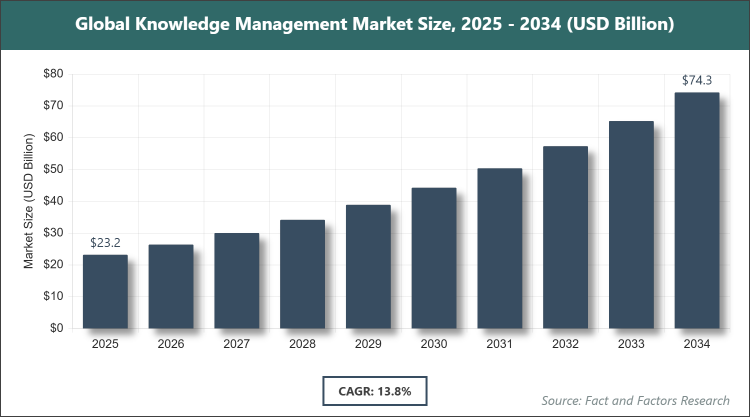
[227+ Pages Report] According to Facts & Factors, the global knowledge management market size was estimated at USD 23.2 billion in 2025 and is expected to reach USD 74.22 billion by the end of 2034. The knowledge management industry is anticipated to grow by a CAGR of 13.8% between 2026 and 2034. The knowledge management Market is driven by increasing demand for efficient knowledge sharing and digital transformation across organizations.
 Market Overview
Knowledge management refers to the systematic process of capturing, organizing, storing, and sharing an organization's collective expertise, information, and intellectual assets to enhance decision-making, innovation, and operational efficiency. It encompasses strategies, tools, and practices that enable employees to access relevant knowledge easily, fostering collaboration and reducing redundancy in work processes.
Key Insights
- As per the analysis shared by our research analyst, the global knowledge management market is estimated to grow annually at a CAGR of around 13.8% over the forecast period (2026-2034)
- In terms of revenue, the global knowledge management market size was valued at around USD 23.2 billion in 2025 and is projected to reach USD 74.22 billion, by 2034
- The knowledge management market is projected to grow at a significant rate due to the growing digital transformation across industries
- Based on offering, the solutions segment dominated with 60% share as it provides core platforms for knowledge capture and retrieval, enabling seamless integration with AI tools
- Based on deployment mode, the cloud segment dominated with 62% share due to its scalability, cost-effectiveness, and ease of remote access
- Based on organization size, the large enterprises segment dominated with 70% share owing to their complex operations requiring robust knowledge systems
- Based on end-use, the IT & telecom segment dominated with 25% share because of the need for rapid innovation and handling vast technical knowledge
- Based on region, North America dominated with 38% share due to advanced digital infrastructure and high adoption of AI-driven tools
Growth Drivers
- Rising Adoption of AI and Automation Technologies
The integration of artificial intelligence and machine learning into knowledge management systems is revolutionizing how organizations handle information, enabling automated content categorization, intelligent search capabilities, and predictive insights that significantly enhance operational efficiency.
This technological advancement allows businesses to process vast amounts of unstructured data in real-time, transforming raw information into actionable knowledge while reducing manual efforts and minimizing human errors in knowledge retrieval processes.
Restraints
- Data Privacy and Security Concerns
Increasing regulatory requirements and cyber threats pose significant challenges to knowledge management implementation, as organizations must balance accessibility with robust protection measures for sensitive information.
This restraint often leads to delayed adoption or increased implementation costs, as companies invest heavily in compliance frameworks and security protocols to safeguard their intellectual assets.
Opportunities
- Expansion in Emerging Markets
Rapid digital transformation in developing regions presents substantial growth potential for knowledge management solutions, as businesses in these areas seek to leverage technology for competitive advantage.
This opportunity allows providers to customize solutions for diverse cultural and operational contexts, potentially capturing new market segments through localized features and affordable pricing models.
Challenges
- Resistance to Organizational Change
Employee reluctance to adopt new systems and processes can hinder the successful implementation of knowledge management initiatives, requiring comprehensive change management strategies.
This challenge necessitates ongoing training programs and cultural shifts within organizations to ensure widespread acceptance and effective utilization of knowledge management tools.
Report Scope
Report Attribute |
Details |
Market Size 2025 |
USD 23.2 Billion |
Projected Market Size in 2034 |
USD 74.22 Billion |
CAGR Growth Rate |
13.8% CAGR |
Base Year |
2025 |
Forecast Years |
2026-2034 |
Key Market Players |
IBM Corporation, Microsoft Corporation, Atlassian Corporation, ServiceNow Inc., Oracle Corporation, SAP SE, Salesforce Inc., OpenText Corporation, eGain Corporation, Bloomfire Inc., and Others. |
Key Segment |
By Offering, By Deployment Mode, By Organization Size, By End-Use, and By Region |
Major Regions Covered |
North America, Europe, Asia Pacific, Latin America, and the Middle East & Africa |
Purchase Options |
Request customized purchase options to meet your research needs. Explore purchase options |
Market Segmentation
The knowledge management market is segmented by offering, deployment mode, organization size, end-use, and region.
Based on Offering Segment, the knowledge management market is divided into solutions and services. The most dominant segment is solutions, which focuses on core software platforms for knowledge capture, storage, and dissemination. It drives the market by providing essential tools that enable organizations to centralize information, improve search functionality, and integrate with existing systems, ultimately enhancing productivity and decision-making. The second most dominant is services, which includes implementation, consulting, and maintenance support. It complements solutions by ensuring successful deployment and optimization, helping organizations overcome technical challenges and maximize ROI through expert guidance and ongoing assistance.
Based on Deployment Mode Segment, the knowledge management market is divided into cloud, on-premises, and hybrid. The most dominant segment is cloud, offering flexible, scalable access to knowledge resources without heavy infrastructure investments. It drives growth by enabling remote collaboration, automatic updates, and cost-effective storage, particularly beneficial for distributed teams in modern work environments. The second most dominant is hybrid, combining cloud flexibility with on-premises security for sensitive data. It supports market expansion by addressing diverse organizational needs, allowing customized approaches that balance accessibility with compliance requirements in regulated industries.
Based on Organization Size Segment, the knowledge management market is divided into large enterprises and SMEs. The most dominant segment is large enterprises, which require sophisticated systems to manage vast amounts of complex, distributed knowledge across global operations. It propels market growth through substantial investments in advanced features like AI integration and enterprise-wide analytics, setting industry standards for knowledge management practices. The second most dominant is SMEs, increasingly adopting affordable, cloud-based solutions to compete effectively. It contributes to market diversification by driving demand for user-friendly, scalable tools that enable smaller organizations to enhance efficiency without extensive IT resources.
Based on End-Use Segment, the knowledge management market is divided into IT & telecom, BFSI, healthcare, manufacturing, government, retail, and others. The most dominant segment is IT & telecom, where rapid technological evolution demands efficient knowledge sharing for innovation and problem-solving. It accelerates market growth by requiring advanced systems for technical documentation, code repositories, and collaborative development, influencing broader industry adoption of cutting-edge features. The second most dominant is BFSI, emphasizing secure knowledge management for regulatory compliance and risk assessment. It supports market evolution by demanding robust security measures and audit trails, driving the development of specialized financial knowledge tools that enhance decision-making in complex economic environments.
Recent Developments
- In January 2025, Microsoft announced the integration of advanced AI capabilities into its SharePoint platform, enhancing knowledge discovery through natural language processing and automated content tagging.
- In February 2025, IBM acquired a startup specializing in semantic search technology, bolstering its Watson Knowledge Catalog for improved enterprise knowledge management.
- In March 2024, ServiceNow launched a new module for its platform focused on AI-driven knowledge curation, aimed at improving employee productivity in large organizations.
Regional Analysis
-
North America to dominate the global market
North America leads the knowledge management market, driven by its advanced technological infrastructure and high concentration of innovative enterprises. The region benefits from strong adoption of AI and cloud technologies, with the United States serving as the dominating country through its tech hubs like Silicon Valley fostering continuous innovation in knowledge platforms.
Europe follows closely, emphasizing data privacy and collaborative knowledge systems aligned with GDPR regulations. Germany dominates here, leveraging its strong manufacturing sector to implement sophisticated knowledge management in Industry 4.0 initiatives, promoting efficient knowledge sharing across supply chains.
Asia Pacific emerges as the fastest-growing region, fueled by rapid digital transformation and expanding IT sectors. China leads this growth, with massive investments in AI-powered knowledge systems supporting its vast workforce and ambitious technological advancement goals.
Latin America shows promising potential, particularly in adopting cloud-based solutions for improved business efficiency. Brazil dominates the region, implementing knowledge management in its diverse industries from agriculture to finance, addressing challenges in information accessibility across geographically dispersed operations.
The Middle East & Africa region focuses on knowledge management for economic diversification beyond oil. The United Arab Emirates leads, utilizing advanced systems in its smart city initiatives and knowledge-based economy transition, emphasizing collaborative platforms for international business partnerships.
Competitive Analysis
The global knowledge management market is dominated by players:
- IBM Corporation
- Microsoft Corporation
- Atlassian Corporation
- ServiceNow Inc.
- Oracle Corporation
- SAP SE
- Salesforce Inc.
- OpenText Corporation
- eGain Corporation
- Bloomfire Inc.
The global knowledge management market is segmented as follows:
By Offering
- Solutions
- Services
By Deployment Mode
- Cloud
- On-Premises
- Hybrid
By Organization Size
- Large Enterprises
- SMEs
By End-Use
- IT & Telecom
- BFSI
- Healthcare
- Manufacturing
- Government
- Retail
- Others
By Region
- North America
- The U.S.
- Canada
- Mexico
- Europe
- France
- The UK
- Spain
- Germany
- Italy
- Rest of Europe
- Asia Pacific
- China
- Japan
- India
- Australia
- Southeast Asia
- Rest of Asia Pacific
- The Middle East & Africa
- Saudi Arabia
- UAE
- Egypt
- Kuwait
- South Africa
- Rest of the Middle East & Africa
- Latin America
- Brazil
- Argentina
- Rest of Latin America
Industry Major Market Players
The global knowledge management market is dominated by players:
- IBM Corporation
- Microsoft Corporation
- Atlassian Corporation
- ServiceNow Inc.
- Oracle Corporation
- SAP SE
- Salesforce Inc.
- OpenText Corporation
- eGain Corporation
- Bloomfire Inc.



Copyright © 2025 - 2026, All Rights Reserved, Facts and Factors