
Search Market Research Report
Industrial Ethernet Market Size, Share Global Analysis Report, 2026-2034

Industrial Ethernet Market Size, Share, Growth Analysis Report By Type (EtherNet/IP, PROFINET, EtherCAT, Modbus TCP, POWERLINK, and Others), By Application (Discrete Automation, Process Automation, Motion Control, Safety Systems, and Others), By End-User (Automotive, Food & Beverage, Oil & Gas, Chemicals, Energy & Power, Pharmaceuticals, , and Others), and By Region - Global Industry Insights, Overview, Comprehensive Analysis, Trends, Statistical Research, Market Intelligence, Historical Data and Forecast 2026-2034
Industry Insights
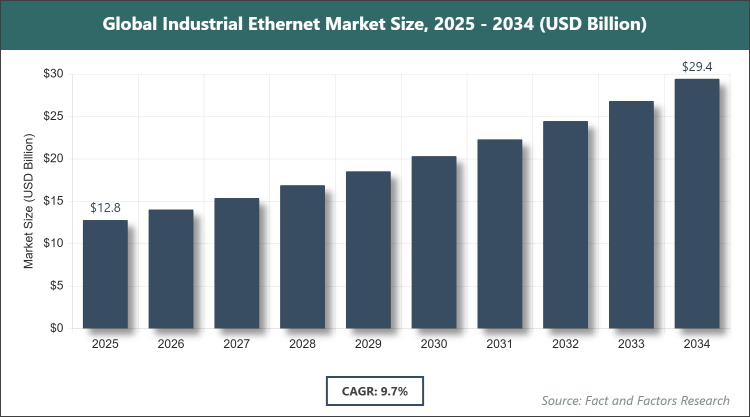
[242 + Pages Report] According to Facts & Factors, the global Industrial Ethernet market size was estimated at USD 12.8 billion in 2025 and is expected to reach USD 29.4 billion by the end of 2034. The Industrial Ethernet industry is anticipated to grow by a CAGR of 9.7% between 2026 and 2034. The Industrial Ethernet Market is driven by accelerating Industry 4.0 adoption and the need for real-time, high-bandwidth communication in smart factories.
 Market Overview
The Industrial Ethernet market encompasses ruggedised, deterministic networking technologies designed to deliver reliable, high-speed data communication in harsh industrial environments where standard commercial Ethernet cannot operate. These solutions replace legacy fieldbus systems with Ethernet-based protocols that support real-time control, seamless integration with enterprise IT networks, and advanced features such as Time-Sensitive Networking (TSN), Power over Ethernet (PoE), and cybersecurity protocols. Industrial Ethernet enables synchronised motion control, predictive maintenance, remote monitoring, and seamless data flow from shop floor to cloud, forming the backbone of smart manufacturing, IIoT deployments, and digital twin implementations across discrete and process industries.
Key Insights
- As per the analysis shared by our research analyst, the Industrial Ethernet market is estimated to grow annually at a CAGR of around 9.7% over the forecast period (2026-2034).
- In terms of revenue, the Industrial Ethernet market size was valued at around USD 12.8 billion in 2025 and is projected to reach USD 29.4 billion by 2034.
- The Industrial Ethernet Market is driven by Industry 4.0 transformation and IIoT proliferation.
- Based on the Type, the Ethernet/IP segment dominated the market in 2025 with a share of 32% due to its open standard, seamless integration with Rockwell Automation ecosystems, and strong presence in North American discrete manufacturing.
- Based on the Application, the Discrete Automation segment dominated the market in 2025 with a share of 58%, owing to high demand for real-time motion control and robotics in automotive and electronics assembly lines.
- Based on the End-User, the Automotive segment dominated the market in 2025 with a share of 24% because of extensive use in vehicle assembly, battery manufacturing, and smart logistics.
- Asia Pacific dominated the global Industrial Ethernet market in 2025 with a share of 41% attributed to massive manufacturing output, government smart factory initiatives, and rapid IIoT adoption in China, Japan, and South Korea.
Growth Drivers
- Industry 4.0 and IIoT Adoption
Manufacturers are aggressively deploying connected machines, collaborative robots, and digital twins that require deterministic, high-bandwidth networks, driving the replacement of legacy fieldbuses with industrial Ethernet protocols.
Government incentives for smart manufacturing in the Asia Pacific and Europe further accelerate large-scale network upgrades across automotive, electronics, and food processing facilities.
Restraints
- High Initial Deployment Cost and Legacy System Integration
Retrofitting brownfield plants with industrial Ethernet switches, gateways, and cabling involves significant capital expenditure and production downtime.
Compatibility challenges with older PLCs and field devices increase project complexity and extend return-on-investment timelines for many enterprises.
Opportunities
- Time-Sensitive Networking (TSN) and 5G Integration
Emerging TSN standards enable convergence of IT and OT networks, unlocking new use cases in motion control and safety systems, while 5G private networks extend connectivity to remote and mobile assets.
Rising demand for edge computing and AI-driven predictive maintenance creates opportunities for managed industrial Ethernet infrastructure with built-in cybersecurity.
Challenges
- Cybersecurity Vulnerabilities in Converged Networks
Increased connectivity exposes industrial control systems to ransomware and targeted attacks, requiring continuous investment in segmentation, encryption, and zero-trust architectures.
Shortage of skilled industrial network engineers capable of designing and securing converged IT/OT environments slows deployment pace globally.
Report Scope
Report Attribute |
Details |
Market Size 2025 |
USD 12.8 Billion |
Projected Market Size in 2034 |
USD 29.4 Billion |
CAGR Growth Rate |
9.7% CAGR |
Base Year |
2025 |
Forecast Years |
2026-2034 |
Key Market Players |
Cisco Systems, Inc., Siemens AG, Rockwell Automation, Inc., ABB Ltd., Schneider Electric SE, Emerson Electric Co., Honeywell International Inc., Moxa Inc., Belden Inc., Omron Corporation, and Others. |
Key Segment |
By Type, By Application, By End-User, and By Region |
Major Regions Covered |
North America, Europe, Asia Pacific, Latin America, and the Middle East & Africa |
Purchase Options |
Request customised purchase options to meet your research needs. Explore purchase options |
Market Segmentation
The Industrial Ethernet market is segmented by type, application, end-user, and region.
Based on Type Segment, the Industrial Ethernet market is divided into Ethernet/IP, ProfiNet, EtherCAT, Modbus TCP, Powerlink, and others. The most dominant segment is EtherNet/IP, driven by its widespread adoption in North America and open-standard flexibility. The second most dominant is PROFINET. EtherNet/IP dominates due to seamless integration with major automation platforms, high performance in discrete manufacturing, and strong ecosystem support, helping drive market growth by enabling plug-and-play connectivity in smart factory environments.
Based on Application Segment, the Industrial Ethernet market is divided into discrete automation, process automation, motion control, safety systems and others. The most dominant segment is Discrete Automation, supported by robotics and assembly line requirements. The second most dominant is Process Automation. Discrete Automation leads because it demands ultra-low latency and high synchronisation for high-speed production lines, propelling market expansion through continuous upgrades in automotive, electronics, and consumer goods manufacturing.
Based on End-User Segment, the Industrial Ethernet market is divided into automotive, food & beverage, oil & gas, chemicals, energy & power, pharmaceuticals, and others. The most dominant segment is Automotive, fueled by electric vehicle production and smart factories. The second most dominant is Food & Beverage. Automotive dominates due to stringent quality requirements, high-volume production, and rapid adoption of collaborative robots and digital twins, driving market growth through large-scale network modernisation projects.
Recent Developments
- In February 2026, Cisco Systems launched the IE 4000 series ruggedised industrial Ethernet switches with built-in TSN support for motion control applications.
- In December 2025, Siemens AG introduced the SCALANCE XC-300 series with enhanced cybersecurity features and 10 Gbps bandwidth for Industry 4.0 deployments.
- In October 2025, Rockwell Automation expanded its EtherNet/IP portfolio with new Stratix 4300 remote access routers for secure IIoT connectivity.
- In July 2025, ABB Ltd. released the new AC500 PLC platform fully integrated with TSN-enabled industrial Ethernet for real-time automation.
- In April 2025, Moxa Inc. unveiled the EDS-4000 series with zero-touch provisioning and advanced network management for large-scale smart factory rollouts.
Regional Analysis
- Asia Pacific to dominate the global market
Asia Pacific leads the Industrial Ethernet market through its position as the global manufacturing powerhouse, supported by aggressive Industry 4.0 policies, massive electronics and automotive production, and rapid IIoT adoption. The region benefits from cost-competitive local manufacturing of switches and gateways. China dominates within Asia Pacific, with its “Made in China 2025” initiative driving widespread deployment of PROFINET and EtherNet/IP networks across new smart factories and existing plant upgrades.
North America holds a significant share through technological leadership and early adoption of TSN and secure converged networks. The United States leads the region, with a strong presence of Rockwell Automation and Cisco driving innovation in automotive and aerospace smart manufacturing ecosystems.
Europe exhibits steady growth driven by stringent Industry 4.0 standards and a focus on energy-efficient, secure automation. Germany leads the region, leveraging its automotive and machinery excellence to integrate high-performance industrial Ethernet in digital twin and predictive maintenance applications.
Latin America is gradually expanding with new greenfield manufacturing investments and the modernisation of existing plants. Brazil leads, supported by the automotive and food processing sectors, adopting cost-effective industrial Ethernet solutions.
The Middle East & Africa region shows promising potential linked to oil & gas digitalisation and new industrial cities. The United Arab Emirates leads through smart manufacturing zones that prioritise secure, high-speed industrial Ethernet infrastructure.
Competitive Analysis
The global Industrial Ethernet market is dominated by players:
- Cisco Systems, Inc.
- Siemens AG
- Rockwell Automation, Inc.
- ABB Ltd.
- Schneider Electric SE
- Emerson Electric Co.
- Honeywell International Inc.
- Moxa Inc.
- Belden Inc.
- Omron Corporation
The global Industrial Ethernet market is segmented as follows:
By Type
- EtherNet/IP
- PROFINET
- EtherCAT
- Modbus TCP
- POWERLINK
- Others
By Application
- Discrete Automation
- Process Automation
- Motion Control
- Safety Systems
By End-User
- Automotive
- Food & Beverage
- Oil & Gas
- Chemicals
- Energy & Power
- Pharmaceuticals
- Others
By Region
- North America
- The U.S.
- Canada
- Mexico
- Europe
- France
- The UK
- Spain
- Germany
- Italy
- Rest of Europe
- Asia Pacific
- China
- Japan
- India
- Australia
- Southeast Asia
- Rest of Asia Pacific
- The Middle East & Africa
- Saudi Arabia
- UAE
- Egypt
- Kuwait
- South Africa
- Rest of the Middle East & Africa
- Latin America
- Brazil
- Argentina
- Rest of Latin America
Industry Major Market Players
- Cisco Systems, Inc.
- Siemens AG
- Rockwell Automation, Inc.
- ABB Ltd.
- Schneider Electric SE
- Emerson Electric Co.
- Honeywell International Inc.
- Moxa Inc.
- Belden Inc.
- Omron Corporation



Copyright © 2025 - 2026, All Rights Reserved, Facts and Factors