
Search Market Research Report
High Altitude Aeronautical Platform Stations (HAAPS) Market Size, Share Global Analysis Report, 2026 - 2034

High Altitude Aeronautical Platform Stations (HAAPS) Market Size, Share, Growth Analysis Report By Type (Airships, UAVs and Balloons), By Application (Earth Observation, Communication, Research and Others), By End User (Government, Defense, and Research Institutes and Commercial), And By Region - Global Industry Insights, Overview, Comprehensive Analysis, Trends, Statistical Research, Market Intelligence, Historical Data and Forecast 2026 - 2034
Industry Insights
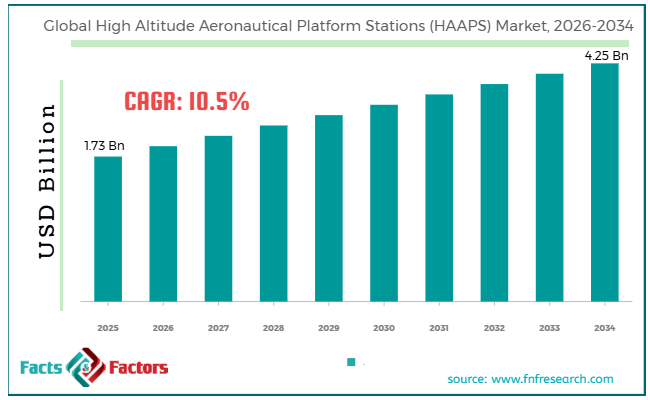
[223+ Pages Report] According to Facts & Factors, the global high altitude aeronautical platform stations (HAAPS) market size was worth around USD 1.73 billion in 2025 and is predicted to grow to around USD 4.25 billion by 2034 with a compound annual growth rate (CAGR) of roughly 10.5% between 2026 and 2034.
 Market Overview
High altitude platforms that function in the stratosphere, basically acting as satellites but inside the Earth's atmosphere, are known as high altitude aeronautical platform stations (HAAPS). Unmanned aircraft systems (UAS), which comprise remotely piloted aircraft and the surrounding support systems, are frequently used to compare them. HAPS stand out from the rest, though, since it functions as an independent fleet system capable of carrying out strategic plans for a range of uses, including disaster relief, environmental monitoring, and telecommunications. The lower stratosphere is the average operating altitude of a high-altitude aeronautical platform station (HAAPS), which is between 18 and 22 kilometers (or roughly 59,000 and 72,000 feet). This range of altitudes was selected taking into account atmospheric and technical factors to maximize their usefulness in a variety of applications.
HAPS are regulated in a way that reflects their special characteristics and sets them apart from unmanned aircraft systems (UAS), which are more widely known and are frequently mentioned in discussions of drones. The development, implementation, and integration of HAPS into domestic and international airspace are all impacted by this legislative distinction, which makes it significant.
Key Insights
- As per the analysis shared by our research analyst, the global High Altitude Aeronautical Platform Stations (HAAPS) market is estimated to grow annually at a CAGR of around 10.5% over the forecast period (2026-2034).
- In terms of revenue, the global High Altitude Aeronautical Platform Stations (HAAPS) market size was valued at around USD 1.73 billion in 2025 and is projected to reach USD 4.25 billion, by 2034.
- Technological advancement is expected to drive market growth over the forecast period.
- Based on the type, the UAVs segment is expected to dominate the market during the forecast period.
- Based on the application, the communication segment is expected to capture the largest market share over the forecast period.
- Based on the end user, the commercial segment is expected to grow at a rapid rate over the forecast period.
- Based on region, North America is expected to dominate the market during the forecast period.
Growth Drivers
- Technological advancement drives market growth
New developments in materials science, renewable energy, and aerospace engineering are propelling the creation of more reliable, effective, and affordable HAAPS systems. The public and business sectors are investing in HAAPS as a result of advancements in solar power, lightweight materials, aerodynamics, and autonomous systems that are broadening their uses and capabilities. For instance, the first SungliderTM, a solar-powered high-altitude pseudo-satellite (HAPS) intended to cover a 200-kilometer radius from a location 20 kilometers in the sky, was put together by AeroVironment, Inc.
Restraints
- Limitations of technology hinder market growth
Although HAAPS technology has come a long way, there are still technical issues with power production, propulsion, autonomy, cargo capacity, and endurance. To increase HAAPS's operational viability and capabilities, it is imperative to develop lightweight and efficient power sources, improve propulsion systems, improve autonomous navigation capabilities, and increase cargo capacity. It will take ongoing research and development to overcome these technological constraints, which could provide difficulties for producers and operators. Therefore, technological limitations might be a major restraining factor for the HAAPS market over the anticipated timeframe.
Opportunities
- Rising investment and trials offer a potential opportunity for market growth
The increasing investment and trials are expected to offer a potential opportunity for market growth over the projected period. For instance, in July 2025, the High Altitude Pseudo Satellite (HAPS) Uncrewed Aerial System (UAS) - PHASA-35 from BAE Systems completed a stratospheric flight trial, according to British engineers. PHASA-35 reached the stratosphere and climbed to over 66,000 feet in less than a day before making a successful landing. The testing, which was finished in New Mexico, USA, last month, gave engineers the chance to evaluate how well the experimental solar-electric drone operated in the planet's outermost atmosphere.
The flight represents a critical turning point in the PHASA-35's development, which got underway in 2018. Prismatic Ltd, a division of BAE Systems, created the aircraft to function above weather and traditional air traffic. It can offer a solid and enduring platform for multiple applications, such as security, surveillance, and reconnaissance, as well as ultra-long endurance intelligence.
Challenges
- Regulatory challenge poses a major challenge to market expansion
Complex legal and regulatory issues, such as those about international agreements controlling the use of frequency bands and airspace, privacy concerns regarding surveillance capabilities, spectrum allotment for communication systems, and airspace laws, must be taken into account when deploying HAAPS. It can take a while and be expensive to go over these regulatory obstacles and get the required approvals, which delays the commercialization and implementation of HAAPS.
Report Scope
Report Attribute |
Details |
Market Size in 2025 |
USD 1.73 Billion |
Projected Market Size in 2034 |
USD 4.25 Billion |
CAGR Growth Rate |
10.5% CAGR |
Base Year |
2025 |
Forecast Years |
2026-2034 |
Key Market Players |
Aurora Flight Sciences, Airbus, HEMERIA, Sierra Nevada Corporation (SNC), Lockheed Martin Corporation, UAVOS Inc., Aerostar, Prismatic Ltd, World View Enterprises Inc., Zero 2 Infinity S.I., AeroVironment Inc., Sceye, Flying Whales, and others. |
Key Segment |
By Type, By Application, By End-User, and Region |
Major Regions Covered |
North America, Europe, Asia Pacific, Latin America, and the Middle East &, Africa |
Purchase Options |
Request customized purchase options to meet your research needs. Explore purchase options |
Segmentation Analysis
The global High Altitude Aeronautical Platform Stations (HAAPS) industry is segmented based on type, application, end user and region.
Based on the type, the global High Altitude Aeronautical Platform Stations (HAAPS) market is bifurcated into airships, UAVs and balloons. The UAVs segment is expected to dominate the market during the forecast period. The military's requirement for sophisticated intelligence, surveillance, and reconnaissance capabilities is driving the segment's increasing demand. Because of their increased flight endurance, increased range capabilities, and faster deployment time than other platforms, UAVs are the ideal solution for these needs.
Based on the application, the global High Altitude Aeronautical Platform Stations (HAAPS) industry is segmented into earth observation, communication, research and others. The communication segment is expected to capture the largest market share over the forecast period. The need for mobile and high-speed internet is growing, particularly in rural and isolated locations, therefore telecom companies are searching for creative ways to expand their networks. HAAPS offer an affordable way to increase capacity and coverage, especially in disadvantaged areas where deploying terrestrial infrastructure is difficult or not possible financially.
Additionally, for military communications, surveillance, reconnaissance, and command and control activities, defense organizations across the globe are investing in HAAPS technology. To improve situational awareness, enable communication on the battlefield, and assist missions in difficult or hostile conditions, HAAPS units are outfitted with secure communication systems, intelligence gathering sensors, and real-time data transfer capabilities. Thereby, driving the segment growth.
Based on the end user, the global High Altitude Aeronautical Platform Stations (HAAPS) market is segmented into government, defense, and research institutes and commercial. The commercial segment is expected to grow at a rapid rate over the forecast period. Companies are using HAAPS more and more for applications like mining, forestry, agriculture, environmental preservation, infrastructure inspection, and aerial surveillance and reconnaissance. With its sophisticated sensors, cameras, and imaging systems, HAAPS platforms offer real-time aerial intelligence that helps enterprises and organizations operating in difficult or distant environments make better decisions, optimize their resources, and manage risks.
Regional Analysis
- North America is expected to dominate the market during the forecast period
North America is expected to dominate the market over the forecast period. The regional expansion is attributed to the rising telecommunication and defense spending. There is a growing need for HAAPS in the military, communication, surveillance, and reconnaissance applications due to the significant defense and telecommunications infrastructure investments made by the US and Canada. North American telecommunications companies are investigating HAAPS as a way to enhance 5G network deployment, improve emergency communication systems, and provide mobile and broadband internet access to remote locations.
For instance, as per the data published by SIPRI, with a military budget of 916 billion dollars in 2025, the United States topped the list of nations with the largest military spending. That accounted for more than 40% of the 2.4 trillion dollars in military spending that year that was spent globally. Thus, the aforementioned stats drive the market expansion in the region.
Competitive Analysis
The global High Altitude Aeronautical Platform Stations (HAAPS) market is dominated by players like:
- Aurora Flight Sciences
- Airbus
- HEMERIA
- Sierra Nevada Corporation (SNC)
- Lockheed Martin Corporation
- UAVOS Inc.
- Aerostar
- Prismatic Ltd
- World View Enterprises Inc.
- Zero 2 Infinity S.I.
- AeroVironment Inc.
- Sceye
- Flying Whales
The global High Altitude Aeronautical Platform Stations (HAAPS) market is segmented as follows:
By Type
- Airships
- UAVs
- Balloons
By Application
- Earth Observation
- Communication
- Research
- Others
By End User
- Government, Defense, and Research Institutes
- Commercial
By Region
- North America
- The U.S.
- Canada
- Mexico
- Europe
- France
- The UK
- Spain
- Germany
- Italy
- Rest of Europe
- Asia Pacific
- China
- Japan
- India
- Australia
- Southeast Asia
- Rest of Asia Pacific
- The Middle East & Africa
- Saudi Arabia
- UAE
- Egypt
- Kuwait
- South Africa
- Rest of the Middle East & Africa
- Latin America
- Brazil
- Argentina
- Rest of Latin America
Industry Major Market Players
- Aurora Flight Sciences
- Airbus
- HEMERIA
- Sierra Nevada Corporation (SNC)
- Lockheed Martin Corporation
- UAVOS Inc.
- Aerostar
- Prismatic Ltd
- World View Enterprises Inc.
- Zero 2 Infinity S.I.
- AeroVironment Inc.
- Sceye
- Flying Whales



Copyright © 2025 - 2026, All Rights Reserved, Facts and Factors