
Search Market Research Report
Healthcare Analytics Market Size, Share Global Analysis Report, 2026-2034

Healthcare Analytics Market Size, Share, Growth Analysis Report By Type (Descriptive Analytics, Predictive Analytics, Prescriptive Analytics, and Others), By Application (Clinical Analytics, Financial Analytics, Operational Analytics, and Others), By End-User (Healthcare Providers, Healthcare Payers, Pharmaceutical Companies, and Others), and By Region - Global Industry Insights, Overview, Comprehensive Analysis, Trends, Statistical Research, Market Intelligence, Historical Data and Forecast 2026-2034
Industry Insights
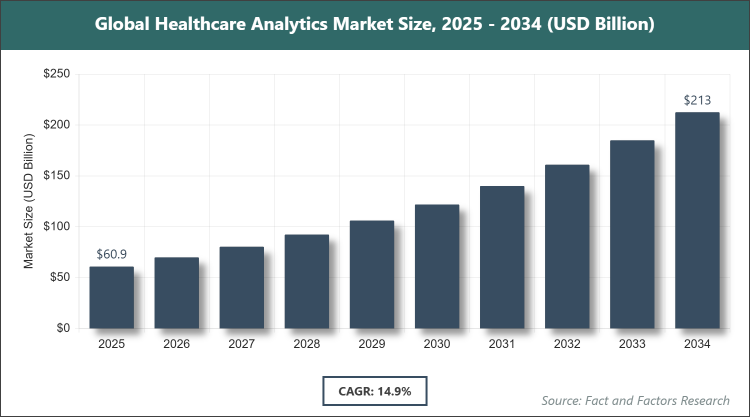
[232+ Pages Report] According to Facts & Factors, the global Healthcare Analytics market size was estimated at USD 60.9 billion in 2025 and is expected to reach USD 228.4 billion by the end of 2034. The Healthcare Analytics industry is anticipated to grow by a CAGR of 14.9% between 2026 and 2034. The Healthcare Analytics Market is driven by the increasing adoption of big data in healthcare and the need for cost-effective patient care.
 Market Overview
Healthcare analytics involves the use of data analysis tools and techniques to extract insights from vast amounts of healthcare data, enabling informed decision-making in clinical, operational, and financial aspects. It encompasses descriptive, predictive, and prescriptive methods to improve patient outcomes, optimize resource allocation, and enhance overall efficiency in healthcare delivery. This field integrates data from electronic health records, claims, and other sources to support evidence-based practices without relying on specific numerical projections.
Key Insights
- As per the analysis shared by our research analyst, the Healthcare Analytics market is estimated to grow annually at a CAGR of around 14.9% over the forecast period (2026-2034).
- In terms of revenue, the Healthcare Analytics market size was valued at around USD 60.9 billion in 2025 and is projected to reach USD 228.4 billion by 2034.
- The market is driven by the increasing adoption of big data in healthcare, the need for cost-effective patient care, and advancements in AI and machine learning technologies.
- Based on the type, the descriptive analytics segment dominated with a 46% share due to its widespread use in analyzing historical data to understand past trends and performance in healthcare settings.
- Based on the application, the clinical analytics segment dominated with a 36% share because it enables better patient monitoring, treatment optimization, and improved clinical outcomes through data-driven insights.
- Based on the end-user, the healthcare providers segment dominated with a 56% share owing to hospitals and clinics leveraging analytics for operational efficiency and enhanced decision-making in patient care.
- The North America region dominated with a 50% share attributed to its advanced healthcare infrastructure, high adoption of digital technologies, and strong focus on data-driven healthcare solutions.
Growth Drivers
- Increasing Volume of Healthcare Data
The explosion of data from electronic health records, wearable devices, and telemedicine has necessitated advanced analytics to derive actionable insights. This surge supports better disease management and personalized medicine, driving demand for analytics solutions across the sector.
Healthcare organizations are investing in analytics to handle this data deluge, improving operational efficiencies and patient satisfaction. As data continues to grow exponentially, the reliance on analytics for real-time decision-making will further accelerate market expansion.
- Adoption of AI and Machine Learning in Healthcare
Integration of AI enhances predictive capabilities, enabling early disease detection and resource optimization. This technological advancement reduces costs and improves accuracy in diagnostics and treatment planning.
Collaborations between tech firms and healthcare providers are fostering innovative solutions, expanding the application of analytics in areas like population health management. This trend is expected to sustain long-term growth as AI evolves.
- Focus on Value-Based Care Models
Shifting from fee-for-service to value-based care emphasizes outcomes and efficiency, where analytics play a crucial role in measuring performance and reducing unnecessary expenditures.
Regulatory incentives and payer pressures are encouraging adoption, leading to improved care coordination and patient engagement. This driver aligns with global healthcare reforms aimed at sustainability.
Restraints
- Data Privacy and Security Concerns
Stringent regulations like HIPAA and GDPR pose challenges in data sharing and utilization, limiting the scope of analytics implementations.
Breaches can erode trust and incur heavy penalties, deterring investments in analytics platforms. Balancing innovation with compliance remains a key hurdle.
- High Implementation Costs
The initial investment in analytics infrastructure, including software and training, can be prohibitive for smaller healthcare entities.
Ongoing maintenance and integration with legacy systems add to expenses, slowing adoption in resource-constrained settings.
Opportunities
- Expansion in Emerging Markets
Growing healthcare infrastructure in Asia-Pacific and Latin America presents opportunities for analytics adoption to address unmet needs in patient care and efficiency.
Government initiatives and increasing digitalization create a fertile ground for market entry and partnerships.
- Integration with Telehealth and Remote Monitoring
Analytics can enhance remote care by providing real-time insights, opening new avenues in chronic disease management and preventive health.
This integration supports scalable solutions, attracting investments and expanding user bases.
Challenges
- Lack of Skilled Professionals
The shortage of data scientists and analysts familiar with healthcare domains hampers effective utilization of analytics tools.
Training programs are needed to bridge this gap, but current deficits delay ROI realization.
- Interoperability Issues Among Systems
Diverse data formats and systems complicate integration, leading to incomplete insights and inefficiencies.
Standardization efforts are underway, but fragmented ecosystems persist as a barrier.
Report Scope
Report Attribute |
Details |
Market Size 2025 |
USD 60.9 Billion |
Projected Market Size in 2034 |
USD 228.4 Billion |
CAGR Growth Rate |
14.9% CAGR |
Base Year |
2025 |
Forecast Years |
2026-2034 |
Key Market Players |
IBM Corporation, Optum, Inc., Oracle Corporation, SAS Institute Inc., Cerner Corporation, McKesson Corporation, Health Catalyst, Inc., MedeAnalytics, Allscripts Healthcare Solutions, Verisk Analytics, and Others. |
Key Segment |
By Type (Descriptive Analytics, Predictive Analytics, Prescriptive Analytics, and Others), By Application (Clinical Analytics, Financial Analytics, Operational Analytics, and Others), By End-User (Healthcare Providers, Healthcare Payers, Pharmaceutical Companies, and Others), and By Region |
Major Regions Covered |
North America, Europe, Asia Pacific, Latin America, and the Middle East & Africa |
Purchase Options |
Request customized purchase options to meet your research needs. Explore purchase options |
Market Segmentation
The Healthcare Analytics market is segmented by type, application, end-user, and region.
Based on Type Segment, the Healthcare Analytics market is divided into descriptive analytics, predictive analytics, prescriptive analytics, and others. The most dominant segment is descriptive analytics, which holds a significant market position due to its foundational role in summarizing historical data to identify patterns and trends essential for operational reporting. The second most dominant is predictive analytics, appreciated for forecasting future events based on historical data. Descriptive analytics drives the market by providing baseline insights that inform strategic decisions and performance metrics, while predictive analytics contributes by enabling proactive interventions, reducing risks, and optimizing resource allocation in healthcare environments.
Based on Application Segment, the Healthcare Analytics market is divided into clinical analytics, financial analytics, operational analytics, and others. The most dominant segment is clinical analytics, crucial for enhancing patient care through data-driven clinical decisions. The second most dominant is financial analytics, focused on cost management and revenue optimization. Clinical analytics dominates due to its direct impact on improving treatment outcomes and patient safety, driving market growth by supporting evidence-based medicine; financial analytics aids by identifying cost-saving opportunities and ensuring financial sustainability, contributing to overall efficiency.
Based on End-User Segment, the Healthcare Analytics market is divided into healthcare providers, healthcare payers, pharmaceutical companies, and others. The most dominant segment is healthcare providers, leading due to their extensive use in hospitals and clinics for daily operations. The second most dominant is healthcare payers, involved in claims and risk management. Providers drive the market through direct application in patient care and workflow optimization, ensuring broad adoption; payers contribute by leveraging analytics for fraud detection and cost control, enhancing market dynamics.
Recent Developments
- In December 2025, Hallym University Hospital in South Korea adopted stroke AI from Vuno for rapid detection of large vessel occlusion and intracranial hemorrhage on CT scans, reducing treatment times and improving patient outcomes.
- In October 2025, Heidi Health raised USD 65 million in Series A funding to expand its AI medical scribe platform globally, automating clinical documentation and generating progress notes, referral letters, and patient summaries.
- In June 2025, SAS launched the SAS Health Cost of Care Analytics solution, utilizing AI and analytics to assist payers and providers in analyzing care episodes, reducing costs, and enhancing overall healthcare outcomes.
- In April 2024, Oracle partnered with DNAnexus to enable scientists and medical experts to handle, examine, and collaborate on multi-omic, clinical, and real-world evidence data for advanced research.
Regional Analysis
- North America to dominate the global market
North America leads the Healthcare Analytics market, with the United States as the dominating country due to its sophisticated healthcare systems and early adoption of digital technologies. The region's emphasis on value-based care and regulatory support for data interoperability fosters innovation. High investment in AI and big data by major players enhances analytical capabilities. Collaborative efforts between tech companies and healthcare providers drive efficiency. Strong focus on research and development ensures continuous advancement in analytics applications.
Europe maintains a strong position in the Healthcare Analytics market, led by Germany with its robust engineering and healthcare integration expertise. The region's aging population demands efficient resource management through analytics. EU-wide data protection regulations like GDPR ensure secure data usage. Countries such as the UK and France contribute via national health initiatives promoting digital transformation. Medical research collaborations accelerate adoption of predictive tools.
Asia Pacific is rapidly expanding in the Healthcare Analytics market, dominated by China through massive investments in digital health infrastructure and AI. Urbanization increases demand for scalable analytics in managing large patient volumes. Government policies in Japan and India support telemedicine and data-driven care. Rising healthcare expenditure addresses chronic diseases effectively. Partnerships with global tech firms enhance local capabilities.
Latin America shows growing potential in the Healthcare Analytics market, with Brazil leading via improving healthcare access and digital initiatives. Economic development enables adoption of cost-effective analytics solutions. Public-private partnerships focus on population health management. Increasing awareness of data's role in efficiency drives market entry. Regional challenges are met with tailored analytics approaches.
The Middle East & Africa region is progressing in the Healthcare Analytics market, dominated by Saudi Arabia with Vision 2030 healthcare reforms and tech investments. Oil-funded infrastructure upgrades support analytics adoption. South Africa contributes through established health systems utilizing data for disease control. International aid introduces advanced tools to remote areas. Focus on preventive care leverages analytics for better outcomes.
Competitive Analysis
The global Healthcare Analytics market is dominated by players:
- IBM Corporation
- Optum, Inc.
- Oracle Corporation
- SAS Institute Inc.
- Cerner Corporation
- McKesson Corporation
- Health Catalyst, Inc.
- MedeAnalytics
- Allscripts Healthcare Solutions
- Verisk Analytics
The global Healthcare Analytics market is segmented as follows:
By Type
- Descriptive Analytics
- Predictive Analytics
- Prescriptive Analytics
- Others
By Application
- Clinical Analytics
- Financial Analytics
- Operational Analytics
- Others
By End-User
- Healthcare Providers
- Healthcare Payers
- Pharmaceutical Companies
- Others
By Region
- North America
- The U.S.
- Canada
- Mexico
- Europe
- France
- The UK
- Spain
- Germany
- Italy
- Rest of Europe
- Asia Pacific
- China
- Japan
- India
- Australia
- Southeast Asia
- Rest of Asia Pacific
- The Middle East & Africa
- Saudi Arabia
- UAE
- Egypt
- Kuwait
- South Africa
- Rest of the Middle East & Africa
- Latin America
- Brazil
- Argentina
- Rest of Latin America
Industry Major Market Players
The global Healthcare Analytics market is dominated by players:
- IBM Corporation
- Optum, Inc.
- Oracle Corporation
- SAS Institute Inc.
- Cerner Corporation
- McKesson Corporation
- Health Catalyst, Inc.
- MedeAnalytics
- Allscripts Healthcare Solutions
- Verisk Analytics



Copyright © 2025 - 2026, All Rights Reserved, Facts and Factors