
Search Market Research Report
Grain Oriented Electrical Steel Market Size, Share Global Analysis Report, 2026-2034

Grain Oriented Electrical Steel Market Size, Share, Growth Analysis Report By Product Type (Conventional, High Magnetic Strength Sheets, and Domain Refinement), By Thickness (0.2 mm and Below, 0.23 mm, 0.27 mm, 0.30 mm, and 0.35 mm and Above), By Application (Transformer, Power Generator, Electric Motor, and Others), and By Region - Global Industry Insights, Overview, Comprehensive Analysis, Trends, Statistical Research, Market Intelligence, Historical Data and Forecast 2026-2034
Industry Insights
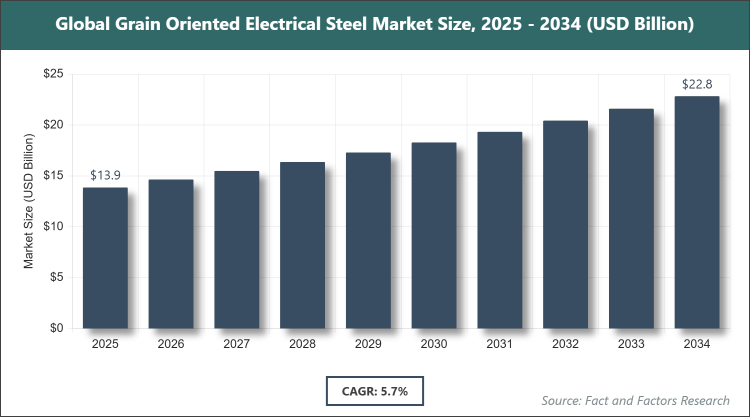
[235+ Pages Report] According to Facts & Factors, the global Grain Oriented Electrical Steel market size was estimated at USD 13.86 billion in 2025 and is expected to reach USD 22.88 billion by the end of 2034. The Grain Oriented Electrical Steel industry is anticipated to grow by a CAGR of 5.7% between 2026 and 2034. The Grain Oriented Electrical Steel Market is driven by increasing demand for energy-efficient transformers and electric vehicles.
 Market Overview
Grain Oriented Electrical Steel, also known as GOES, is a specialized alloy designed with a unique crystalline structure where the grains are aligned in the direction of rolling to enhance magnetic properties. This material is primarily utilized in the manufacturing of transformer cores, electric motors, and generators, where it minimizes core losses and improves efficiency in electrical energy transmission and distribution. Unlike non-oriented electrical steel, GOES exhibits superior permeability along the rolling direction, making it ideal for applications requiring unidirectional magnetic flux, such as in power infrastructure and renewable energy systems.
Key Insights
- As per the analysis shared by our research analyst, the global Grain Oriented Electrical Steel market is estimated to grow annually at a CAGR of around 5.7% over the forecast period (2026-2034).
- In terms of revenue, the global Grain Oriented Electrical Steel market size was valued at around USD 13.86 Billion in 2025 and is projected to reach USD 22.88 Billion, by 2034.
- The Grain Oriented Electrical Steel market is driven by increasing demand for energy-efficient electrical components and the rise in electric vehicle adoption.
- Based on the product type, the conventional segment accounted for the largest market share of 54.68% and is expected to dominate the global market.
- The conventional segment dominates due to its extensive use in transformers, power generators, and industrial induction machines, driven by rising electrical supply demands from urbanization and technological advancements.
- Based on the thickness, the 0.23 mm segment accounted for the largest market share of 50.38% and is expected to dominate the global market.
- The 0.23 mm segment leads because it is commonly applied in small transformers, generators, and electric motors for household appliances, benefiting from consumer demand for energy-efficient devices.
- Based on the application, the transformer segment accounted for the largest market share of 77.34% and is expected to dominate the global market.
- The transformer segment is dominant owing to global energy consumption growth and the need for efficient power and distribution transformers where GOES serves as a core material to reduce energy losses.
- The Asia Pacific region is expected to dominate the market with the largest share of 71.10%.
- The Asia Pacific dominates due to its strong manufacturing base in countries like China, India, and South Korea, coupled with rising demand from power generation, electric vehicles, and expanding electrical industries.
Growth Drivers
- Increasing Demand in Electrical Industry
The escalating global population and rapid urbanization have significantly boosted the need for robust electrical infrastructure, including transformers and power distribution systems. This demand is further amplified by the construction of industrial facilities, warehouses, and public transportation hubs like metro stations, all of which require reliable electrical components made from grain oriented electrical steel to ensure efficient energy transmission.
As developing economies invest heavily in expanding their power networks and improving electricity access, the material's ability to minimize core losses becomes crucial, leading to widespread adoption in both new installations and upgrades of existing grids. This trend is supported by government initiatives aimed at enhancing energy reliability and reducing transmission inefficiencies, positioning GOES as a key enabler in modern electrical systems.
- Electric Vehicle Adoption
The shift towards electric vehicles is reshaping the automotive landscape, with GOES playing a pivotal role in enhancing the performance of traction motors, stators, and charging infrastructure. Environmental regulations and rising fuel costs are accelerating EV adoption, necessitating high-quality electrical steel that offers low iron loss and high permeability to improve vehicle efficiency and range.
Manufacturers are increasingly focusing on redesigning automotive components to incorporate advanced GOES variants, which not only support sustainability goals but also help in achieving better profit margins through optimized energy use. This driver is particularly strong in regions with aggressive EV targets, driving innovation and investment in GOES production to meet the evolving demands of the transportation sector.
- Government Investments
Governments worldwide are channeling funds into power network expansions, fuel extraction projects, and residential housing schemes to bolster electricity access and infrastructure resilience. These investments create a fertile ground for GOES applications, as the material is essential for building efficient transformers and generators that support these initiatives.
Such policies not only stimulate economic growth but also address energy security concerns, encouraging the use of advanced materials like GOES to achieve long-term sustainability. The focus on renewable integration and grid modernization further amplifies this driver, ensuring steady demand for high-performance electrical steel in public and private sector projects.
- Technological Advancements
Innovations in material science have led to the development of GOES with superior magnetic properties, such as reduced core losses and enhanced permeability, making it indispensable for high-efficiency motors and generators. These advancements allow for more compact and energy-saving designs in electrical devices, aligning with global efforts to reduce carbon emissions and improve energy utilization.
The ongoing research into domain refinement and high magnetic strength variants is opening new avenues for application in emerging technologies, further propelling market growth. As industries prioritize efficiency, these technological improvements ensure GOES remains at the forefront of electrical engineering solutions.
Restraints
- Price Fluctuations in Steel and Raw Materials
Volatility in the prices of steel, scrap, iron, and coal poses a significant challenge, influenced by supply-demand imbalances, production costs, and limited storage capacities. These fluctuations can disrupt manufacturing budgets and lead to unpredictable pricing for end products, deterring investments in GOES-dependent projects.
In an industry where cost predictability is key, such instability affects profitability and can slow down adoption rates, especially in price-sensitive markets. Manufacturers must navigate these challenges through strategic sourcing and hedging, but persistent volatility remains a core restraint on market expansion.
- High Production Costs
The manufacturing of GOES involves complex processes that result in high costs, particularly for premium grades used in specialized applications like large transformers. Limited return on investment for expensive equipment, coupled with import tariffs, restricts accessibility and hampers market penetration in developing regions.
Additionally, the absence of widespread energy-efficient alternatives exacerbates this issue, as buyers weigh the long-term benefits against upfront expenses. This restraint underscores the need for cost-reduction innovations to broaden the material's appeal across diverse economic landscapes.
- Environmental and Health Risks
The production of GOES can have environmental impacts, including emissions and resource consumption, which raise concerns amid stringent regulations and public scrutiny. Health risks associated with handling certain alloys further complicate operations, requiring investments in safety measures and sustainable practices.
These factors can delay project approvals and increase compliance costs, acting as a barrier to growth. Balancing environmental responsibility with industrial demands is essential, but current challenges in this area continue to restrain unrestricted market development.
Opportunities
- EV Market Growth
The burgeoning electric vehicle sector presents vast opportunities for GOES, as automakers seek materials that enhance motor efficiency and support sustainable redesigns. With governments incentivizing EV production, the demand for high-performance electrical steel in traction systems and charging networks is set to surge.
This opportunity allows suppliers to collaborate on innovative solutions, capturing market share in a rapidly expanding industry. As EV adoption accelerates globally, GOES positioned for automotive applications stands to benefit significantly from this transformative shift.
- Green Energy Projects
Initiatives focused on renewable energy and low-carbon technologies open doors for GOES in efficient transformers and generators essential for green grids. Joint ventures and innovations in eco-friendly steel variants, like low-CO2 products, align with global sustainability goals and attract investment.
These projects not only drive demand but also foster technological partnerships, enhancing the material's role in cleaner energy systems. The emphasis on reducing emissions creates a promising landscape for GOES in supporting the transition to greener infrastructures.
- Infrastructure Development
Rapid infrastructure growth in developing countries, including power generation and distribution networks, offers substantial opportunities for GOES integration. As nations prioritize electrification and modernization, the material's efficiency advantages become critical for scalable solutions.
This development encourages foreign investments and local manufacturing expansions, broadening market reach. Capitalizing on these trends can lead to long-term contracts and innovation in application-specific GOES variants.
Challenges
- Supply Chain Disruptions
Global events, such as pandemics or geopolitical tensions, can interrupt raw material supplies and labor availability, affecting GOES production timelines. These disruptions, seen during COVID-19 with restrictions in key regions, lead to delays and increased costs across the value chain.
Manufacturers face challenges in maintaining inventory and meeting demand, requiring resilient strategies like diversified sourcing. Overcoming these issues is vital for market stability, but ongoing vulnerabilities continue to pose risks.
- Regulatory Compliance
Stringent environmental and safety regulations demand continuous adaptations in GOES production, increasing operational complexities and costs. Compliance with varying standards across regions can slow innovation and market entry, particularly for smaller players.
Balancing regulatory requirements with competitive pricing remains a hurdle, as non-compliance risks penalties and reputational damage. Addressing this challenge necessitates proactive policy engagement and sustainable manufacturing practices.
Report Scope
Report Attribute |
Details |
Market Size 2025 |
USD 13.86 Billion |
Projected Market Size in 2034 |
USD 22.88 Billion |
CAGR Growth Rate |
5.7% CAGR |
Base Year |
2025 |
Forecast Years |
2026-2034 |
Key Market Players |
Nippon Steel Corporation, ArcelorMittal, POSCO, thyssenkrupp Steel, JFE Steel Corporation, Baosteel Group Corporation, Cleveland-Cliffs Inc., Arnold Magnetic Technologies, Stalprodukt S.A., VIZ-Steel, and Others. |
Key Segment |
By Product Type, By Thickness, By Application, and By Region |
Major Regions Covered |
North America, Europe, Asia Pacific, Latin America, and the Middle East & Africa |
Purchase Options |
Request customized purchase options to meet your research needs. Explore purchase options |
Market Segmentation
The Grain Oriented Electrical Steel market is segmented by product type, thickness, application, and region.
Based on Product Type Segment, the Grain Oriented Electrical Steel market is divided into conventional, high magnetic strength sheets, and domain refinement. The most dominant segment is conventional, holding a significant market share due to its broad applicability in transformers and generators, where it provides reliable performance at a cost-effective price point, driving overall market growth through widespread adoption in electrical infrastructure projects. The second most dominant is high magnetic strength sheets, which excel in demanding applications like electric vehicle motors by offering superior flux density and reduced losses, helping to propel the market forward amid the global shift towards electrification and energy efficiency.
Based on Thickness Segment, the Grain Oriented Electrical Steel market is divided into 0.2 mm and below, 0.23 mm, 0.27 mm, 0.30 mm, and 0.35 mm and above. The most dominant segment is 0.23 mm, capturing the largest share owing to its optimal balance of thinness and magnetic efficiency, making it ideal for small transformers and household appliances, thereby fueling market expansion through consumer-driven demand for compact, energy-saving devices. The second most dominant is 0.35 mm and above, preferred for high-power applications such as large generators due to its ability to handle greater magnetic flux without excessive losses, contributing to market growth in industrial and power distribution sectors.
Based on Application Segment, the Grain Oriented Electrical Steel market is divided into transformer, power generator, electric motor, and others. The most dominant segment is transformer, leading the market because of its critical role in reducing energy losses in power transmission, driven by global infrastructure upgrades and renewable energy integration, which significantly boosts overall market dynamics. The second most dominant is electric motor, gaining traction from the automotive industry's electrification push, where GOES enhances motor efficiency and performance, thereby accelerating market growth through innovative vehicle technologies.
Recent Developments
- October 2023: Nippon Steel Corporation supplied low-CO2 NSCarbolex Neutral steel to GE Vernova for transformers, leveraging the benefits of grain oriented electrical steel to support sustainable energy solutions.
- August 2023: JFE Steel and JSW Steel formed JSW JFE Electrical Steel Private Limited with a USD 670 million investment to produce grain oriented electrical steel sheets in India, targeting the growing demand in electric vehicles and green energy markets.
- February 2023: thyssenkrupp Steel expanded its facility in India to produce 50,000 tonnes of cold-rolled grain oriented steel, enhancing local supply for electrical applications.
- March 2022: ArcelorMittal invested USD 328 million in a new electrical steel production unit in France, aimed at supporting electric vehicle motor manufacturing with a 200-kiloton capacity.
- March 2021: Arnold Magnetic Technologies acquired Ramco Electric Motors, Inc., to strengthen its offerings in electric motor solutions using grain oriented electrical steel.
Regional Analysis
- Asia Pacific to dominate the global market
The Asia Pacific region stands out as the powerhouse in the grain oriented electrical steel market, driven by its robust industrial base and rapid economic expansion. China emerges as the dominating country, with its massive manufacturing capabilities and extensive investments in power infrastructure and electric vehicles fueling demand. The region's focus on urbanization and renewable energy projects further solidifies its position, as local producers innovate to meet escalating needs for efficient electrical components. Collaborative ventures between international and domestic firms enhance technological advancements, ensuring sustained growth. Overall, Asia Pacific's strategic emphasis on energy efficiency and electrification cements its leadership in the global landscape.
North America plays a pivotal role in the grain oriented electrical steel market, characterized by advanced technological integration and a strong emphasis on sustainable energy solutions. The United States dominates this region, leveraging its innovative automotive sector and grid modernization efforts to drive material adoption. Investments in electric vehicle infrastructure and renewable power sources propel demand, while stringent efficiency standards encourage the use of high-performance GOES. Collaboration between industry leaders and research institutions fosters continuous improvements, positioning North America as a key innovator. The region's commitment to reducing energy losses through superior materials underscores its significant contribution to market dynamics.
Europe exhibits a mature yet dynamic presence in the grain oriented electrical steel market, with a strong focus on environmental sustainability and regulatory compliance. Germany leads as the dominating country, renowned for its engineering prowess and automotive industry advancements that prioritize energy-efficient technologies. The region's push towards green energy transitions and electric mobility amplifies GOES utilization in transformers and motors. Supportive policies and investments in infrastructure upgrades enhance market penetration, while innovation in low-loss materials addresses efficiency demands. Europe's balanced approach to industrial growth and ecological responsibility ensures its influential role in shaping global trends.
Latin America is emerging as a promising market for grain oriented electrical steel, fueled by ongoing infrastructure developments and increasing energy needs. Brazil dominates the region, with its expanding power sector and investments in renewable sources driving demand for efficient electrical materials. Urbanization and industrialization efforts create opportunities for GOES in transformers and generators, supported by government initiatives for energy access. Regional partnerships with global players introduce advanced technologies, boosting local capabilities. Latin America's focus on sustainable development positions it for steady growth in the electrical steel arena.
The Middle East & Africa region is witnessing gradual advancement in the grain oriented electrical steel market, driven by infrastructure investments and diversification from oil-dependent economies. Saudi Arabia stands out as the dominating country, with ambitious projects in renewable energy and smart grids increasing the need for high-efficiency materials. The region's emphasis on power generation and distribution enhancements supports GOES adoption in critical applications. International collaborations bring expertise and innovation, aiding market expansion. As the area prioritizes energy security and efficiency, it contributes to the global market's evolving landscape.
Competitive Analysis
The global Grain Oriented Electrical Steel market is dominated by players:
- Nippon Steel Corporation
- ArcelorMittal
- POSCO
- thyssenkrupp Steel
- JFE Steel Corporation
- Baosteel Group Corporation
- Cleveland-Cliffs Inc.
- Arnold Magnetic Technologies
- Stalprodukt S.A.
- VIZ-Steel
The global Grain Oriented Electrical Steel market is segmented as follows:
By Product Type
- Conventional
- High Magnetic Strength Sheets
- Domain Refinement
By Thickness
- 0.2 mm and Below
- 0.23 mm
- 0.27 mm
- 0.30 mm
- 0.35 mm and Above
By Application
- Transformer
- Power Generator
- Electric Motor
- Others
By Region
- North America
- The U.S.
- Canada
- Mexico
- Europe
- France
- The UK
- Spain
- Germany
- Italy
- Rest of Europe
- Asia Pacific
- China
- Japan
- India
- Australia
- Southeast Asia
- Rest of Asia Pacific
- The Middle East & Africa
- Saudi Arabia
- UAE
- Egypt
- Kuwait
- South Africa
- Rest of the Middle East & Africa
- Latin America
- Brazil
- Argentina
- Rest of Latin America
Industry Major Market Players
The global Grain Oriented Electrical Steel market is dominated by players:
- Nippon Steel Corporation
- ArcelorMittal
- POSCO
- thyssenkrupp Steel
- JFE Steel Corporation
- Baosteel Group Corporation
- Cleveland-Cliffs Inc.
- Arnold Magnetic Technologies
- Stalprodukt S.A.
- VIZ-Steel



Copyright © 2025 - 2026, All Rights Reserved, Facts and Factors