
Search Market Research Report
FTIR Spectrometer Market Size, Share Global Analysis Report, 2026-2034

FTIR Spectrometer Market Size, Share, Growth Analysis Report By Type (Benchtop, Portable, Laboratory Type, and Others), By Application (Pharmaceutical Industry, Food and Agriculture Industry, Chemical Industry, Polymer, Oil and Gas Industry, and Others), By End-User (Research Laboratories, Pharmaceutical Companies, Chemical Manufacturers, Environmental Testing Labs, and Others), and By Region - Global Industry Insights, Overview, Comprehensive Analysis, Trends, Statistical Research, Market Intelligence, Historical Data and Forecast 2026-2034
Industry Insights
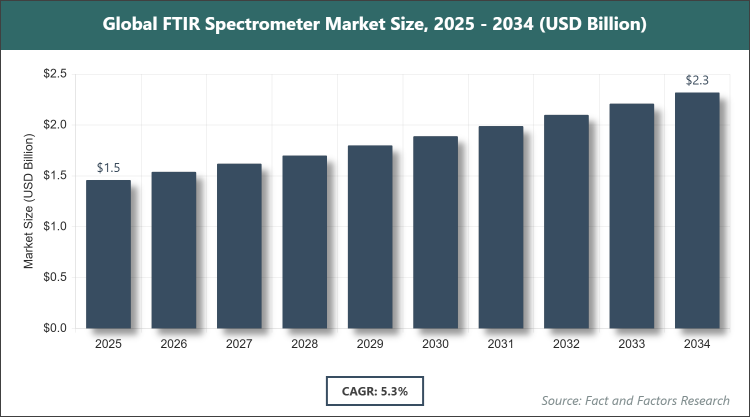
[225+ Pages Report] According to Facts & Factors, the global FTIR Spectrometer market size was estimated at USD 1.46 billion in 2025 and is expected to reach USD 2.41 billion by the end of 2034. The FTIR Spectrometer industry is anticipated to grow by a CAGR of 5.3% between 2026 and 2034. The FTIR Spectrometer Market is driven by increasing demand in the pharmaceutical and chemical industries for precise molecular analysis.
 Market Overview
FTIR spectrometer, or Fourier Transform Infrared spectrometer, is an analytical instrument that uses infrared light to identify and quantify chemical compounds by measuring their absorption spectra, enabling detailed molecular structure analysis across various industries. This market involves the design, production, and distribution of benchtop, portable, and laboratory models that facilitate non-destructive testing for quality control, research, and environmental monitoring, focusing on technological enhancements to improve resolution, speed, and portability without invasive sample preparation.
Key Insights
- As per the analysis shared by our research analyst, the FTIR Spectrometer market is estimated to grow annually at a CAGR of around 5.3% over the forecast period (2026-2034).
- In terms of revenue, the FTIR Spectrometer market size was valued at around USD 1.46 billion in 2025 and is projected to reach USD 2.41 billion by 2034.
- Due to a variety of driving factors, the market is predicted to rise at a significant rate. The FTIR Spectrometer Market is driven by advancements in spectroscopy technology, rising R&D activities, and stringent quality control regulations in pharmaceuticals.
- Based on the Type, the Laboratory Type segment dominated the market in 2025 with a market share of 45% and why it is due to its high precision and suitability for complex research applications in controlled environments.
- Based on the Application, the Pharmaceutical Industry segment dominated the market in 2025 with a market share of 35% and why it is due to the need for accurate drug formulation and impurity detection to comply with regulatory standards.
- Based on the End-User, the Pharmaceutical Companies segment dominated the market in 2025 with a market share of 40% and why it is because it requires reliable tools for ongoing quality assurance and product development.
- Based on region, North America was the leading revenue generator in 2025, holding a market share of 40%, due to advanced research infrastructure andthe presence of key players.
Growth Drivers
- Advancements in Spectroscopy Technology
The integration of AI and automation in FTIR spectrometers has enhanced data analysis accuracy and speed, making them indispensable in high-throughput environments like pharmaceuticals. This progress reduces operational costs and improves user-friendliness, attracting more adopters across sectors.
Furthermore, miniaturization and improved resolution capabilities expand applications in field testing, driving demand in environmental and food safety monitoring.
Restraints
- High Initial Costs
The substantial investment required for advanced FTIR systems limits adoption among small enterprises and in developing regions, where budget constraints prioritize basic equipment. This factor slows market penetration in price-sensitive markets.
Additionally, maintenance and calibration expenses add to the total ownership cost, deterring frequent upgrades.
Opportunities
- Rising R&D in Emerging Economies
Increasing investments in scientific research in Asia-Pacific create demand for affordable, portable FTIR models suitable for diverse applications. This trend opens avenues for market expansion through localized manufacturing.
Moreover, collaborations with academic institutions can foster innovation, leading to customized solutions for niche sectors.
Challenges
- Stringent Regulatory Compliance
Varying international standards for instrument validation complicate global operations, requiring extensive certifications that delay product launches. This issue affects supply chain efficiency.
Ongoing changes in regulations necessitate continuous adaptations, straining resources for smaller manufacturers.
Report Scope
Report Attribute |
Details |
Market Size 2025 |
USD 1.46 Billion |
Projected Market Size in 2034 |
USD 2.41 Billion |
CAGR Growth Rate |
5.3% CAGR |
Base Year |
2025 |
Forecast Years |
2026-2034 |
Key Market Players |
Bruker Corporation, Thermo Fisher Scientific, PerkinElmer, Agilent Technologies, Shimadzu Corporation, ABB Bomem, Metrohm, Gasera Ltd., Biotage AB, Analytik Jena AG, and Others. |
Key Segment |
By Type, By Application, By End-User, and By Region |
Major Regions Covered |
North America, Europe, Asia Pacific, Latin America, and the Middle East & Africa |
Purchase Options |
Request customized purchase options to meet your research needs. Explore purchase options |
Market Segmentation
The FTIR Spectrometer market is segmented by Type, Application, End-User, and region.
Based on Type Segment, the FTIR Spectrometer market is divided into Benchtop, Portable, Laboratory Type, and others. The most dominant segment is Laboratory Type, which leads due to its superior sensitivity and versatility in handling complex samples, driving the market by enabling detailed molecular studies in research labs. The second most dominant is Portable, prominent for its mobility in on-site analysis, contributing to market growth through applications in environmental monitoring.
Based on Application Segment, the FTIR Spectrometer market is divided into Pharmaceutical Industry, Food and Agriculture Industry, Chemical Industry, Polymer, Oil and Gas Industry, and others. The most dominant segment is Pharmaceutical Industry, excelling because of critical needs for compound identification and purity testing, propelling the market via regulatory-driven demand. The second most dominant is Chemical Industry, valued for process optimization, boosting market expansion through industrial quality control.
Based on End-User Segment, the FTIR Spectrometer market is divided into Research Laboratories, Pharmaceutical Companies, Chemical Manufacturers, Environmental Testing Labs, and others. The most dominant segment is Pharmaceutical Companies, dominating due to ongoing drug development requirements, driving the market with high-volume testing needs. The second most dominant is Research Laboratories, essential for academic advancements, contributing to market progress through innovation.
Recent Developments
- In 2025, Thermo Fisher Scientific launched a new portable FTIR spectrometer with enhanced AI-driven analysis for rapid field testing in environmental applications.
- In mid-2025, Bruker Corporation acquired a startup specializing in miniaturized optics, strengthening its position in compact FTIR solutions.
- In late 2025, Agilent Technologies introduced a benchtop model with improved spectral resolution for pharmaceutical quality control.
Regional Analysis
- North America to dominate the global market
North America remains the frontrunner in the FTIR Spectrometer market, underpinned by robust R&D ecosystems and substantial funding for scientific advancements. The United States leads as the dominating country, where leading pharmaceutical firms and research institutions leverage cutting-edge FTIR for drug discovery and material science, bolstered by favorable policies like NIH grants that accelerate technology adoption. Canada's contributions through academic collaborations enhance regional innovation, while Mexico's growing chemical sector adds to the momentum with cost-effective manufacturing hubs.
Asia-Pacific is witnessing explosive growth, propelled by industrialization and expanding healthcare infrastructure. China dominates, with its massive investments in biotech and environmental monitoring driving widespread FTIR use in pollution control and food safety, supported by government initiatives like Made in China 2025 that prioritize analytical tech. India's pharmaceutical boom complements this, as generic drug production demands precise spectroscopy, while Japan's precision engineering fosters high-end instrument development.
Europe holds a strong position, characterized by stringent quality standards and collaborative research frameworks. Germany leads, excelling in chemical and polymer analysis through institutions like Max Planck Society, where FTIR aids in advanced materials research amid EU regulations emphasizing sustainability. The United Kingdom's post-Brexit focus on biotech innovation supports growth, with France contributing via environmental applications in agriculture.
Latin America is emerging steadily, fueled by resource extraction and agribusiness. Brazil dominates, utilizing FTIR in oil and gas for compositional analysis, aligned with Petrobras' exploration efforts and environmental compliance needs. Argentina's food industry adopts the technology for quality assurance, enhancing export competitiveness in global markets.
Middle East & Africa shows promising uptake, driven by oil economies and diversification strategies. Saudi Arabia leads, integrating FTIR in petrochemical refining under Vision 2030 to optimize processes and reduce emissions. South Africa's mining sector employs it for mineral analysis, supporting regional economic stability through resource management.
Competitive Analysis
The global FTIR Spectrometer market is dominated by players:
- Bruker Corporation
- Thermo Fisher Scientific
- PerkinElmer
- Agilent Technologies
- Shimadzu Corporation
- ABB Bomem
- Metrohm
- Gasera Ltd.
- Biotage AB
- Analytik Jena AG
The global FTIR Spectrometer market is segmented as follows:
By Type
- Benchtop
- Portable
- Laboratory Type
- Others
By Application
- Pharmaceutical Industry
- Food and Agriculture Industry
- Chemical Industry
- Polymer
- Oil and Gas Industry
- Others
By End-User
- Research Laboratories
- Pharmaceutical Companies
- Chemical Manufacturers
- Environmental Testing Labs
- Others
By Region
- North America
- The U.S.
- Canada
- Mexico
- Europe
- France
- The UK
- Spain
- Germany
- Italy
- Rest of Europe
- Asia Pacific
- China
- Japan
- India
- Australia
- Southeast Asia
- Rest of Asia Pacific
- The Middle East & Africa
- Saudi Arabia
- UAE
- Egypt
- Kuwait
- South Africa
- Rest of the Middle East & Africa
- Latin America
- Brazil
- Argentina
- Rest of Latin America
Industry Major Market Players
- Bruker Corporation
- Thermo Fisher Scientific
- PerkinElmer
- Agilent Technologies
- Shimadzu Corporation
- ABB Bomem
- Metrohm
- Gasera Ltd.
- Biotage AB
- Analytik Jena AG



Copyright © 2025 - 2026, All Rights Reserved, Facts and Factors