
Search Market Research Report
Digital Out of Home Market Size, Share Global Analysis Report, 2026-2034

Digital Out of Home Market Size, Share, Growth Analysis Report By Format (Billboards, Transit Displays, Street Furniture, Venue-based Displays, and Others), By Application (Indoor and Outdoor), By End-Use (Retail & FMCG, Entertainment, Travel & Tourism, Government, BFSI, Healthcare, Automotive, Real Estate, and Others), and By Region - Global Industry Insights, Overview, Comprehensive Analysis, Trends, Statistical Research, Market Intelligence, Historical Data and Forecast 2026-2034
Industry Insights
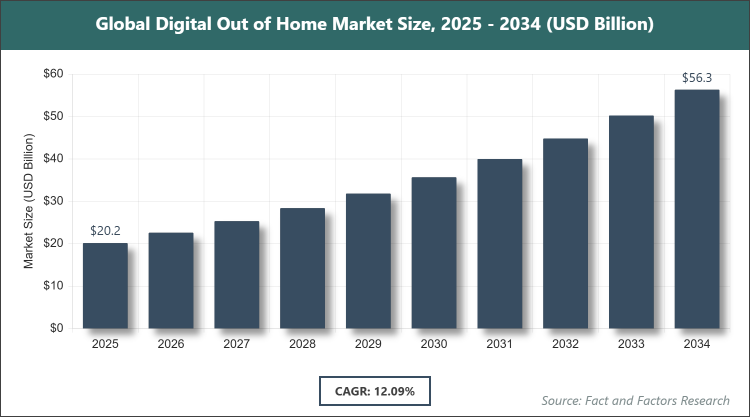
[242 + Pages Report] According to Facts & Factors, the global Digital Out of Home market size was estimated at USD 20.17 billion in 2025 and is expected to reach USD 56.1 billion by the end of 2034. The Digital Out of Home industry is anticipated to grow by a CAGR of 12.09% between 2026 and 2034. The Digital Out of Home Market is driven by increasing adoption of programmatic advertising and technological advancements in digital displays.
 Market Overview
The Digital Out of Home market involves the use of digital screens and displays placed in public spaces to deliver advertising content to consumers outside their homes. This includes dynamic billboards, transit displays, street furniture, and venue-based screens that provide targeted, real-time messaging through technologies like LED, LCD, and interactive platforms. DOOH enhances traditional out-of-home advertising by enabling programmatic buying, audience measurement, and contextual relevance, making it a versatile tool for brands to engage passersby in high-traffic areas such as airports, malls, and urban streets, while integrating with broader digital marketing strategies.
Key Insights
- As per the analysis shared by our research analyst, the Digital Out of Home market is estimated to grow annually at a CAGR of around 12.09% over the forecast period (2026-2034).
- In terms of revenue, the Digital Out of Home market size was valued at around USD 20.17 billion in 2025 and is projected to reach USD 56.1 billion by 2034.
- The Digital Out of Home Market is driven by rising urbanization and demand for data-driven advertising.
- Based on the Format, the Billboards segment dominated the market in 2025 with a share of 40% due to their high visibility and large-scale impact in urban areas.
- Based on the Application, the Outdoor segment dominated the market in 2025 with a share of 70%, owing to extensive deployment in high-traffic public spaces for a broader audience reach.
- Based on the End-Use, the Retail & FMCG segment dominated the market in 2025 with a share of 25% because of targeted promotions driving consumer purchases in shopping environments.
- North America dominated the global Digital Out of Home market in 2025 with a share of 34%, attributed to advanced digital infrastructure and high advertising spends.
Growth Drivers
- Advancements in Digital Display Technologies
Innovations such as high-resolution LED screens and interactive kiosks enhance visual appeal and engagement, allowing for dynamic content that captures attention in real-time. Integration with AI for personalized ads further boosts effectiveness, attracting more advertisers.
Urbanization increases high-traffic locations ideal for DOOH, while programmatic platforms streamline ad buying, reducing costs and improving ROI. Government initiatives for smart cities also support infrastructure development, expanding market reach.
Restraints
- High Initial Installation and Maintenance Costs
Expensive hardware like digital screens and software systems deters small businesses, particularly in emerging markets with limited budgets. Regulatory approvals for installations add delays and expenses.
Power consumption and vulnerability to weather in outdoor setups increase ongoing costs, while competition from online advertising diverts budgets. Fragmented supply chains complicate scalability, limiting widespread adoption.
Opportunities
- Integration with Mobile and Social Media
Linking DOOH with QR codes and geofencing enables seamless omnichannel experiences, enhancing user interaction and data collection for refined targeting.
Partnerships with tech firms can introduce AR/VR elements, creating immersive ads. Emerging markets offer untapped potential with growing digital adoption, supported by e-commerce growth.
Challenges
- Data Privacy and Regulatory Compliance
Strict laws like GDPR restrict audience tracking, complicating personalized advertising and raising compliance costs.
Consumer concerns over surveillance erode trust, while varying regional regulations hinder global campaigns. Technological disparities in measurement standards also challenge accurate ROI assessment.
Report Scope
Report Attribute |
Details |
Market Size 2025 |
USD 20.17 Billion |
Projected Market Size in 2034 |
USD 56.1 Billion |
CAGR Growth Rate |
12.09% CAGR |
Base Year |
2025 |
Forecast Years |
2026-2034 |
Key Market Players |
JCDecux, Clear Channel Outdoor Holdings, Inc., Lamar Advertising Company, OUTFRONT Media, Daktronics, Stroer SE & Co. KGaA, Broadsign International LLC, NEC Display Solutions, Ltd., oOh!media Ltd., Mvix, Inc., and Others. |
Key Segment |
By Format, By Application, By End-Use, and By Region |
Major Regions Covered |
North America, Europe, Asia Pacific, Latin America, and the Middle East & Africa |
Purchase Options |
Request customized purchase options to meet your research needs. Explore purchase options |
Market Segmentation
The Digital Out of Home market is segmented by format, application, end-use, and region.
Based on Format Segment, the Digital Out of Home market is divided into billboards, transit displays, street furniture, venue-based displays, and others. The most dominant segment is Billboards, propelled by their prominent placement and ability to deliver high-impact visuals to large audiences. The second most dominant is Transit Displays, benefiting from captive audiences in public transport. Billboards dominate due to their scalability and integration with programmatic tech, enabling real-time updates and targeted campaigns that boost brand visibility, driving market growth by attracting premium ad spends from major sectors.
Based on the Application Segment, the Digital Out of Home market is divided into Indoor and Outdoor. The most dominant segment is Outdoor, driven by exposure to diverse demographics in public spaces. The second most dominant is Indoor, growing in controlled environments like malls. Outdoor leads because of its unmatched reach in urban settings, facilitating contextual ads that influence on-the-go decisions, propelling market expansion through enhanced engagement and measurable outcomes.
Based on End-Use Segment, the Digital Out of Home market is divided into retail & fmcg, entertainment, travel & tourism, government, bfsi, healthcare, automotive, real estate, and others. The most dominant segment is Retail & FMCG, as it leverages DOOH for impulse-driven promotions. The second most dominant is Entertainment, using vibrant displays for event marketing. Retail & FMCG dominate owing to their focus on consumer behavior analytics, enabling hyper-local ads that increase foot traffic and sales, fueling overall market growth via data integration.
Recent Developments
- In May 2025, Lamar Advertising acquired Premier Outdoor Media, enhancing its position in the greater Philadelphia and New York markets for expanded DOOH coverage.
- In April 2025, JCDecux partnered with Viooh to launch a programmatic DOOH offering, enabling automated and data-driven ad buying for improved efficiency.
- In February 2025, Daktronics introduced energy-efficient digital billboard technology with eco-conscious features, including a Green Mode for sustainability in DOOH applications.
- In January 2025, Talon acquired Out of Home Masters to strengthen its European presence and platform for further growth in the DOOH sector.
- In October 2024, DLM Media partnered with CETV Now to expand digital out-of-home advertising networks across U.S. venues, capitalizing on rising demand.
Regional Analysis
- North America to dominate the global market
North America leads the Digital Out of Home market, supported by sophisticated digital infrastructure, high urbanization, and substantial advertising investments from diverse industries. The region's emphasis on programmatic and interactive technologies drives innovation. The United States dominates within North America, with its extensive network of smart cities and major media hubs, integrating AI for targeted campaigns that enhance engagement, backed by favorable regulations and strong consumer spending patterns, ensuring continued market supremacy.
Europe maintains a robust presence in the Digital Out of Home market, fueled by stringent environmental policies promoting sustainable digital displays and a focus on creative content. Collaborative industry standards aid growth. The United Kingdom leads the region, leveraging its advanced tech ecosystem and iconic urban landscapes for iconic installations, where partnerships with advertisers enable dynamic, context-aware ads that boost tourism and retail, fostering resilient market development.
Asia-Pacific is rapidly advancing in the Digital Out of Home market, driven by massive population centers and infrastructure booms in smart cities. Increasing digital literacy accelerates adoption. China dominates, with its vast urbanization projects and government-backed digital initiatives, deploying extensive LED networks for public information and commercial ads, supported by e-commerce integration that enhances real-time promotions and market penetration.
Latin America shows emerging potential in the Digital Out of Home market, propelled by growing retail sectors and urban expansion. Investments in public transport upgrades support deployment. Brazil leads, utilizing its vibrant economy and major events for high-visibility campaigns, where collaborations with global tech providers introduce affordable solutions, improving accessibility and stimulating gradual industry maturation.
The Middle East & Africa region is gaining traction in the Digital Out of Home market, aided by tourism-driven economies and infrastructure developments. International partnerships facilitate technology transfer. The GCC countries dominate, with ambitious smart city visions like Dubai's, incorporating interactive displays in malls and airports to engage visitors, enhanced by oil revenues funding expansions that position the area for future growth.
Competitive Analysis
The global Digital Out of Home market is dominated by players:
- JCDecaux
- Clear Channel Outdoor Holdings, Inc.
- Lamar Advertising Company
- OUTFRONT Media
- Daktronics
- Stroer SE & Co. KGaA
- Broadsign International LLC
- NEC Display Solutions, Ltd.
- oOh!media Ltd.
- Mvix, Inc.
The global Digital Out of Home market is segmented as follows:
By Format
- Billboards
- Transit Displays
- Street Furniture
- Venue-based Displays
- Others
By Application
- Indoor
- Outdoor
By End-Use
- Retail & FMCG
- Entertainment
- Travel & Tourism
- Government
- BFSI
- Healthcare
- Automotive
- Real Estate
- Others
By Region
- North America
- The U.S.
- Canada
- Mexico
- Europe
- France
- The UK
- Spain
- Germany
- Italy
- Rest of Europe
- Asia Pacific
- China
- Japan
- India
- Australia
- Southeast Asia
- Rest of Asia Pacific
- The Middle East & Africa
- Saudi Arabia
- UAE
- Egypt
- Kuwait
- South Africa
- Rest of the Middle East & Africa
- Latin America
- Brazil
- Argentina
- Rest of Latin America
Industry Major Market Players
- JCDecaux
- Clear Channel Outdoor Holdings, Inc.
- Lamar Advertising Company
- OUTFRONT Media
- Daktronics
- Stroer SE & Co. KGaA
- Broadsign International LLC
- NEC Display Solutions, Ltd.
- oOh!media Ltd.
- Mvix, Inc



Copyright © 2025 - 2026, All Rights Reserved, Facts and Factors