
Search Market Research Report
Bale Net Wrap Market Size, Share Global Analysis Report, 2026-2034

Bale Net Wrap Market Size, Share, Growth Analysis Report By Type (Knitted Bale Net, Extruded Bale Net, and Others), By Application (Bailing Hay, Bailing Straw, Bailing Silage, and Others), By End-User (Farms, Industrial, and Others), and By Region - Global Industry Insights, Overview, Comprehensive Analysis, Trends, Statistical Research, Market Intelligence, Historical Data and Forecast 2026-2034
Industry Insights
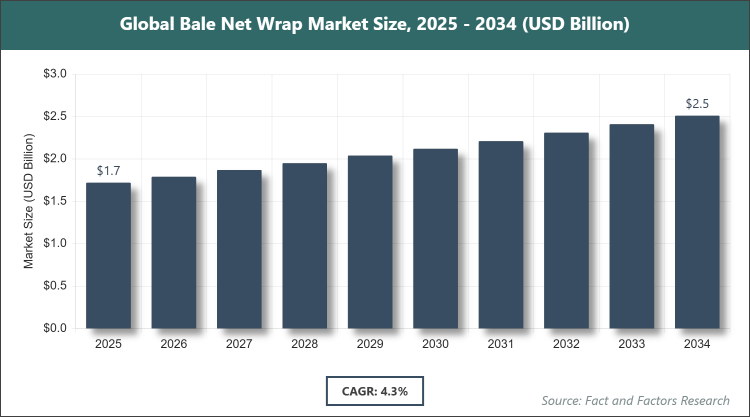
[215 Pages Report] According to Facts & Factors, the global Bale Net Wrap market size was estimated at USD 1.72 billion in 2025 and is expected to reach USD 2.58 billion by the end of 2034. The Bale Net Wrap industry is anticipated to grow by a CAGR of 4.3% between 2026 and 2034. The Bale Net Wrap Market is driven by rising demand for efficient hay preservation and growth in livestock farming.
 Market Overview
The bale net wrap market comprises the manufacturing, distribution, and utilization of netting materials primarily made from polyethylene or similar polymers, designed to securely wrap and protect baled crops such as hay, straw, and silage during storage and transportation, offering advantages like reduced spoilage, easier handling, and improved bale integrity for agricultural operations worldwide, while catering to the needs of farmers and agribusinesses seeking efficient forage management solutions without relying on traditional twine methods. This market involves a supply chain from raw material suppliers to end-users in farming, emphasizing durability, UV resistance, and environmental considerations to enhance crop yield preservation and support sustainable agricultural practices across diverse climatic conditions.
Key Insights
- As per the analysis shared by our research analyst, the Bale Net Wrap market is expected to grow at a CAGR of 4.3% during the forecast period of 2026-2034.
- In terms of revenue, the Bale Net Wrap market size was valued at about USD 1.72 billion in 2025 and is expected to reach USD 2.58 billion by 2034.
- The Bale Net Wrap market is driven by rising demand for efficient hay preservation and growth in livestock farming.
- Based on the type, the knitted bale net segment dominated the market with a share of 60% in 2025 due to its cost-effectiveness and superior strength for bale stability.
- Based on the application, the bailing hay segment dominated the market with a share of 50% in 2025 owing to high global hay production and need for protection against weather elements.
- Based on the end-user, the farms segment dominated the market with a share of 65% in 2025 as it represents the primary agricultural users requiring bulk wrapping solutions.
- North America dominated the market with a share of 40% in 2025 due to advanced farming technologies and high livestock farming activities.
Growth Drivers
- Rising Demand for Efficient Hay Preservation
The increasing need for protecting forage from environmental damage is driving market growth, as bale net wraps provide superior coverage and reduce nutrient loss compared to traditional methods, particularly in regions with variable weather conditions. This driver is supported by growing awareness among farmers about post-harvest losses.
Additionally, advancements in net wrap materials enhance durability and ease of use, encouraging adoption in mechanized farming, thereby expanding market penetration through improved efficiency and cost savings over time.
- Growth in Livestock Farming
Expanding livestock populations globally require consistent high-quality feed, boosting demand for reliable bale wrapping to maintain silage and hay integrity during storage. This is amplified by rising meat and dairy consumption in developing economies.
Furthermore, government subsidies for agricultural improvements facilitate access to modern wrapping solutions, supporting market expansion by enabling small-scale farmers to adopt efficient preservation techniques.
- Increasing Mechanization in Agriculture
The shift towards automated baling equipment necessitates compatible net wraps for seamless operations, driving market growth in industrialized farming regions. This trend is fueled by labor shortages and the need for higher productivity.
Moreover, integration with smart farming technologies allows for optimized wrapping processes, enhancing overall farm efficiency and contributing to sustained market development through innovation.
Restraints
- High Product Costs
Elevated prices of quality net wraps limit adoption among small farmers in price-sensitive markets, constraining growth in emerging regions. This restraint is exacerbated by fluctuating raw material costs like polyethylene.
Strategies to introduce affordable variants and bulk purchasing options are needed, though maintaining quality standards poses challenges to widespread accessibility.
- Competition from Alternative Wrapping Materials
Availability of cheaper twine or film options hinders net wrap market share, as some farmers prefer traditional methods for cost reasons. This issue is prominent in less mechanized areas.
Innovation in hybrid solutions and education on long-term benefits are essential to counter alternatives, yet shifting entrenched practices requires time and effort.
Opportunities
- Innovation in Sustainable Materials
Development of biodegradable net wraps addresses environmental concerns, opening avenues in eco-conscious markets. This opportunity aligns with global sustainability goals.
Investments in R&D for green alternatives can attract premium pricing and partnerships with regulatory bodies, fostering market differentiation.
- Expansion in Emerging Markets
Growing agriculture in Asia and Africa presents untapped potential for net wrap adoption amid rising farm mechanization. This involves tailored products for local crops.
Building distribution networks and awareness campaigns can drive volume growth in these regions.
Challenges
- Supply Chain Disruptions
Volatility in polymer supplies affects production consistency, impacting availability in peak seasons. Diversified sourcing is crucial.
Adopting resilient logistics strategies helps mitigate risks, though it increases operational complexities.
- Environmental Regulations
Strict rules on plastic usage challenge non-biodegradable wraps, requiring shifts to compliant materials. This demands innovation to stay competitive.
Balancing eco-friendliness with performance remains key to overcoming regulatory hurdles.
Report Scope
Report Attribute |
Details |
Market Size 2025 |
USD 1.72 Billion |
Projected Market Size in 2034 |
USD 2.58 Billion |
CAGR Growth Rate |
4.3% CAGR |
Base Year |
2025 |
Forecast Years |
2026-2034 |
Key Market Players |
Tenax Corporation, KARATZIS S.A., RKW Group, Tama Group, UPU Industries, Bridon Cordage, Piippo Oyj, Qingdao Agri, Syfilco, Changzhou LiBo, and Others. |
Key Segment |
By Type, By Application, By End-User, and By Region |
Major Regions Covered |
North America, Europe, Asia Pacific, Latin America, and the Middle East & Africa |
Purchase Options |
Request customized purchase options to meet your research needs. Explore purchase options |
Market Segmentation
The Bale Net Wrap market is segmented by type, application, end-user, and region.
Based on Type Segment, the bale net wrap market is divided into knitted bale net, extruded bale net, and others. The most dominant segment is knitted bale net, holding the largest share due to its flexibility and strong holding capacity that ensures bale integrity during handling and storage, driving the market by reducing losses in high-volume hay production; the second most dominant is extruded bale net, which offers uniform coverage and UV resistance, contributing to market growth through applications in silage where moisture protection is critical.
Based on Application Segment, the bale net wrap market is divided into bailing hay, bailing straw, bailing silage, and others. The most dominant segment is bailing hay, leading because of widespread hay cultivation for livestock feed requiring robust wrapping to prevent spoilage, propelling market expansion via demand from dairy and meat industries; the second most dominant is bailing silage, sustaining growth through its role in anaerobic preservation essential for year-round feed availability in intensive farming.
Based on End-User Segment, the bale net wrap market is divided into farms, industrial, and others. The most dominant segment is farms, dominating owing to direct usage in agricultural operations for crop protection, boosting market through small and large-scale farming needs; the second most dominant is industrial, supporting expansion by facilitating bulk processing in agribusiness for export and storage.
Recent Developments
- In March 2024, Nature’s Net Wrap collaborated with CNH Ventures to launch compostable net wrap, aiming to reduce agricultural waste and promote sustainability.
- In January 2024, CNH backed Canadian start-up Nature's Net Wrap to accelerate compostable solutions for bales, targeting environmental concerns in crop storage.
- In May 2023, Hillco Technologies introduced a wrap twine remover for large bales, enhancing operator efficiency in net wrap handling.
- In August 2023, John Deere launched a connected 1 baler series with new technology for improved baling and moisture sensing.
Regional Analysis
- North America to dominate the global market
North America commands the bale net wrap market with the United States as the dominating country, where advanced mechanized farming and high livestock density drive demand for durable wraps in hay and silage preservation, supported by extensive agricultural infrastructure and innovations in sustainable materials that enhance efficiency, while strong export activities further solidify its leadership through reliable supply chains catering to diverse climatic needs.
Europe holds a substantial share led by Germany, dominating through its focus on precision agriculture and stringent quality standards for forage wrapping, integrated with subsidies for eco-friendly practices that promote biodegradable nets, creating a competitive environment for high-performance products in dairy-intensive regions.
Asia Pacific is expanding rapidly, with China as the key country due to growing mechanization in vast farmlands requiring cost-effective wraps for straw and hay, aided by government initiatives boosting rural economies and increasing feed demands from rising meat consumption.
Latin America shows growth potential dominated by Brazil, where expanding agribusiness in tropical climates necessitates robust wraps for silage protection, supported by investments in export-oriented farming that leverage natural resources for global markets.
The Middle East & Africa region is emerging, led by South Africa with its diverse agriculture needing wraps for arid conditions, complemented by international aid enhancing storage techniques for food security in livestock-dependent economies.
Competitive Analysis
The global Bale Net Wrap market is dominated by players:
- Tenax Corporation
- KARATZIS S.A.
- RKW Group
- Tama Group
- UPU Industries
- Bridon Cordage
- Piippo Oyj
- Qingdao Agri
- Syfilco
- Changzhou LiBo
The global Bale Net Wrap market is segmented as follows:
By Type
- Knitted Bale Net
- Extruded Bale Net
- Others
By Application
- Bailing Hay
- Bailing Straw
- Bailing Silage
- Others
By End-User
- Farms
- Industrial
- Others
By Region
- North America
- The U.S.
- Canada
- Mexico
- Europe
- France
- The UK
- Spain
- Germany
- Italy
- Rest of Europe
- Asia Pacific
- China
- Japan
- India
- Australia
- Southeast Asia
- Rest of Asia Pacific
- The Middle East & Africa
- Saudi Arabia
- UAE
- Egypt
- Kuwait
- South Africa
- Rest of the Middle East & Africa
- Latin America
- Brazil
- Argentina
- Rest of Latin America
Industry Major Market Players
The global Bale Net Wrap market is dominated by players:
- Tenax Corporation
- KARATZIS S.A.
- RKW Group
- Tama Group
- UPU Industries
- Bridon Cordage
- Piippo Oyj
- Qingdao Agri
- Syfilco
- Changzhou LiBo



Copyright © 2025 - 2026, All Rights Reserved, Facts and Factors