
Search Market Research Report
Ambulance Market Size, Share Global Analysis Report, 2026-2034

Ambulance Market Size, Share, Growth Analysis Report By Type (Type A, Type B, Type C, Type D, and Others), By Propulsion (ICE, Electric, and Others), By Application (Emergency, Non-Emergency, and Others), and By Region - Global Industry Insights, Overview, Comprehensive Analysis, Trends, Statistical Research, Market Intelligence, Historical Data and Forecast 2026-2034
Industry Insights
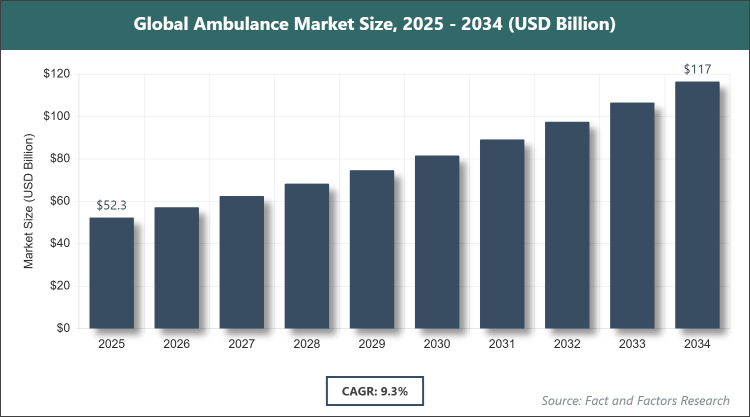
[215+ Pages Report] According to Facts & Factors, the global Ambulance market size was estimated at USD 52.33 billion in 2025 and is expected to reach USD 113.57 billion by the end of 2034. The Ambulance industry is anticipated to grow by a CAGR of 9.3% between 2026 and 2034. The Ambulance Market is driven by rising demand for emergency medical services and technological advancements in vehicle design.
 Market Overview
The ambulance market involves the manufacturing, distribution, and servicing of specialized vehicles equipped for emergency medical transportation, designed to provide rapid response, patient stabilization, and safe conveyance to healthcare facilities. These vehicles integrate advanced medical equipment, communication systems, and ergonomic designs to support paramedics in delivering life-saving care during transit. The market addresses diverse needs from basic patient transport to intensive care units on wheels, reflecting innovations in propulsion, safety features, and integration with telemedicine, while complying with stringent regulatory standards for reliability and performance in critical situations.
Key Insights
- As per the analysis shared by our research analyst, the global Ambulance market is estimated to grow annually at a CAGR of around 9.3% over the forecast period (2026-2034).
- In terms of revenue, the global Ambulance market size was valued at around USD 52.33 billion in 2025 and is projected to reach USD 113.57 billion, by 2034.
- The Ambulance market is projected to witness significant growth due to increasing healthcare infrastructure investments and rising incidence of medical emergencies.
- Based on the Type, the Type C segment accounted for the largest market share of 40% due to its advanced life support capabilities suitable for critical care transport.
- Based on the Propulsion, the ICE segment dominated the market with the highest share owing to its established reliability and widespread infrastructure support.
- Based on the Application, the Emergency segment held the leading position with a substantial share because of the growing need for rapid response in accidents and health crises.
- Based on the region, the North America region captured around 45% market share, driven by advanced healthcare systems and high adoption of innovative ambulance technologies.
Growth Drivers
- Rising Incidence of Medical Emergencies
The increasing prevalence of chronic diseases, accidents, and natural disasters is driving demand for efficient ambulance vehicles equipped with state-of-the-art medical tools for immediate intervention. Global aging populations further amplify this need, as elderly individuals require frequent emergency transports. Innovations in vehicle design, such as enhanced suspension for patient comfort and integrated defibrillators, improve response times and outcomes.
Moreover, government initiatives to upgrade emergency medical services (EMS) infrastructure, including fleet modernization, support market expansion. This driver fosters collaborations between manufacturers and healthcare providers, leading to customized solutions that enhance operational efficiency and patient safety.
Restraints
- High Acquisition and Maintenance Costs
The substantial upfront costs for advanced ambulances, coupled with ongoing expenses for equipment upkeep and compliance with safety standards, pose barriers for budget-constrained regions and small operators. Economic downturns exacerbate this issue, delaying fleet renewals. Stringent certification processes increase financial burdens.
Additionally, fluctuations in raw material prices affect manufacturing costs, impacting affordability. These restraints limit market penetration in developing areas, requiring financing options and cost-effective innovations to alleviate pressures.
Opportunities
- Adoption of Electric Ambulances
The shift toward sustainable propulsion systems offers opportunities for electric ambulances, reducing emissions and operational costs while aligning with environmental regulations. Advances in battery technology enable longer ranges and faster charging, suitable for urban EMS. Government subsidies for green vehicles accelerate adoption.
Furthermore, integration with smart city infrastructures enhances routing efficiency. This opportunity expands market scope into eco-conscious sectors, attracting investments in R&D for hybrid models.
Challenges
- Regulatory Compliance Variations
Differing international standards for vehicle safety and medical equipment complicate global manufacturing and exports, increasing adaptation costs. Evolving regulations on emissions and data privacy add complexity. Supply chain disruptions for specialized components hinder compliance timelines.
In addition, training requirements for new technologies strain resources. These challenges demand harmonized standards and agile manufacturing strategies to maintain competitiveness.
Report Scope
Report Attribute |
Details |
Market Size 2025 |
USD 52.33 Billion |
Projected Market Size in 2034 |
USD 113.57 Billion |
CAGR Growth Rate |
9.3% CAGR |
Base Year |
2025 |
Forecast Years |
2026-2034 |
Key Market Players |
Demers Ambulances, Braun Industries, Wheeled Coach Industries, Osage Ambulances, Ambulance Manufacturing Company, Glenmore, Stryker, Ferno, REV Group, Ford Motor Company, Toyota Motor Corporation, Leader Ambulance, and Others. |
Key Segment |
By Type, By Propulsion, By Application, and By Region |
Major Regions Covered |
North America, Europe, Asia Pacific, Latin America, and the Middle East & Africa |
Purchase Options |
Request customized purchase options to meet your research needs. Explore purchase options |
Market Segmentation
The Ambulance market is segmented by type, propulsion, application, and region.
Based on Type Segment, The Ambulance market is divided into Type A, Type B, Type C, Type D, and others. The most dominant segment is Type C, which holds the largest share due to its comprehensive advanced life support features essential for critical care, driving the market by enabling high-level medical interventions during transport; the second most dominant is Type B, favored for basic life support in routine emergencies, contributing to market growth through cost-effective solutions for widespread EMS needs.
Based on Propulsion Segment, The Ambulance market is divided into ICE, Electric, and others. The most dominant segment is ICE, commanding the highest share because of its proven durability and fuel availability, which drives the market by supporting reliable operations in diverse terrains; the second most dominant is Electric, growing for its low emissions and quiet operation, propelling market expansion amid sustainability pushes.
Based on Application Segment, The Ambulance market is divided into Emergency, Non-Emergency, and others. The most dominant segment is Emergency, holding the biggest share due to rising accident rates and health crises requiring immediate response, driving the market by prioritizing life-saving capabilities; the second most dominant is Non-Emergency, used for patient transfers, contributing to market growth via efficient healthcare logistics.
Recent Developments
- In March 2024, new regulations enhanced ambulance safety standards, impacting vehicle designs globally.
- In July 2024, a major manufacturer launched an electric ambulance model with extended range capabilities.
Regional Analysis
- North America to dominate the global market
North America commands the ambulance market, with the United States as the dominant country through its advanced EMS systems and high healthcare spending, fostering innovations in vehicle technology for rapid response. The region's focus on integrating telemedicine enhances patient care during transit, while robust insurance coverage supports fleet expansions. Investments in training and infrastructure solidify its position. The U.S. leads due to regulatory frameworks promoting safety and efficiency.
Europe maintains strength with emphasis on sustainable ambulances, led by Germany via engineering excellence and export prowess. EU policies on emissions drive electric vehicle adoption, improving urban mobility. Collaborative R&D across nations advances modular designs. Germany's dominance stems from automotive heritage and green initiatives.
Asia Pacific grows rapidly with urbanization and healthcare reforms, dominated by China through manufacturing scale and domestic demand. Government investments in EMS infrastructure boost adoption. China's lead arises from cost-effective production and policy support for electrification.
Latin America advances with improving healthcare access, led by Brazil via public health expansions. Infrastructure projects enhance emergency coverage. Brazil's position strengthens from regional leadership and foreign partnerships.
The Middle East & Africa progresses through oil-funded healthcare upgrades, with Saudi Arabia dominating via Vision 2030's EMS investments. Strategic alliances improve vehicle quality. Saudi Arabia's lead comes from economic diversification efforts.
Competitive Analysis
The global Ambulance market is dominated by players:
- Demers Ambulances
- Braun Industries
- Wheeled Coach Industries
- Osage Ambulances
- Ambulance Manufacturing Company
- Glenmore
- Stryker
- Ferno
- REV Group
- Ford Motor Company
- Toyota Motor Corporation
- Leader Ambulance
The global Ambulance market is segmented as follows:
By Type
- Type A
- Type B
- Type C
- Type D
- Others
By Propulsion
- ICE
- Electric
- Others
By Application
- Emergency
- Non-Emergency
- Others
By Region
- North America
- The U.S.
- Canada
- Mexico
- Europe
- France
- The UK
- Spain
- Germany
- Italy
- Rest of Europe
- Asia Pacific
- China
- Japan
- India
- Australia
- Southeast Asia
- Rest of Asia Pacific
- The Middle East & Africa
- Saudi Arabia
- UAE
- Egypt
- Kuwait
- South Africa
- Rest of the Middle East & Africa
- Latin America
- Brazil
- Argentina
- Rest of Latin America
Industry Major Market Players
- Demers Ambulances
- Braun Industries
- Wheeled Coach Industries
- Osage Ambulances
- Ambulance Manufacturing Company
- Glenmore
- Stryker
- Ferno
- REV Group
- Ford Motor Company
- Toyota Motor Corporation
- Leader Ambulance



Copyright © 2025 - 2026, All Rights Reserved, Facts and Factors