
Search Market Research Report
Incubator Shaker Market Size, Share Global Analysis Report, 2026-2034

Incubator Shaker Market Size, Share, Growth Analysis Report By Type (Orbital Incubator Shaker, Reciprocating Incubator Shaker, Stackable Incubator Shaker, and Others), By Application (Cell Culture, Microbiology, Protein Expression, Enzyme Studies, and Others), By End-User (Pharmaceutical & Biotechnology Companies, Academic & Research Institutes, Hospitals & Diagnostic Labs, and Others), and By Region - Global Industry Insights, Overview, Comprehensive Analysis, Trends, Statistical Research, Market Intelligence, Historical Data and Forecast 2026-2034
Industry Insights
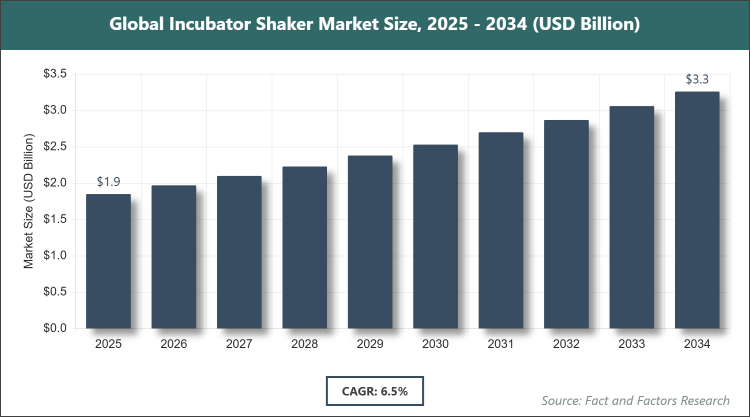
[231 + Pages Report] According to Facts & Factors, the global Incubator Shaker market size was estimated at USD 1.85 billion in 2025 and is expected to reach USD 3.25 billion by the end of 2034. The Incubator Shaker industry is anticipated to grow by a CAGR of 6.5% between 2026 and 2034. The Incubator Shaker Market is driven by surging demand for cell culture and microbial research in the pharmaceutical and biotechnology industries.
 Market Overview
The Incubator Shaker market comprises specialized laboratory instruments that combine controlled temperature incubation with orbital or reciprocating shaking motion to provide optimal growth conditions for microorganisms, mammalian cells, and other biological cultures. These devices maintain precise temperature, humidity, and CO₂ levels while delivering consistent agitation to ensure uniform nutrient distribution, oxygenation, and prevention of sedimentation in liquid cultures. Available in benchtop, floor-standing, and stackable configurations with advanced features such as programmable speed, timer controls, and remote monitoring, incubator shakers are indispensable tools in drug discovery, vaccine development, enzyme production, and academic research, enabling reproducible and scalable biological experiments under highly controlled laboratory environments.
Key Insights
- As per the analysis shared by our research analyst, the Incubator Shaker market is estimated to grow annually at a CAGR of around 6.5% over the forecast period (2026-2034).
- In terms of revenue, the Incubator Shaker market size was valued at around USD 1.85 billion in 2025 and is projected to reach USD 3.25 billion by 2034.
- The Incubator Shaker Market is driven by expanding biopharmaceutical R&D and cell therapy applications.
- Based on the Type, the Orbital Incubator Shaker segment dominated the market in 2025 with a share of 68% due to superior mixing efficiency, gentle agitation suitable for sensitive cell lines, and widespread adoption in standard protocols.
- Based on the Application, the Cell Culture segment dominated the market in 2025 with a share of 55%, owing to rising demand for monoclonal antibodies, vaccines, and regenerative medicine requiring large-scale mammalian cell expansion.
- Based on the End-User, the Pharmaceutical & Biotechnology Companies segment dominated the market in 2025 with a share of 62% because of continuous investment in drug discovery pipelines and biologics manufacturing.
- Asia Pacific dominated the global Incubator Shaker market in 2025 with a share of 42%, attributed tothe rapid expansion of biotech hubs, government funding for life sciences research, and growing CRO/CMO activities in China and India.
Growth Drivers
- Expansion of Biopharmaceutical and Cell Therapy Research
The global surge in biologics, monoclonal antibodies, and cell & gene therapies has dramatically increased the need for reliable, large-capacity incubator shakers capable of supporting high-density mammalian cell cultures under tightly controlled conditions.
The rising number of clinical trials and contract manufacturing organizations further amplifies demand for scalable shaking incubation platforms in both development and production phases.
Restraints
- High Capital Investment and Maintenance Costs
Advanced models with CO₂ control, refrigeration, and stackable designs require significant upfront investment, limiting adoption among smaller academic labs and start-ups in emerging markets.
Frequent calibration, filter replacements, and energy consumption add to long-term operational expenses, slowing replacement cycles in budget-constrained facilities.
Opportunities
- Integration with Smart Lab Technologies
IoT-enabled incubator shakers with remote monitoring, predictive maintenance alerts, and cloud-based data logging are gaining traction, allowing researchers to optimize workflows and ensure compliance in 24/7 operations.
Growing demand for compact, energy-efficient benchtop units in point-of-care and decentralized biotech facilities presents new volume opportunities across the Asia Pacific and Latin America.
Challenges
- Stringent Regulatory Requirements and Contamination Risks
Compliance with GMP, GLP, and ISO standards demands extensive validation documentation and cleanroom-compatible designs, increasing development time and cost for manufacturers.
Risk of cross-contamination in shared multi-user environments necessitates robust sterilization protocols and frequent downtime, impacting productivity in high-throughput laboratories.
Report Scope
Report Attribute |
Details |
Market Size 2025 |
USD 1.85 Billion |
Projected Market Size in 2034 |
USD 3.25 Billion |
CAGR Growth Rate |
6.5% CAGR |
Base Year |
2025 |
Forecast Years |
2026-2034 |
Key Market Players |
Thermo Fisher Scientific Inc., Eppendorf AG, Labnet International, Benchmark Scientific, Infors HT, New Brunswick Scientific, IKA Works, Heidolph Instruments, Stuart Equipment, Esco Micro Pte Ltd., and Others. |
Key Segment |
By Type, By Application, By End-User, and By Region |
Major Regions Covered |
North America, Europe, Asia Pacific, Latin America, and the Middle East & Africa |
Purchase Options |
Request customized purchase options to meet your research needs. Explore purchase options |
Market Segmentation
The Incubator Shaker market is segmented by type, application, end-user, and region.
Based on Type Segment, the Incubator Shaker market is divided into orbital incubator shaker, reciprocating incubator shaker, stackable incubator shaker, and others. The most dominant segment is Orbital Incubator Shaker, driven by uniform circular motion ideal for cell suspension cultures. The second most dominant is the Stackable Incubator Shaker. Orbital Incubator Shaker dominates due to its gentle yet effective mixing that minimizes shear stress on delicate cells while maximizing oxygen transfer, helping drive market growth by becoming the standard choice for mammalian cell culture and fermentation processes worldwide.
Based on Application Segment, the Incubator Shaker market is divided into cell culture, microbiology, protein expression, enzyme studies, and others. The most dominant segment is Cell Culture, supported by booming demand for biologics and stem cell research. The second most dominant is Microbiology. Cell Culture leads because it requires precise temperature and agitation control for large-scale production of therapeutic proteins and vaccines, propelling market expansion through sustained investment in biomanufacturing infrastructure.
Based on End-User Segment, the Incubator Shaker market is divided into pharmaceutical & biotechnology companies, academic & research institutes, hospitals & diagnostic labs, and others. The most dominant segment is Pharmaceutical & Biotechnology Companies, fueled by commercial-scale production needs. The second most dominant is Academic & Research Institutes. Pharmaceutical & Biotechnology Companies dominate due to large capital budgets and focus on scalable, GMP-compliant equipment that supports pipeline advancement and commercial manufacturing, driving market growth through recurring high-volume purchases.
Recent Developments
- In January 2026, Eppendorf launched the new Innova S44i stackable incubator shaker with an advanced touchscreen interface and remote monitoring capabilities.
- In November 2025, Thermo Fisher Scientific introduced the MaxQ 8000 refrigerated orbital shaker with improved energy efficiency and CO₂ control for mammalian cell culture.
- In September 2025, Labnet International expanded its Orbit series with a compact benchtop model featuring programmable protocols for protein expression studies.
- In June 2025, Benchmark Scientific released the Orbi-Shaker XL with extended capacity for large-scale microbial fermentation applications.
- In March 2025, Infors HT unveiled the Multitron Pro stackable system with integrated humidity control for advanced cell therapy workflows.
Regional Analysis
- Asia Pacific to dominate the global market
Asia Pacific commands the Incubator Shaker market through rapid expansion of biotechnology clusters, government-backed life sciences funding, and increasing contract research and manufacturing activities. The region benefits from cost-competitive local production and growing demand for biologics. China dominates within Asia Pacific, with its massive investment in biopharma parks, domestic vaccine production, and cell therapy research creating sustained high-volume demand for advanced incubator shakers across both industrial and academic facilities.
North America maintains strong technological leadership in the Incubator Shaker market, supported by world-class research universities and major biopharmaceutical companies. The United States leads the region, driven by continuous innovation in cell and gene therapy and substantial NIH funding that supports procurement of high-end, automated shaking incubation systems.
Europe exhibits steady growth in the Incubator Shaker market, propelled by stringent quality standards and a focus on sustainable laboratory practices. Germany leads the region, leveraging its engineering excellence and strong pharmaceutical sector to integrate energy-efficient, GMP-compliant incubator shakers into both research and production environments.
Latin America is experiencing a gradual expansion in the Incubator Shaker market, supported by rising biotech start-ups and improving research infrastructure. Brazil leads, with increasing investment in vaccine and biosimilar development driving the adoption of reliable shaking incubators in academic and industrial labs.
The Middle East & Africa region shows emerging potential in the Incubator Shaker market, linked to new research centers and healthcare modernization programs. The United Arab Emirates leads through strategic investments in life sciences hubs that incorporate advanced incubator shakers for regional biotech and pharmaceutical initiatives.
Competitive Analysis
The global Incubator Shaker market is dominated by players:
- Thermo Fisher Scientific Inc.
- Eppendorf AG
- Labnet International
- Benchmark Scientific
- Infors HT
- New Brunswick Scientific (Eppendorf)
- IKA Works
- Heidolph Instruments
- Stuart Equipment (Cole-Parmer)
- Esco Micro Pte Ltd.
The global Incubator Shaker market is segmented as follows:
By Type
- Orbital Incubator Shaker
- Reciprocating Incubator Shaker
- Stackable Incubator Shaker
- Others
By Application
- Cell Culture
- Microbiology
- Protein Expression
- Enzyme Studies
- Others
By End-User
- Pharmaceutical & Biotechnology Companies
- Academic & Research Institutes
- Hospitals & Diagnostic Labs
- Others
By Region
- North America
- The U.S.
- Canada
- Mexico
- Europe
- France
- The UK
- Spain
- Germany
- Italy
- Rest of Europe
- Asia Pacific
- China
- Japan
- India
- Australia
- Southeast Asia
- Rest of Asia Pacific
- The Middle East & Africa
- Saudi Arabia
- UAE
- Egypt
- Kuwait
- South Africa
- Rest of the Middle East & Africa
- Latin America
- Brazil
- Argentina
- Rest of Latin America
Industry Major Market Players
- Thermo Fisher Scientific Inc.
- Eppendorf AG
- Labnet International
- Benchmark Scientific
- Infors HT
- New Brunswick Scientific (Eppendorf)
- IKA Works
- Heidolph Instruments
- Stuart Equipment (Cole-Parmer)
- Esco Micro Pte Ltd.
Frequently Asked Questions



Copyright © 2025 - 2026, All Rights Reserved, Facts and Factors