
Search Market Research Report
In Nucleic Acid Testing Market Size, Share Global Analysis Report, 2026-2034

In Nucleic Acid Testing Market Size, Share, Growth Analysis Report By Type (PCR-based, Transcription-Mediated Amplification (TMA), Loop-Mediated Isothermal Amplification (LAMP), and Others), By Application (Infectious Diseases, Oncology, Genetic Testing, Blood Screening, and Others), By End-User (Hospitals & Clinics, Diagnostic Laboratories, Academic & Research Institutes, and Others), and By Region - Global Industry Insights, Overview, Comprehensive Analysis, Trends, Statistical Research, Market Intelligence, Historical Data and Forecast 2026-2034
Industry Insights
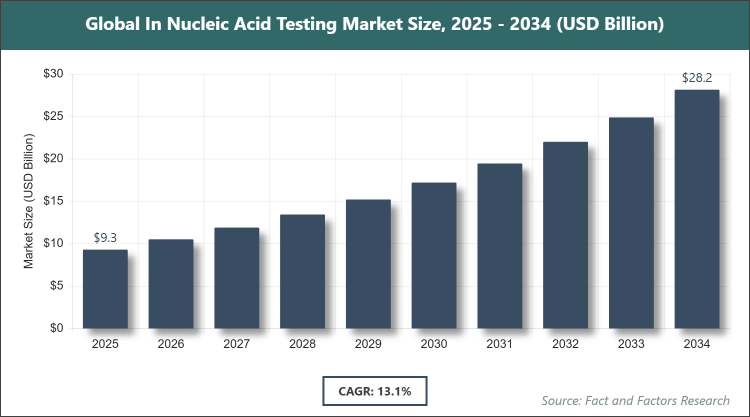
[236 Pages Report] According to Facts & Factors, the global In Nucleic Acid Testing market size was estimated at USD 9.3 billion in 2025 and is expected to reach USD 31.3 billion by the end of 2034. The In Nucleic Acid Testing industry is anticipated to grow by a CAGR of 13.1% between 2026 and 2034. The In-Nucleic Acid Testing Market is driven by the rising prevalence of infectious diseases and the rapid adoption of molecular diagnostics for early detection.
 Market Overview
The In Nucleic Acid Testing market refers to the industry involved in the detection and quantification of specific DNA or RNA sequences using molecular techniques to diagnose infectious diseases, genetic disorders, oncology markers, and blood-borne pathogens. These tests amplify and detect nucleic acids with high sensitivity and specificity, enabling early identification of pathogens, viral load monitoring, cancer mutations, and genetic predispositions. Delivered through PCR, TMA, LAMP, and other amplification methods, nucleic acid testing has become the gold standard for accurate, rapid diagnostics in clinical, research, and blood-screening settings, supporting personalized medicine, outbreak control, and transfusion safety while shifting healthcare toward precise, molecular-level decision-making.
Key Insights
- As per the analysis shared by our research analyst, the In Nucleic Acid Testing market is estimated to grow annually at a CAGR of around 13.1% over the forecast period (2026-2034).
- In terms of revenue, the In Nucleic Acid Testing market size was valued at around USD 9.3 billion in 2025 and is projected to reach USD 31.3 billion by 2034.
- The In-Nucleic Acid Testing Market is driven by increasing infectious disease burden and advancements in molecular diagnostics.
- Based on the Type, the PCR-based segment dominated the market in 2025 with a share of 65% due to its high sensitivity, established infrastructure, and widespread availability across laboratories.
- Based on the Application, the Infectious Diseases segment dominated the market in 2025 with a share of 58%, owing to global demand for rapid pathogen detection in outbreaks and routine screening.
- Based on the End-User, the Diagnostic Laboratories segment dominated the market in 2025 with a share of 52% because of centralized high-throughput testing capabilities and specialized expertise.
- North America dominated the global In Nucleic Acid Testing market in 2025 with a share of 42% attributed to advanced healthcare infrastructure, high R&D investment, and strong regulatory support for molecular diagnostics.
Growth Drivers
- Rising Prevalence of Infectious Diseases
The persistent threat of viral and bacterial outbreaks, including COVID-19 variants and emerging pathogens, has heightened the need for rapid, accurate nucleic acid-based diagnostics in clinical and public health settings.
Technological improvements in automation and point-of-care platforms have made testing faster and more accessible, encouraging broader adoption in hospitals and remote areas.
Restraints
- High Cost of Instruments and Reagents
Advanced nucleic acid testing platforms require expensive equipment and consumables, limiting adoption in low-resource settings and smaller laboratories.
Reimbursement inconsistencies and lengthy regulatory approval processes further delay market entry for new assays in various regions.
Opportunities
- Expansion in Point-of-Care and Home-Based Testing
Miniaturized, portable nucleic acid testing devices integrated with smartphones enable decentralized testing, opening new markets in home care and resource-limited environments.
Growing focus on oncology companion diagnostics and personalized medicine creates demand for targeted nucleic acid panels in precision healthcare.
Challenges
- Complex Regulatory Landscape and Data Interpretation
Stringent validation requirements and varying global standards slow the introduction of new tests, while the need for skilled personnel to interpret complex results limits scalability.
Supply chain vulnerabilities for specialized enzymes and probes can disrupt testing capacity during high-demand periods.
Report Scope
Report Attribute |
Details |
Market Size 2025 |
USD 9.3 Billion |
Projected Market Size in 2034 |
USD 31.3 Billion |
CAGR Growth Rate |
13.1% CAGR |
Base Year |
2025 |
Forecast Years |
2026-2034 |
Key Market Players |
Roche Diagnostics, Abbott Laboratories, Thermo Fisher Scientific, QIAGEN N.V., bioMérieux SA, Hologic, Inc., Becton, Dickinson and Company, Danaher Corporation, Siemens Healthineers, Grifols S.A., and Others. |
Key Segment |
By Type, By Application, By End-User, and By Region |
Major Regions Covered |
North America, Europe, Asia Pacific, Latin America, and the Middle East & Africa |
Purchase Options |
Request customized purchase options to meet your research needs. Explore purchase options |
Market Segmentation
The In Nucleic Acid Testing market is segmented by type, application, end-user, and region.
Based on Type Segment, the In Nucleic Acid Testing market is divided into PCR-based, transcription-mediated amplification (TMA), loop-mediated isothermal amplification (LAMP), and others. The most dominant segment is PCR-based, driven by its versatility and gold-standard status. The second most dominant is TMA. PCR-based testing dominates due to its unmatched sensitivity, multiplexing capability, and established global infrastructure, helping drive market growth by enabling high-throughput screening and quantitative viral load monitoring across diverse clinical applications.
Based on Application Segment, the In Nucleic Acid Testing market is divided into Infectious diseases, oncology, genetic testing, blood screening, and others. The most dominant segment is Infectious Diseases, fueled by pandemic preparedness and routine diagnostics. The second most dominant is Oncology. Infectious Diseases lead because of continuous demand for pathogen identification and monitoring, propelling market expansion through government funding and integration into standard care protocols worldwide.
Based on End-User Segment, the In Nucleic Acid Testing market is divided into hospitals & clinics, diagnostic laboratories, academic & research institutes, and others. The most dominant segment is Diagnostic Laboratories, supported by centralized expertise and volume processing. The second most dominant is Hospitals & Clinics. Diagnostic Laboratories dominate due to specialized equipment and a skilled workforce for complex assays, driving market growth by ensuring quality results and supporting large-scale testing programs.
Recent Developments
- In February 2026, Roche Diagnostics received FDA approval for its cobas MPXV assay, expanding nucleic acid testing capabilities for monkeypox detection.
- In December 2025, Thermo Fisher Scientific launched a new automated nucleic acid extraction system integrated with real-time PCR for high-throughput infectious disease testing.
- In October 2025, Abbott introduced a point-of-care molecular platform for rapid respiratory pathogen detection in decentralized settings.
- In July 2025, QIAGEN expanded its QIAstat-Dx portfolio with new syndromic panels for gastrointestinal and respiratory infections.
- In March 2025, bioMérieux secured CE marking for its BIOFIRE SPOTFIRE system, enabling multiplex nucleic acid testing in near-patient environments.
Regional Analysis
- North America to dominate the global market
North America leads the In Nucleic Acid Testing market through advanced laboratory infrastructure, high healthcare expenditure, and proactive adoption of molecular diagnostics for infectious disease management and oncology. The region benefits from strong regulatory frameworks and substantial R&D investments. The United States dominates within North America, with its dense network of reference laboratories, CDC-supported surveillance programs, and rapid integration of new assays into clinical practice that ensure high testing volumes and innovation leadership.
Europe holds a significant share in the In Nucleic Acid Testing market, supported by unified EU regulations and emphasis on pandemic preparedness. Collaborative research networks accelerate assay development. Germany leads the region, leveraging its diagnostic manufacturing strength and universal healthcare coverage to drive widespread implementation of nucleic acid testing in hospitals and public health labs.
Asia Pacific is the fastest-growing region in the In Nucleic Acid Testing market, driven by large populations, rising infectious disease awareness, and government initiatives for local manufacturing. China dominates, with massive investments in diagnostic infrastructure and domestic production of PCR reagents that reduce dependency on imports while meeting surging demand in urban and rural healthcare settings.
Latin America shows steady expansion in the In Nucleic Acid Testing market, supported by improving laboratory capacity and international aid for disease control. Brazil leads, utilizing nucleic acid testing for HIV, tuberculosis, and dengue surveillance through public health networks.
The Middle East & Africa region demonstrates growing adoption in the In Nucleic Acid Testing market, fueled by investments in healthcare modernization and outbreak response capabilities. South Africa leads, with advanced reference laboratories supporting regional surveillance and research programs for HIV and tuberculosis.
Competitive Analysis
The global In Nucleic Acid Testing market is dominated by players:
- Roche Diagnostics
- Abbott Laboratories
- Thermo Fisher Scientific
- QIAGEN N.V.
- bioMérieux SA
- Hologic, Inc.
- Becton, Dickinson and Company
- Danaher Corporation
- Siemens Healthineers
- Grifols S.A.
The global In Nucleic Acid Testing market is segmented as follows:
By Type
- PCR-based
- Transcription-Mediated Amplification (TMA)
- Loop-Mediated Isothermal Amplification (LAMP)
- Others
By Application
- Infectious Diseases
- Oncology
- Genetic Testing
- Blood Screening
- Others
By End-User
- Hospitals & Clinics
- Diagnostic Laboratories
- Academic & Research Institutes
- Others
By Region
- North America
- The U.S.
- Canada
- Mexico
- Europe
- France
- The UK
- Spain
- Germany
- Italy
- Rest of Europe
- Asia Pacific
- China
- Japan
- India
- Australia
- Southeast Asia
- Rest of Asia Pacific
- The Middle East & Africa
- Saudi Arabia
- UAE
- Egypt
- Kuwait
- South Africa
- Rest of the Middle East & Africa
- Latin America
- Brazil
- Argentina
- Rest of Latin America
Industry Major Market Players
- Roche Diagnostics
- Abbott Laboratories
- Thermo Fisher Scientific
- QIAGEN N.V.
- bioMérieux SA
- Hologic, Inc.
- Becton, Dickinson and Company
- Danaher Corporation
- Siemens Healthineers
- Grifols S.A.
Frequently Asked Questions



Copyright © 2025 - 2026, All Rights Reserved, Facts and Factors