
Search Market Research Report
Hyperspectral Imaging System Market Size, Share Global Analysis Report, 2026-2034

Hyperspectral Imaging System Market Size, Share, Growth Analysis Report By Type (Pushbroom, Snapshot, Tunable Filter, and Others), By Application (Remote Sensing, Medical Diagnostics, Military Surveillance, Machine Vision & Optical Sorting, Food & Agriculture, Mining & Geology, and Others), By End-User (Defense & Security, Agriculture, Healthcare & Pharmaceuticals, Food & Beverage, Mining, Environmental Monitoring, and Others), and By Region - Global Industry Insights, Overview, Comprehensive Analysis, Trends, Statistical Research, Market Intelligence, Historical Data and Forecast 2026-2034
Industry Insights
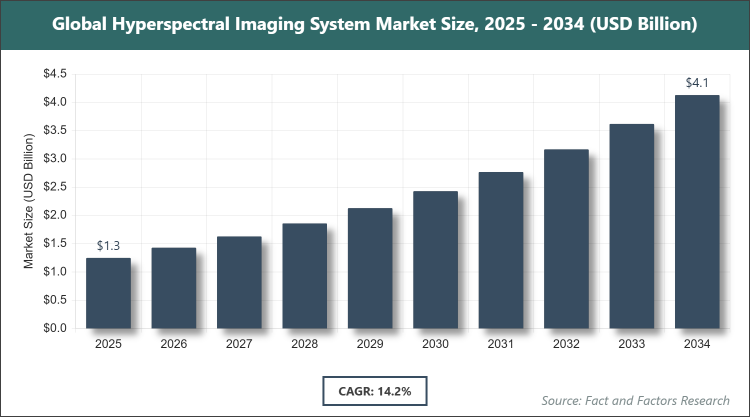
[239 + Pages Report] According to Facts & Factors, the global Hyperspectral Imaging System market size was estimated at USD 1.25 billion in 2025 and is expected to reach USD 4.15 billion by the end of 2034. The Hyperspectral Imaging System industry is anticipated to grow by a CAGR of 14.2% between 2026 and 2034. The Hyperspectral Imaging System Market is driven by rapid advancements in sensor miniaturization, AI-powered data analytics, and expanding adoption across precision agriculture, defense surveillance, and medical diagnostics.
 Market Overview
The Hyperspectral Imaging System market involves advanced optical instruments that capture and process information across hundreds of contiguous narrow spectral bands, enabling precise identification and characterization of materials based on their unique spectral signatures. Unlike traditional RGB or multispectral imaging, hyperspectral systems generate a three-dimensional data cube containing spatial and spectral information, allowing differentiation of objects that appear identical to the human eye or conventional cameras. These systems integrate high-resolution cameras, spectrographs, and sophisticated software for real-time or post-processing analysis. Applications span defense target detection, crop health monitoring, mineral mapping, medical tissue analysis, food quality inspection, and environmental monitoring, delivering non-invasive, highly accurate insights that drive innovation in remote sensing, industrial automation, and life sciences.
Key Insights
- As per the analysis shared by our research analyst, the Hyperspectral Imaging System market is estimated to grow annually at a CAGR of around 14.2% over the forecast period (2026-2034).
- In terms of revenue, the Hyperspectral Imaging System market size was valued at around USD 1.25 billion in 2025 and is projected to reach USD 4.15 billion, by 2034.
- The Hyperspectral Imaging System Market is driven by technological miniaturization and AI integration for real-time analysis.
- Based on the Type, the Pushbroom segment dominated the market in 2025 with a share of 48% due to its high spatial resolution, established reliability in airborne and satellite platforms, and cost-effectiveness for large-area scanning.
- Based on the Application, the Remote Sensing segment dominated the market in 2025 with a share of 35% owing to widespread use in agriculture, environmental monitoring, and mineral exploration requiring detailed spectral data over vast areas.
- Based on the End-User, the Defense & Security segment dominated the market in 2025 with a share of 32% because of critical requirements for target identification, camouflage detection, and surveillance in military operations.
- North America dominated the global Hyperspectral Imaging System market in 2025 with a share of 38% attributed to strong defense budgets, advanced R&D infrastructure, and early commercial adoption in agriculture and healthcare.
Growth Drivers
- Miniaturization and AI-Driven Analytics
Compact, lightweight sensors compatible with drones, UAVs, and handheld devices have dramatically expanded field deployment possibilities, while AI algorithms enable rapid data processing and actionable insights from massive hyperspectral datasets.
Government funding for precision agriculture, climate monitoring, and defense modernization programs further accelerates procurement of advanced hyperspectral systems worldwide.
Restraints
- High System Cost and Complex Data Processing
Sophisticated hyperspectral cameras and associated software require substantial capital investment, limiting adoption among smaller organizations and in price-sensitive emerging markets.
The enormous volume of data generated demands powerful computing resources and specialized expertise, creating operational bottlenecks for end-users without dedicated analytics teams.
Opportunities
- Expansion in Precision Agriculture and Medical Diagnostics
Integration with drones and satellites for real-time crop health assessment, disease detection, and yield prediction opens massive new markets in smart farming across Asia Pacific and Latin America.
Non-invasive tissue characterization in oncology, wound care, and surgical guidance creates high-value opportunities in healthcare as regulatory approvals for clinical use increase.
Challenges
- Lack of Standardization and Skilled Workforce
Absence of universal data formats and calibration standards complicates interoperability between different vendors’ systems and hinders broader industry adoption.
Shortage of trained hyperspectral data analysts and integration engineers slows deployment and limits realization of full system potential in many sectors.
Report Scope
Report Attribute |
Details |
Market Size 2025 |
USD 1.25 Billion |
Projected Market Size in 2034 |
USD 4.15 Billion |
CAGR Growth Rate |
14.2% CAGR |
Base Year |
2025 |
Forecast Years |
2026-2034 |
Key Market Players |
Headwall Photonics, Inc., Specim, Spectral Imaging Ltd., Resonon Inc., BaySpec, Inc., Corning Incorporated, IMEC, Cubert GmbH, Telops Inc., Surface Optics Corporation, Norsk Elektro Optikk AS, and Others. |
Key Segment |
By Type, By Application, By End-User, and By Region |
Major Regions Covered |
North America, Europe, Asia Pacific, Latin America, and the Middle East & Africa |
Purchase Options |
Request customized purchase options to meet your research needs. Explore purchase options |
Market Segmentation
The Hyperspectral Imaging System market is segmented by type, application, end-user, and region.
Based on Type Segment, the Hyperspectral Imaging System market is divided into pushbroom, snapshot, tunable filter, and others. The most dominant segment is Pushbroom, driven by superior spatial resolution and proven performance in aerial and industrial scanning. The second most dominant is Snapshot. Pushbroom dominates due to its balance of high throughput, reliability, and established ecosystem in satellite and airborne platforms, helping drive market growth by enabling large-scale commercial and defense applications with cost-effective data acquisition.
Based on Application Segment, the Hyperspectral Imaging System market is divided into remote sensing, medical diagnostics, military surveillance, machine vision & optical sorting, food & agriculture, mining & geology, and others. The most dominant segment is Remote Sensing, fueled by satellite and drone-based environmental and agricultural monitoring. The second most dominant is Military Surveillance. Remote Sensing leads because it addresses global needs for detailed land-use mapping, crop monitoring, and resource exploration, propelling market expansion through recurring government and commercial contracts.
Based on End-User Segment, the Hyperspectral Imaging System market is divided into defense & security, agriculture, healthcare & pharmaceuticals, food & beverage, mining, environmental monitoring, and others. The most dominant segment is Defense & Security, supported by high-stakes surveillance requirements. The second most dominant is Agriculture. Defense & Security dominates due to substantial budgets for advanced reconnaissance and target detection technologies, driving market growth through long-term procurement programs and continuous technology upgrades.
Recent Developments
- In January 2026, Specim, Spectral Imaging Ltd. launched the new FX50 hyperspectral camera optimized for high-speed industrial sorting and quality control applications.
- In November 2025, Headwall Photonics completed the acquisition of Inno-spec GmbH to strengthen its industrial hyperspectral portfolio in Europe.
- In October 2025, Resonon Inc. introduced the Pika IR-L+ compact SWIR hyperspectral imager with enhanced sensitivity for defense and mineral mapping.
- In July 2025, BaySpec, Inc. unveiled the OCI-F pushbroom hyperspectral imager featuring real-time onboard AI processing for drone-based precision agriculture.
- In April 2025, Corning Incorporated expanded its hyperspectral offerings with new tunable filter modules for medical and pharmaceutical imaging systems.
Regional Analysis
- North America to dominate the global market
North America leads the Hyperspectral Imaging System market through substantial defense spending, world-class research institutions, and early commercialization of hyperspectral technology across agriculture and healthcare. The region benefits from strong venture capital support and robust patent portfolios. The United States dominates within North America, with its advanced aerospace and defense sector, NASA and USDA programs driving innovation, and a thriving ecosystem of sensor manufacturers and system integrators that accelerate adoption in both government and private sectors.
Europe maintains a technologically sophisticated position, supported by collaborative EU research initiatives and strict environmental monitoring requirements. Germany leads the region, leveraging its engineering excellence and strong industrial base to develop high-precision systems for machine vision, pharmaceuticals, and automotive quality control.
Asia Pacific exhibits the fastest growth, driven by massive investments in precision agriculture, mining, and defense modernization across China, India, and Japan. China dominates, with its focus on domestic sensor development, satellite programs, and smart farming initiatives rapidly scaling hyperspectral deployment in vast agricultural and resource sectors.
Latin America is emerging strongly, fueled by large-scale mining and agricultural operations requiring advanced resource mapping. Brazil leads, utilizing hyperspectral systems for tropical crop monitoring and mineral exploration supported by government sustainability programs.
The Middle East & Africa region shows promising uptake driven by oil & gas, mining, and smart agriculture projects. The United Arab Emirates leads through strategic investments in hyperspectral technology for environmental monitoring and precision farming in arid regions.
Competitive Analysis
The global Hyperspectral Imaging System market is dominated by players:
- Headwall Photonics, Inc.
- Specim, Spectral Imaging Ltd.
- Resonon Inc.
- BaySpec, Inc.
- Corning Incorporated
- IMEC
- Cubert GmbH
- Telops Inc.
- Surface Optics Corporation
- Norsk Elektro Optikk AS
The global Hyperspectral Imaging System market is segmented as follows:
By Type
- Pushbroom
- Snapshot
- Tunable Filter
- Others
By Application
- Remote Sensing
- Medical Diagnostics
- Military Surveillance
- Machine Vision & Optical Sorting
- Food & Agriculture
- Mining & Geology
- Others
By End-User
- Defense & Security
- Agriculture
- Healthcare & Pharmaceuticals
- Food & Beverage
- Mining
- Environmental Monitoring
- Others
By Region
- North America
- The U.S.
- Canada
- Mexico
- Europe
- France
- The UK
- Spain
- Germany
- Italy
- Rest of Europe
- Asia Pacific
- China
- Japan
- India
- Australia
- Southeast Asia
- Rest of Asia Pacific
- The Middle East & Africa
- Saudi Arabia
- UAE
- Egypt
- Kuwait
- South Africa
- Rest of the Middle East & Africa
- Latin America
- Brazil
- Argentina
- Rest of Latin America
Industry Major Market Players
- Headwall Photonics, Inc.
- Specim, Spectral Imaging Ltd.
- Resonon Inc.
- BaySpec, Inc.
- Corning Incorporated
- IMEC
- Cubert GmbH
- Telops Inc.
- Surface Optics Corporation
- Norsk Elektro Optikk AS
Frequently Asked Questions



Copyright © 2025 - 2026, All Rights Reserved, Facts and Factors