
Search Market Research Report
Gabion Boxes Market Size, Share Global Analysis Report, 2026-2034

Gabion Boxes Market Size, Share, Growth Analysis Report By Type (Galvanized Large-size Wire Hexagonal Mesh, Zn-5%Al-mixed Rare Earth Alloy Plating, Galvanized Plastic-coated Hexagonal Mesh, Zn-10%Al-mixed Rare Earth Alloy Plating, and Others), By Application (Control and Guide Rivers and Floods, Protect Channels and River Beds, Road Protection, and Others), By End-User (Construction, Military, Landscaping, and Others), and By Region - Global Industry Insights, Overview, Comprehensive Analysis, Trends, Statistical Research, Market Intelligence, Historical Data and Forecast 2026-2034
Industry Insights
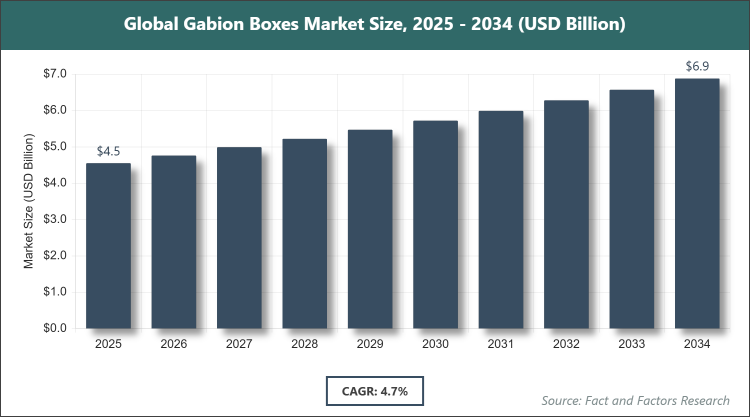
[240+ Pages Report] According to Facts & Factors, the global Gabion Boxes market size was estimated at USD 4.55 billion in 2025 and is expected to reach USD 6.87 billion by the end of 2034. The Gabion Boxes industry is anticipated to grow by a CAGR of 4.7% between 2026 and 2034. The Gabion Boxes Market is driven by rising demand for sustainable erosion control and infrastructure development solutions.
 Market Overview
Gabion boxes are wire mesh containers filled with rocks, stones, or other durable materials, designed to provide structural stability and erosion resistance in various civil engineering and landscaping applications. These modular units are widely utilized for retaining walls, riverbank protection, and soil stabilization, offering a flexible, permeable, and environmentally friendly alternative to traditional concrete structures.
Key Insights
- As per the analysis shared by our research analyst, the Gabion Boxes are estimated to grow annually at a CAGR of around 4.7% over the forecast period (2026-2034).
- In terms of revenue, the Gabion Boxes market size was valued at around USD 4.55 billion in 2025 and is expected to reach USD 6.87 billion by 2034.
- The market is driven by increasing infrastructure projects and the need for flood management.
- Based on the Type, the Galvanized Large-size Wire Hexagonal Mesh segment accounted for the leading share in the market in 2025 (40%) and is anticipated to maintain its dominance over the forecast period. This dominance is attributable to its superior durability and cost-effectiveness in harsh environmental conditions.
- Based on the Application, the Control and Guide Rivers and Floods segment accounted for the leading share in the market in 2025 (45%) and is anticipated to maintain its dominance over the forecast period. This dominance is attributable to growing concerns over climate-induced flooding and river erosion.
- Based on the End-User, the Construction segment accounted for the leading share in the market in 2025 (50%) and is anticipated to maintain its dominance over the forecast period. This dominance is attributable to extensive use in road, rail, and urban infrastructure projects.
- Based on Region, Asia Pacific dominated the global Gabion Boxes market in 2025 (38%) and is anticipated to maintain its dominance over the forecast period. This dominance is attributable to rapid urbanization and massive investments in flood control infrastructure.
Growth Drivers
- Increasing Infrastructure Development
The global surge in construction activities, particularly in emerging economies, is fueling demand for versatile and durable materials like gabion boxes for road protection, retaining walls, and slope stabilization. Governments worldwide are investing heavily in transportation and urban development projects, where gabions offer cost-effective solutions for long-term structural integrity.
Advancements in wire mesh technology, such as improved coatings for corrosion resistance, are enhancing the appeal of gabion boxes in challenging terrains and climates. This driver is further supported by international initiatives promoting sustainable building practices, positioning gabions as an eco-friendly option that integrates well with natural landscapes.
Restraints
- Fluctuating Raw Material Prices
Volatility in the costs of steel wire and zinc coatings, key components in gabion manufacturing, poses a significant challenge, potentially increasing production expenses and affecting profit margins for suppliers. This issue is exacerbated by global supply chain disruptions and trade tariffs on metals.
Limited awareness in certain regions about the benefits of gabions compared to conventional materials like concrete can slow adoption rates. Additionally, stringent quality standards and certification requirements add to the operational complexities, restraining market growth in underdeveloped markets.
Opportunities
- Rising Focus on Sustainable Construction
The growing emphasis on green building practices and environmental conservation presents opportunities for gabion boxes, which allow for natural vegetation growth and minimal ecological disruption. Innovations in recyclable and biodegradable mesh materials could attract eco-conscious projects in landscaping and habitat restoration.
Expansion into untapped markets in Africa and Latin America, where flood-prone areas require affordable erosion control, offers potential for market players. Collaborations with governments on disaster resilience programs could further unlock new avenues for growth.
Challenges
- Competition from Alternative Materials
The availability of substitutes like geosynthetics and precast concrete blocks, which may offer faster installation or lower maintenance in specific applications, challenges the widespread adoption of gabion boxes. Perceptions of gabions as labor-intensive to fill and assemble can deter potential users.
Environmental regulations restricting quarrying for fill materials in some regions add to the challenges. Ensuring consistent quality across global supply chains remains a hurdle, potentially impacting trust in gabion solutions for critical infrastructure.
Report Scope
Report Attribute |
Details |
Market Size 2025 |
USD 4.55 Billion |
Projected Market Size in 2034 |
USD 6.87 Billion |
CAGR Growth Rate |
4.7% CAGR |
Base Year |
2025 |
Forecast Years |
2026-2034 |
Key Market Players |
Maccaferri, TianZe, ChangYi, Link Middle East, ZhongLu, Tensar International Corporation, Rothfuss Best Gabion GmbH & Co. KG, TechFab India Industries Ltd., Gabion Technologies (India), Terra Aqua Gabions, Inc., and Others. |
Key Segment |
By Type, By Application, By End-User, and By Region |
Major Regions Covered |
North America, Europe, Asia Pacific, Latin America, and the Middle East & Africa |
Purchase Options |
Request customized purchase options to meet your research needs. Explore purchase options |
Market Segmentation
The Gabion Boxes market is segmented by Type, Application, End-User, and region.
Based on Type Segment, the Gabion Boxes market is divided into Galvanized Large-size Wire Hexagonal Mesh, Zn-5%Al-mixed Rare Earth Alloy Plating, Galvanized Plastic-coated Hexagonal Mesh, Zn-10%Al-mixed Rare Earth Alloy Plating, and others. The most dominant segment is Galvanized Large-size Wire Hexagonal Mesh, which leads due to its high tensile strength and resistance to environmental degradation, making it ideal for heavy-duty applications and driving market growth through reliable performance in infrastructure projects. The second most dominant is Galvanized Plastic-coated Hexagonal Mesh, valued for added corrosion protection in moist environments, contributing to market expansion by extending product lifespan and reducing maintenance costs.
Based on Application Segment, the Gabion Boxes market is divided into Control and Guide Rivers and Floods, Protect Channels and River Beds, Road Protection, and others. The most dominant segment is Control and Guide Rivers and Floods, dominating owing to escalating flood risks from climate change, boosting demand for effective water management solutions and propelling market growth. The second most dominant is Road Protection, essential for stabilizing embankments and preventing landslides, aiding market progression in transportation infrastructure development.
Based on End-User Segment, the Gabion Boxes market is divided into Construction, Military, Landscaping, and others. The most dominant segment is Construction, leading because of widespread integration in civil engineering for retaining structures, driving the market through large-scale urban and rural projects. The second most dominant is Military, growing due to applications in defensive barriers and base fortifications, supporting market advancement via specialized security needs.
Recent Developments
- In early 2024, Maccaferri launched a new eco-friendly gabion line featuring recyclable steel and non-toxic anti-corrosion coatings, targeting river rehabilitation projects in Europe.
- In mid-2024, TianZe expanded its production facility in China, increasing capacity by 40% with AI-based quality control to meet rising global demand.
- In 2024, Gabion Technologies India partnered with the Indian Ministry of Railways to deploy gabion barriers along 300 km of rail embankments for landslide prevention.
- In July 2024, Rothfuss Best Gabion used gabions in the 'Health Innovation Campus' project in Birmingham, featuring innovative wall paneling near water bodies.
- In 2023, TechFab India introduced advanced gabion mattresses for enhanced erosion control in coastal areas, gaining traction in Asia-Pacific markets.
Regional Analysis
- Asia Pacific to dominate the global market
Asia Pacific leads the market, with China as the dominating country, where extensive river management and urbanization initiatives drive widespread adoption of durable solutions for flood control and infrastructure stability. The region's focus on rapid development and disaster resilience enhances innovation in materials. Government policies supporting sustainable practices further strengthen demand, creating a vibrant ecosystem for manufacturers and suppliers.
North America maintains a strong position, dominated by the United States, benefiting from advanced engineering standards and investments in coastal protection against erosion. Collaborations between public agencies and private firms promote efficient project execution. The emphasis on environmental regulations encourages eco-friendly alternatives, ensuring steady integration into diverse construction landscapes.
Europe exhibits mature growth, led by Italy and Germany, with a heritage in innovative designs and applications in historical preservation and modern infrastructure. EU directives on sustainability bolster market expansion through funded projects. The region's expertise in quality manufacturing supports export opportunities, fostering a competitive environment.
Latin America shows emerging potential, with Brazil as the dominating country, fueled by needs for riverbed protection and road networks in varied terrains. International aid for environmental projects aids technology transfer. Growing awareness of cost-effective solutions drives gradual adoption across urban and rural areas.
The Middle East & Africa region progresses steadily, dominated by South Africa, where mining and infrastructure demands necessitate robust stabilization methods. Regional initiatives for water conservation enhance usage in arid zones. Partnerships with global entities introduce advanced techniques, addressing local challenges effectively.
Competitive Analysis
The global Gabion Boxes market is dominated by players:
- Maccaferri
- TianZe
- ChangYi
- Link Middle East
- ZhongLu
- Tensar International Corporation
- Rothfuss Best Gabion GmbH & Co. KG
- TechFab India Industries Ltd.
- Gabion Technologies (India)
- Terra Aqua Gabions, Inc.
The global Gabion Boxes market is segmented as follows:
By Type
- Galvanized Large-size Wire Hexagonal Mesh
- Zn-5%Al-mixed Rare Earth Alloy Plating
- Galvanized Plastic-coated Hexagonal Mesh
- Zn-10%Al-mixed Rare Earth Alloy Plating
- Others
By Application
- Control and Guide Rivers and Floods
- Protect Channels and River Beds
- Road Protection
- Others
By End-User
- Construction
- Military
- Landscaping
- Others
By Region
- North America
- The U.S.
- Canada
- Mexico
- Europe
- France
- The UK
- Spain
- Germany
- Italy
- Rest of Europe
- Asia Pacific
- China
- Japan
- India
- Australia
- Southeast Asia
- Rest of Asia Pacific
- The Middle East & Africa
- Saudi Arabia
- UAE
- Egypt
- Kuwait
- South Africa
- Rest of the Middle East & Africa
- Latin America
- Brazil
- Argentina
- Rest of Latin America
Industry Major Market Players
- Maccaferri
- TianZe
- ChangYi
- Link Middle East
- ZhongLu
- Tensar International Corporation
- Rothfuss Best Gabion GmbH & Co. KG
- TechFab India Industries Ltd.
- Gabion Technologies (India)
- Terra Aqua Gabions, Inc
Frequently Asked Questions



Copyright © 2025 - 2026, All Rights Reserved, Facts and Factors