
Search Market Research Report
G418 Sulfate Market Size, Share Global Analysis Report, 2026-2034

G418 Sulfate Market Size, Share, Growth Analysis Report By Type (Powder, Solution, and Others), By Application (Cell Transfection, Gene Therapy, Protein Production, and Others), By End-User (Pharmaceutical & Biotechnology Companies, Academic & Research Institutes, and Others), and By Region - Global Industry Insights, Overview, Comprehensive Analysis, Trends, Statistical Research, Market Intelligence, Historical Data and Forecast 2026-2034
Industry Insights
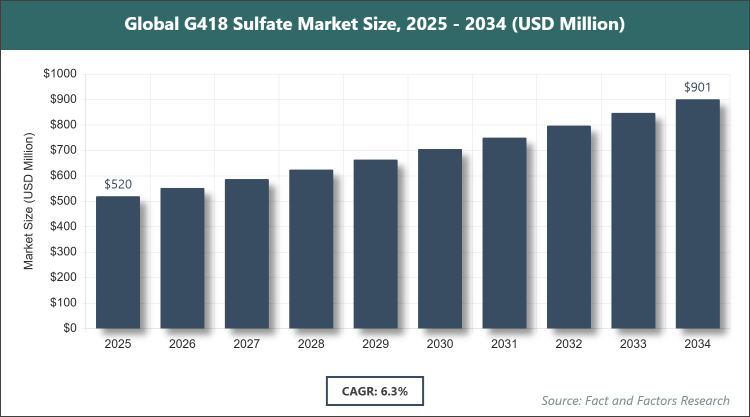
[235+ Pages Report] According to Facts & Factors, the global G418 Sulfate market size was estimated at USD 520 million in 2025 and is expected to reach USD 900 million by the end of 2034. The G418 Sulfate industry is anticipated to grow by a CAGR of 6.3% between 2026 and 2034. The G418 Sulfate Market is driven by increasing demand in biotechnology for stable cell line selection and genetic engineering applications.
 Market Overview
G418 Sulfate, also known as Geneticin, is an aminoglycoside antibiotic derived from Micromonospora rhodorangea, primarily used as a selective agent in molecular biology and cell culture. It inhibits protein synthesis in eukaryotic cells by binding to the 80S ribosome, making it essential for selecting cells that have been successfully transfected with neomycin resistance genes, thereby enabling the development of stable cell lines for research and therapeutic purposes.
Key Insights
- As per the analysis shared by our research analyst, the G418 Sulfate is estimated to grow annually at a CAGR of around 6.3% over the forecast period (2026-2034).
- In terms of revenue, the G418 Sulfate market size was valued at around USD 520 million in 2025 and is expected to reach USD 900 million by 2034.
- The market is driven by expanding applications in gene therapy and biopharmaceutical production.
- Based on the Type, the Solution segment accounted for the leading share in the market in 2025 (60%) and is anticipated to maintain its dominance over the forecast period. This dominance is attributable to its ready-to-use formulation, which simplifies laboratory workflows and reduces preparation time.
- Based on the Application, the Cell Transfection segment accounted for the leading share in the market in 2025 (45%) and is anticipated to maintain its dominance over the forecast period. This dominance is attributable to the critical role of G418 in selecting stably transfected cells for genetic research and drug development.
- Based on the End-User, the Pharmaceutical & Biotechnology Companies segment accounted for the leading share in the market in 2025 (50%) and is anticipated to maintain its dominance over the forecast period. This dominance is attributable to high-volume usage in large-scale biomanufacturing and therapeutic development processes.
- Based on Region, North America dominated the global G418 Sulfate market in 2025 (40%) and is anticipated to maintain its dominance over the forecast period. This dominance is attributable to advanced research infrastructure and the strong presence of biotech firms driving innovation.
Growth Drivers
- Increasing Adoption in Biotechnology Research
The surge in genetic engineering and cell-based assays has propelled the demand for reliable selection agents like G418 Sulfate, facilitating the creation of stable cell lines essential for studying gene functions and disease mechanisms. This is further amplified by rising investments in life sciences research globally, where G418's specificity and efficacy make it indispensable.
Advancements in CRISPR-Cas9 and other gene-editing technologies have integrated G418 into routine protocols, enhancing its utility in high-throughput screening and personalized medicine development. Government funding and collaborations between academia and industry continue to fuel this growth trajectory.
Restraints
- Regulatory Hurdles in Antibiotic Usage
Stringent regulations on antibiotic use in research and manufacturing, aimed at curbing resistance development, pose challenges to market expansion. Compliance with varying international standards increases operational complexities for suppliers and users alike.
High purity requirements and potential cytotoxicity concerns necessitate rigorous quality controls, escalating production costs, and limiting accessibility for smaller research entities. These factors collectively hinder broader adoption in emerging markets.
Opportunities
- Expansion in Emerging Markets
Rapid growth in biotechnology sectors across Asia-Pacific and Latin America offers untapped potential, driven by increasing R&D expenditures and the establishment of new research facilities. Affordable formulations tailored for these regions could accelerate market penetration.
Partnerships with local distributors and development of cost-effective alternatives may capitalize on this opportunity, fostering innovation in applications like vaccine production and regenerative medicine.
Challenges
- Supply Chain Vulnerabilities
Dependence on specific microbial sources for production exposes the market to supply disruptions from raw material shortages or manufacturing inconsistencies. Geopolitical tensions and environmental factors further exacerbate these issues.
Maintaining consistent potency and sterility amid fluctuating demand requires robust supply chain strategies, yet persistent challenges in scaling production efficiently continue to impact market stability.
Report Scope
Report Attribute |
Details |
Market Size 2025 |
USD 520 Million |
Projected Market Size in 2034 |
USD 900 Million |
CAGR Growth Rate |
6.3% CAGR |
Base Year |
2025 |
Forecast Years |
2026-2034 |
Key Market Players |
Thermo Fisher Scientific, InvivoGen, Merck KGaA, Gold Biotechnology Inc., MP Biomedicals, Carl Roth, Biowest, Capricorn Scientific, and Others. |
Key Segment |
By Type, By Application, By End-User, and By Region |
Major Regions Covered |
North America, Europe, Asia Pacific, Latin America, and the Middle East & Africa |
Purchase Options |
Request customized purchase options to meet your research needs. Explore purchase options |
Market Segmentation
The G418 Sulfate market is segmented by Type, Application, End-User, and region.
Based on Type Segment, The G418 Sulfate market is divided into Powder, Solution, and Others. The most dominant segment is Solution, which leads due to its convenience in direct application without reconstitution, minimizing errors and contamination risks, thereby driving market growth through enhanced efficiency in lab settings. The second most dominant is Powder, preferred for its longer shelf life and cost-effectiveness in bulk purchases, contributing to market expansion by supporting large-scale industrial uses.
Based on Application Segment, The G418 Sulfate market is divided into Cell Transfection, Gene Therapy, Protein Production, and Others. The most dominant segment is Cell Transfection, dominating owing to its foundational role in genetic manipulation experiments, boosting demand as research in genomics intensifies, thus propelling overall market advancement. The second most dominant is Gene Therapy, crucial for developing therapeutic vectors, aiding market growth by aligning with rising clinical trials and personalized treatments.
Based on End-User Segment, The G418 Sulfate market is divided into Pharmaceutical & Biotechnology Companies, Academic & Research Institutes, and Others. The most dominant segment is Pharmaceutical & Biotechnology Companies, leading because of their extensive use in drug discovery and bioprocessing, driving the market through high-volume procurement and innovation. The second most dominant is Academic & Research Institutes, growing due to educational and exploratory research needs, supporting market progression via foundational studies and collaborations.
Recent Developments
- In 2025, Thermo Fisher Scientific introduced an enhanced G418 Sulfate solution with improved stability for long-term cell culture applications, aimed at supporting advanced gene editing workflows.
- In 2024, InvivoGen announced a partnership with a leading biotech firm to develop G418-resistant vectors for Pichia pastoris expression systems, enhancing protein production efficiency.
- In 2023, Merck KGaA expanded its production capacity for high-purity G418 Sulfate to meet growing demand in the Asia-Pacific region, focusing on biopharmaceutical manufacturing.
- In 2022, Gold Biotechnology launched a cost-effective powder form of G418 Sulfate targeted at academic researchers, improving accessibility for smaller labs.
- In 2021, Capricorn Scientific received regulatory approval for its G418 Sulfate products in Europe, strengthening its market position in cell therapy applications.
Regional Analysis
- North America to dominate the global market
North America maintains leadership in the market, with the United States as the dominating country, benefiting from a robust biotechnology ecosystem and substantial investments in R&D by government and private sectors. The presence of major pharmaceutical companies and advanced research facilities accelerates innovation and adoption. Additionally, favorable regulatory environments and strong intellectual property protections encourage new developments, ensuring the region's continued prominence in global supply chains.
Europe follows closely, dominated by Germany and the United Kingdom, where a strong emphasis on life sciences research and collaborations between universities and industry drive demand. The region's focus on sustainable manufacturing practices and stringent quality standards enhances product reliability. Initiatives like Horizon Europe funding further support biotechnology advancements, creating a conducive environment for market growth amid increasing clinical applications.
Asia Pacific demonstrates rapid expansion, led by China and Japan, fueled by burgeoning biotech industries and government initiatives to boost domestic production capabilities. Rising healthcare expenditures and a growing number of research institutions address regional needs effectively. The shift towards affordable generics and biosimilars contributes significantly, positioning the area as a key player in cost-effective solutions.
Latin America exhibits steady progress, with Brazil as the dominating country, supported by increasing investments in pharmaceutical infrastructure and partnerships with international firms. Efforts to enhance local manufacturing reduce import dependencies gradually. The region's focus on addressing public health challenges through research drives adoption, though economic variations influence pace.
The Middle East & Africa region shows emerging potential, dominated by South Africa, where healthcare modernization and collaborations with global entities introduce advanced tools. Awareness campaigns and infrastructure developments are pivotal in overcoming accessibility issues. Strategic investments aim to build local expertise, fostering gradual integration into broader markets.
Competitive Analysis
The global G418 Sulfate market is dominated by players:
- Thermo Fisher Scientific
- InvivoGen
- Merck KGaA
- Gold Biotechnology Inc.
- MP Biomedicals
- Carl Roth
- Biowest
- Capricorn Scientific
- Others
The global G418 Sulfate market is segmented as follows:
By Type
- Powder
- Solution
- Others
By Application
- Cell Transfection
- Gene Therapy
- Protein Production
- Others
By End-User
- Pharmaceutical & Biotechnology Companies
- Academic & Research Institutes
- Others
By Region
- North America
- The U.S.
- Canada
- Mexico
- Europe
- France
- The UK
- Spain
- Germany
- Italy
- Rest of Europe
- Asia Pacific
- China
- Japan
- India
- Australia
- Southeast Asia
- Rest of Asia Pacific
- The Middle East & Africa
- Saudi Arabia
- UAE
- Egypt
- Kuwait
- South Africa
- Rest of the Middle East & Africa
- Latin America
- Brazil
- Argentina
- Rest of Latin America
Industry Major Market Players
- Thermo Fisher Scientific
- InvivoGen
- Merck KGaA
- Gold Biotechnology Inc.
- MP Biomedicals
- Carl Roth
- Biowest
- Capricorn Scientific
- Others
Frequently Asked Questions



Copyright © 2025 - 2026, All Rights Reserved, Facts and Factors